



Table of contents
T-shirts are the most universal clothing items worldwide – and they’re also one of the most commercially interesting. The global t-shirt market is on track for steady growth, custom t-shirt printing is scaling rapidly, and sustainability is reshaping how brands operate.
In this article, we cover:
-
T-shirt industry statistics and growth predictions in the US and worldwide
-
Custom t-shirt printing trends and fashion industry data
-
Sustainable manufacturing statistics and what they mean for your business strategy
Whether you’re researching apparel market trends, validating a business idea, or building a clothing line, these t-shirt industry statistics give you the historical data you need to make smarter calls.
Key takeaways
-
The global t-shirt market is valued at $30.68B in 2026. It’s set for significant growth through 2035, driven by demand for casual wear, personalized apparel, and the continued expansion of print-on-demand services.
-
The custom t-shirt printing market is one of the fastest-growing segments in the apparel industry. It offers strong profit margins for sellers who combine strategic planning with the right printing technology and eCommerce infrastructure.
-
Digital printing is outpacing traditional screen printing in market growth rate. Eco-friendly t-shirt production methods like DTG cut industrial water usage by up to 95% – which matters more every year as sustainability standards tighten.
-
The global t-shirt market is crowded. Leading companies face intense competition from both established fashion brands and independent POD merchants alike – the ones that break through do their market research.
Global t-shirt statistics
The global t-shirts market has expanded well beyond basics. Major fashion brands, independent designers, and print-on-demand (POD) merchants all compete for the same customer, making the most basic garment also one of the most competitive categories in the apparel industry.
The global t-shirt market is projected to reach $44.81B by 2035
The global t-shirts market is valued at $30.68B in 2026 and is projected to reach $44.81B by 2035, expanding at a Compound Annual Growth Rate (CAGR) of 4.3%.
Shifting consumer preferences toward casual wear, the growth of online platforms, and rising demand for personalized apparel are all fueling that sustained market growth.
Today’s t-shirts market covers plain basics, graphic designs, vintage styles, and custom-designed t-shirts – serving everyday shoppers and brand-conscious consumers in the same breath.
The rise of eCommerce and POD services has also opened up the market entry and global production to smaller brands and independent creators. No inventory, no warehouse, no gatekeepers.
1. Casual wear and personalization are the market’s two biggest growth engines
Nearly two-thirds of consumers worldwide reach for a t-shirt as their default daily outfit, according to Global Growth Insights. The same research found that social platforms shape the purchasing choices of more than 40% of buyers, with the strongest effect seen among 18-34-year-olds.
Athleisure isn’t slowing down, and neither are relaxed dress codes – both keep casual wear demand high across every major market.
Personalized t-shirts are another key driver. Custom t-shirts let people communicate identity, values, and creativity. Advances in printing technologies have made customization faster, cheaper, and more accessible.
Successful companies use custom-printed t-shirts for promotional campaigns, corporate events, and fan merchandise – feeding to overall market volume.


2. China leads global t-shirt revenue – But the supply chain is shifting
China still dominates the global t-shirts market on both ends – supply and demand. In 2024, China accounted for 29% of total global t-shirt production volume – more than double that of Bangladesh, the second-largest producer. Vertical integration, scale, and the ability to handle complex, value-added garments at affordable prices keep China at the top.
However, the competitive landscape is shifting. More than 80% of US fashion companies had plans to cut sourcing from China over the next two years, with many targeting a low single-digit percentage by 2026. Geopolitical risks and trade uncertainty drove that shift – and it has largely played out.
Bangladesh, India, Vietnam, the Middle East, and emerging markets are gaining ground as major brands diversify their sourcing. China has led the global manufacturing for 14 years. Now, with a growing middle class and rising fashion consciousness at home, it’s become one of the most important consumer markets in the world – not just a production hub.
3. The women’s t-shirt market is projected to reach $23.5B by 2033
The women’s t-shirt market size is expected to hit $23.5B by 2033, with a CAGR of 5.5% from 2026 to 2033.
Online shopping keeps expanding the range of styles and fits available to consumers of all genders – and buyers are responding.
Men currently account for around 58% of global t-shirt demand, followed by women (33%) and kids (9%). The women’s segment is closing the gap, driven by evolving consumer preferences around fit, style, self-expression, and a social media feed that never stops selling.

Source: Printful
T-shirt market in the United States
The US is one of the most important markets in the global t-shirt industry. More than a consumer base, it’s also a driver of customization trends, eCommerce adoption, and demand for personalized apparel.
4. The US moves 2.1 billion t-shirts a year and counting
How many t-shirts are sold each year in the US? Roughly 2.1 billion units per year – just under a fifth of all global sales – and growing at 3.8% annually.
The United States remains the largest consumer market for t-shirts globally, and t-shirts are one of the most purchased categories in the US. Tees are versatile enough to suit different occasions and styles, and simple enough to produce and ship at scale through both traditional retail and online platforms.
5. More than 6 in 10 US t-shirt purchases now happen online
Over 61% of t-shirt purchases in the US happen digitally, and social media influences nearly 46% of buying decisions – the highest rate of any major global market.
That’s good news for brands of any size. eCommerce reduces overhead, expands geographic reach, and lowers the barriers to market entry – especially for small businesses and POD sellers who don’t want to touch inventory.
6. The men’s t-shirt segment leads, but the women’s is quickly catching up
The men’s t-shirts market is projected to reach $62.96B by 2033, with a market growth of 6.15% from 2026 to 2033. In the US, athleisure still dominates men’s casual wear, with global brands like Nike and Adidas leading the segment.
The women’s segment is right behind. The global women’s t-shirt market is forecast to grow at a CAGR of 6.1% until 2028, driven by demand for comfortable, versatile clothing and the expanding variety of styles online.
Unisex styles are also gaining popularity, as shoppers move away from hard gender categories in what they wear.
Custom t-shirt market trends
The stats show that the custom t-shirt printing market is one of the fastest-growing segments in the broader apparel industry. Digital printing technologies, eCommerce expansion, and a sustained appetite for personalized apparel have pushed this global market beyond what traditional screen printing alone could handle.
Custom t-shirt printing also gives businesses a practical branding tool – one that builds customer loyalty, increases brand visibility, and keeps working long after the transaction.
7. The custom t-shirt printing market is projected to reach $9.82B by 2030
The global custom t-shirt printing market was valued at $5.16B in 2024 and is expected to reach $9.82B by 2030. That means a CAGR of 11.5% from 2025 to 2030. That’s nearly doubling in six years, driven by eCommerce and on-demand production, making custom-printed t-shirts more accessible than ever.
Several factors are driving this apparel industry growth:
-
Online platforms make it straightforward for anyone to design, order, and receive custom t-shirts – no more minimum order quantities, no print shop required
-
The increasing demand for personalized printed t-shirts reflects something bigger – people using clothing to signal identity, values, and affiliations
-
Businesses, nonprofits, and sports teams rely on custom t-shirts for branding, uniforms, and promotional campaigns
-
Print-on-demand services remove the need to hold inventory, reducing financial risk for sellers
-
Advances in printing technologies – from direct-to-garment printing (DTG) to dye-sublimation – have raised the quality ceiling while lowering costs
8. Asia Pacific leads the custom t-shirt printing market
Asia Pacific generated more than 40% of global custom t-shirt printing revenue in 2025, and is forecast to reach $8.25B by 2035 at a CAGR of 11.41%.
The region’s lead comes down to rapid advances in digital textile printing, strong eCommerce adoption, and growing consumer demand for personalized clothing. It’s especially prominent in China and India, where rising spending power and social media marketing are accelerating the shift toward customized t-shirts.
North America’s custom t-shirt printing industry is also on a significant growth trajectory at a CAGR through 2030. It’s driven by the expansion of eCommerce platforms and a large promotional products industry that runs on custom apparel.
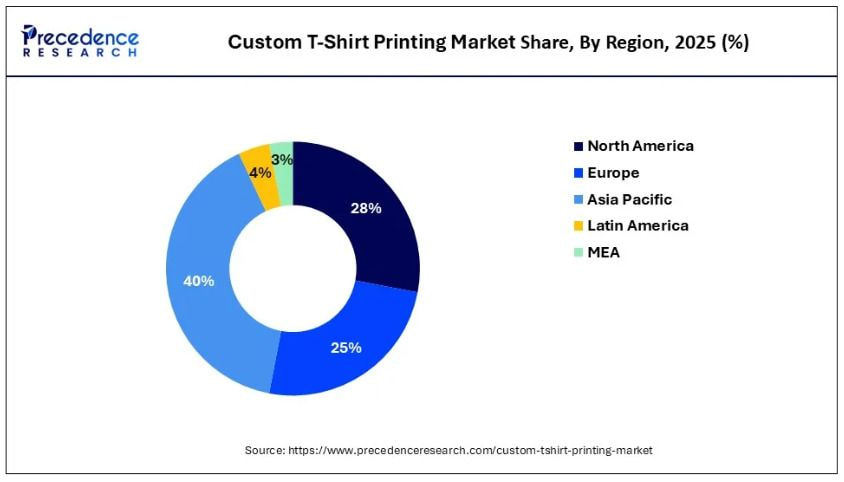
Source: Precedence Research
9. Graphic design shirts dominate, but custom artwork is growing the fastest
The graphic design shirt market held the largest revenue share from custom t-shirt printing in 2024, driven by strong demand for pre-printed designs. These are t-shirts produced with existing artwork – logos, slogans, pop culture references – and no individual customization per order, making them efficient to produce at scale.
However, the artwork segment – fully tailored, individually designed pieces – is growing the fastest. The artwork segment is forecast to grow at a CAGR of 12.1% from 2025 to 2030, reflecting increasing demand for one-of-a-kind designs and personalized messages that traditional graphic t-shirts can’t deliver.
10. T-shirt personalization is reshaping how brands and consumers interact
Personalization has moved from a nice-to-have to a table-stakes. 81% of customers prefer companies that offer personalized experiences, and 70% say it matters to them that brands know their purchase history and preferences.
In apparel, this expectation is especially direct – a custom t-shirt is personalization made tangible.
For online t-shirt businesses, POD turns this demand into a practical advantage. Sellers can offer unlimited design variations, skip the inventory and financial risk, while giving customers exactly what they came for.

Source: “Girl Get After It” via Instagram
T-shirt printing methods
Screen printing vs. digital printing – the two main techniques for applying designs to t-shirts, and the gap between them is narrowing fast. Each serves different use cases, volumes, and quality needs, but digital is gaining ground as POD scales.
11. Screen printing still leads, but its share is narrowing
Screen printing accounted for 40% of the custom t-shirt printing market in 2025 – built on cost efficiency for large runs, color durability, and the ability to handle complex multi-color designs.
For bulk orders – sports uniforms, corporate merchandise, and event apparel – where setup costs spread across high volumes, it’s still the default.
Screen printing’s growth pace is slowing down, though. Digital printing handles short runs, photographic-quality prints, and on-demand production better.
12. Digital printing is the fastest-growing segment, with a CAGR of 12.5% through 2030
The digital printing segment is forecast to grow at a CAGR of 12.5% from 2025 to 2030, driven by speed, flexibility, and lower unit costs for small runs. Digital printing – including direct-to-garment (DTG) and direct-to-film (DTF) – applies designs directly to fabric via computer-controlled systems. It delivers photographic-quality prints with zero minimum order requirements.
In the US, the digital printing segment is anticipated to grow at a CAGR of 12.8% through 2030, as brands and POD merchants increasingly favor on-demand production and a smaller environmental footprint.

Source: ComCap
13. Digital printing uses significantly less water than traditional production methods
Digital textile printing can save as much as 95% of industrial water usage compared to conventional methods. All because it applies ink directly onto fabric, eliminating the water-heavy steps of screen prep, dye baths, and post-print washing.
Less water, less energy – same print quality and turnaround speed. And DTG and DTF methods make that possible without sacrificing print quality or turnaround speed.
14. Cotton remains the material of choice for digitally printed t-shirts
Cotton accounts for around 52% of total t-shirt market demand, favored for comfort, breathability, and broad appeal across casual and semi-formal settings. It also takes digital ink well, making it the most compatible fabric for DTG printing.
Organic cotton is gaining popularity with environmentally conscious consumers willing to pay more for sustainable apparel. Fabric blends – particularly cotton-polyester mixes – are also a go-to, combining cotton’s softness with polyester’s durability and moisture management. For manufacturers and POD sellers, blends are a practical call on quality, cost, and garment longevity.
Sustainable apparel trends
The environmental cost of making clothes is no secret – and t-shirts sit at the center of it. Cotton cultivation is water-intensive, textile dyeing pollutes freshwater systems, and overproduction generates waste at scale.
The qualitative and quantitative data below show where the industry stands and where it’s heading.
15. It takes up to 2,700 liters of water to make the average cotton t-shirt
The average cotton t-shirt takes up to 2,700 liters of water to produce – roughly what a person drinks in 2.5 years. That number spans the full production chain. Cotton needs heavy irrigation and pesticide inputs to grow, and the dyeing and finishing steps burn through – and contaminate – large additional volumes of water, often in regions that can least afford it.
According to the UN, the fashion industry produces around 20% of global wastewater – a direct consequence of those dyeing, finishing, and treatment processes.
Multiply that across the billions of t-shirts made every year, and the scale of the problem becomes clear.
16. The sustainable fashion market is projected to reach $58.18B by 2033
The global sustainable fashion market size is forecast to reach $58.18B by 2033, growing at a CAGR of 22.1% over the forecast period of 2026 to 2033.
This significant growth reflects a real shift in how people shop for clothes – environmental impact, labor conditions, and material sourcing are now part of the decision alongside price and style.
Government regulation is also speeding things up. The EU Green Deal and Extended Producer Responsibility legislation are raising the bar for sustainable manufacturing, pushing brands to rethink their supply chains and materials.
17. 64% Of global consumers say sustainability impacts their buying decisions
The demand for sustainable goods is real, but so are the barriers. High prices remain the main reason many shoppers default to conventional options despite their values. That gap is closing though: products marketed as sustainable are expected to grow 5.6 times faster than those that aren’t.
Greenwashing remains a serious problem. Shoppers are getting better at spotting vague sustainability claims. Brands that can’t back up their sustainability story with transparent supply chains, verified certifications, and real environmental targets are taking on serious reputational risk.

Source: Printful
18. The secondhand apparel market is growing at 11.1% annually
The resale market is both a competitive threat and a market signal for t-shirt brands. The global secondhand apparel market stood at $53.7B in 2026 and is projected to reach $154.3B by 2036, growing – a CAGR of 11.1%, according to Future Market Insights.
Two things drive the secondhand apparel market growth: price and values. Gen Z and Millennials are leading the change, treating resale as a lifestyle choice, not a fallback. A 2025 National Retail Federation survey found that nearly 3 in 5 consumers (~59%) would consider giving pre-owned items as gifts – a strong sign of how mainstream secondhand purchasing has become.
The future of the t-shirt industry
The global t-shirt market shows steady growth across all major segments – customized clothing, sustainable fashion, and Print on Demand included.
Advanced technology is reshaping production, the apparel market is expanding across Asia Pacific, the US, and Europe, and shoppers are raising the bar on quality and accountability.
Whether you’re tracking t-shirt business trends or building a personalized clothing line, this data sets a foundation for smarter business decisions.
Read next: What is sustainable fashion, and can I dress cool while the earth is on fire?

Published author, scholar, and musician, Andris draws on over 11 years of experience in and outside academia to make complex topics accessible – from SEO and website building to AI and monetizing art. Devoted to his family and self-confessed introvert, he loves creating things, playing musical instruments, and walking around forests.

