


Table of contents
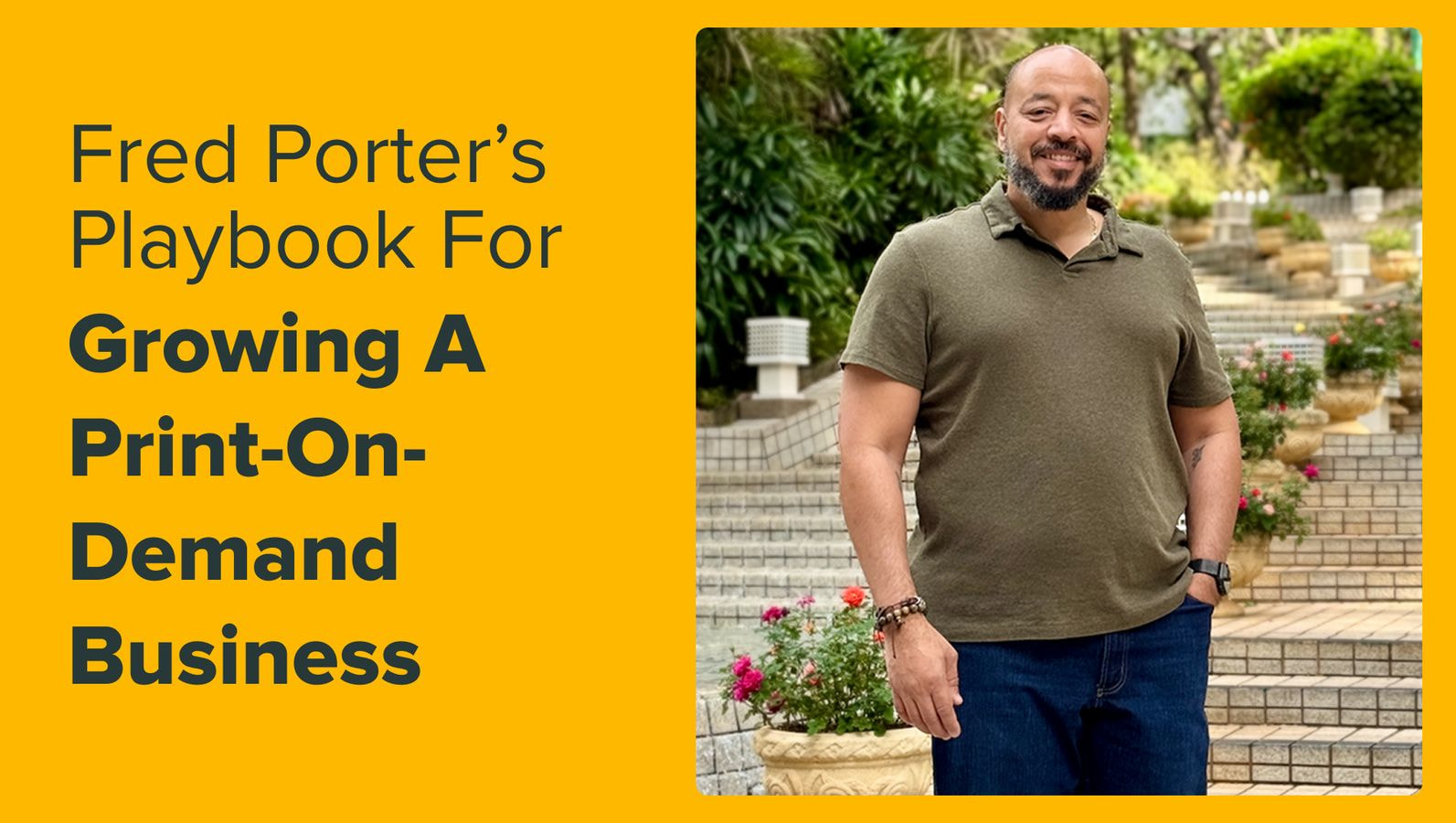
Fred Porter has watched the apparel industry reinvent itself from ink-stained screens to today’s on-demand printing.
Now based in South Florida, the lifelong graphic designer has built a business that reflects both his craft and grit. But Fred credits his success not to the tools but to persistence, failed attempts, and the belief that freedom is worth the work.
If you’ve been wondering how to grow a print-on-demand business, his journey offers plenty of answers.
From screen print shops to Direct to Garment
Fred Porter’s career began in screen printing, a method that defined the apparel industry for decades. He describes the process as rewarding but rigid. Screens, reclaiming chemicals, films, and setup time made every job a marathon. And unless you hit scale, it simply wasn’t profitable.
“The standard cut-off was around 144 pieces,” Fred explains. “Anything less and you were losing money. You could sometimes find a shop to do smaller runs, but you’d really overpay. By the time you sold those shirts, they’d have to retail for $60 or $70 just to break even.”
That’s why Fred noticed the emergence of direct-to-garment (DTG) printing. At first, the quality didn’t rival retail standards, but he saw the potential. “It solved a lot of problems,” Fred says. “And it’s only improved since then.”
Why small batches gave Fred an edge
For Fred, the ability to print small runs completely changed the way he worked. Instead of investing in 144-piece orders, he could test designs a few at a time and see what resonated.
“When you can make one shirt or five, you’re not stuck with inventory you might never sell,” he says. Each design became a manageable experiment. If it gained traction, he could scale it. If not, he moved on without taking a financial hit.
Small batches also gave him a reason to revisit old artwork. After three decades as an artist, Fred had folders of unused material. Print on Demand let him bring those ideas back to life and see how real customers responded.
This approach kept his latest business leaner than past attempts. And with small-batch apparel printing strategies, failure became a learning tool rather than an expensive mistake.

Choosing Printful early and why it mattered
Fred has been following Printful since its earliest days. Back when print-on-demand services were just starting to appear, he tested several providers.
“I remember when it started. I went through all of them back in the day,” he says. “Printful was the best. And the rest – I haven’t really heard from them anymore.”
What kept him loyal beyond quality was the relief of handing off fulfillment. In his earlier ventures, Fred had handled the entire process himself, from building websites to packing shirts and standing in line at the post office. That grind killed more than one attempt to sell directly to consumers.
“That is probably why I found Printful and was so intent on keeping track with them. I still have yet to see anybody who does it as well as Printful.”
Without that support, he says, he’d probably still be freelancing instead of running his own stores. His journey remains one of the standout Printful success stories.
Build bold. Ship smart. Grow with Printful.
Fred built his brand by betting on bold ideas – because Printful made the leap easy.
Here’s how:
✔ No order minimums – launch fast and test risk-free
✔ Automatic fulfillment – we print, pack, and ship while you focus on growth
✔ Global reach – get your products in customers’ hands, anywhereLaunch today, earn faster, and grow bigger with Printful.

Stop waiting for perfect and launch
One of the biggest lessons Fred learned after years of starting and restarting businesses was that chasing perfection only slowed him down. Early on, he’d delay launches until everything felt polished – the apps, the branding, the processes.
“But even with all that in place, once you go live, you face things you never expected,” Fred admits.
That realization made him rethink his approach: It’s better to launch with what you have, fix problems as they come, and treat every misstep as a learning opportunity.
“What I tell anybody who’ll listen is: stop trying to get all your ducks in a row,” he says. “Don’t be scared to fail. Be embarrassed, make mistakes, even close and restart if you have to. You’ll learn more that way than you ever will by trying to make everything perfect.”


How familiarity with Shopify and Printful saved time
By the time Fred launched his current store, he wasn’t guessing anymore. This time, he focused on execution.
He already knew Shopify’s platform and how to integrate it with Printful, so he skipped the trial-and-error phase. With his designs ready, the launch came down to one goal – get orders flowing and fulfillment running smoothly.
“I told myself, any problems that arise after that, I’ll fix them,” Fred says. “By now, I know I’m good at solving problems.”
Within weeks, his store was live and functional. By the third month, sales were climbing and ads began to work. Unlike his earlier stores with complex workflows, this one stayed manageable from day one.
Fred’s approach proves a point for new sellers: choose tools you already understand, launch with a working minimum, and trust yourself to handle any issues.
That way, time is spent learning from real customers, rather than building features that may never matter.

The hidden challenges of shipping and taxes
Designing shirts and setting up stores came naturally to Fred. What caught him off guard were the parts nobody talks about: shipping and taxes.
“These two things are so complex you’ll never be fully prepared unless it’s your specialty,” he admits.
When orders started coming in, the rules around tax collection and the logistics of shipping felt overwhelming. His first reaction was to hire help, but he decided instead to learn the essentials himself.
It wasn’t easy, but it taught him how quickly costs pile up. Without accounting for taxes and shipping, a store that looks profitable on paper might actually be losing money. That realization pushed him to get comfortable with the details instead of avoiding them.
Fred says most of these problems already have solutions. You don’t have to reinvent the wheel – just learn from others and apply what works. That mindset kept him moving forward.
How Fred approaches the challenge of customer acquisition
With fulfillment and operations under control, Fred points to marketing as the biggest challenge. He describes it as “the mammoth” – the task that makes or breaks a store, no matter how strong the product is.
“You could have the best store in the world selling the best things in the world, but you won’t make enough sales to survive if you can’t find customers,” he explains.
For Fred, everything starts with knowing who you’re trying to reach. He warns that without clarity, ad spend disappears quickly. “You can throw a million dollars at ads pointed at the wrong person and that money will evaporate,” he says.
That’s why he insists on defining the customer first. Once you know who they are, everything else (the product photos, the copy, the targeting) should directly speak to that person.
It’s a simple principle that took Fred years to learn. He frames it as the third leg of the stool: fulfillment is one, product creation is the second, but the third (marketing) is what brings customers through the door. Without it, nothing else matters.

Learning the math behind ads and scaling slowly
Once Fred identified his audience, the real work began: figuring out how to advertise profitably. He didn’t outsource this part. Instead, he sat down with Facebook Ads and learned to read the numbers.
“It’s almost like another language,” he admits. “But once you figure it out, you know if an ad is really working.”
He focused on return on ad spend (comparing revenue from a campaign to what it cost to run) and matched it against the true cost of each product. That included not just printing, but also taxes, shipping, and platform fees.
This math became his guardrail. If an ad cost more to run than it brought in, it didn’t matter how many shirts it sold – it had to go.
Scaling was another lesson. Instead of pumping money into a winning ad all at once, Fred increased budgets gradually. “If you add too much, you shock the system,” he says. Careful, incremental increases kept campaigns stable while extending their reach.
Why customer feedback keeps the business moving
For Fred, one of the best perks of running his own store is the direct connection with customers. Some messages are complaints or trolls, but most are encouraging. “For every email I get that says, ‘you suck,’ I get 50 that make my day,” he says.
Positive feedback tells him what’s working. When a customer comments on the fabric quality, fit, or delivery speed, Fred takes note and uses the feedback to refine his offers. Even simple thank-you notes remind him that there’s a real person on the other side of each order.
“I make sure I reach out and let them know their message made my day,” he says. That personal touch is important to him, especially after years in corporate roles where the end customer felt distant.

The freedom to work and live on his own terms
For Fred, success is more than sales – it’s the freedom. In his corporate years, he rarely felt secure enough to plan ahead.
Layoffs were common, burnout was everywhere, and even in senior roles, he didn’t feel in control. “I never felt safe,” he says. “I could have stayed forever, but I always felt like anything could happen, and I’d be back to square one.”
Now, running his own business, he can shape his workday around his family. If his daughters need a ride, if there’s a school recital, or if his wife needs the car, he can make it work. That flexibility wasn’t possible in the corporate world, where even a doctor’s visit felt like a disruption.
The freedom is both practical and emotional.
Fred feels he no longer has to wait until retirement to live his life.
He can work hard and still be present with his family. The business demands constant attention, but it doesn’t burn him out the same way freelancing once did.
Looking ahead to building a team
Fred admits he tends to do everything himself. It’s partly perfectionism, partly habit from years of freelancing. But as his store grows, he knows that the limit is getting close.
“There comes a point where one person can’t do everything,” he says. He’s proud of the systems he’s built, but he sees how bringing in help could push the business further. Tasks like ad management and operations could be outsourced, freeing him to focus on design and strategy.
What he misses most from corporate life is collaboration. Working alongside coworkers, sharing ideas, and pushing projects forward as a group is something he didn’t expect to value until it was gone.
“I do miss working with a team,” Fred admits. “That camaraderie of getting things done together.”
The idea of teaching also appeals to him. Passing on what he’s learned (from early screen-print days to managing online stores) feels like a natural next step. For now, though, he’s focused on timing. He wants to bring in the right people, not just anyone.
Lessons from Fred’s playbook for new sellers
Fred offers lessons earned through trial, error, and persistence. For anyone starting or wondering how to grow a print-on-demand business, his advice is direct.
-
Don’t wait for perfection: Launch early, expect problems, and treat mistakes as part of the process.
-
Lean on partners where it makes sense: Printful gave Fred the fulfillment foundation he needed so he could focus on design and marketing. Without it, he says he’d still be stuck managing boxes instead of growing a brand.
-
Pay attention to the numbers: From taxes and shipping to ad spend, every dollar needs to be accounted for. If a campaign looks like it’s working but eats into margins, it’s not a win.
-
Listen to customers: Their feedback is both validation and direction. It keeps the work human and shows where to improve.
Fred has built plenty of designs, but his proudest creation is a business that lets him work hard without missing life in between.
Thinking about starting a print-on-demand business? Take Fred’s advice: don’t wait for perfect. And with Printful, getting started is easier than you think.

By Anita Njoki
Anita is a dynamic content operations manager with a proven record of transforming innovative ideas into impactful digital strategies. She leverages data-driven insights, expertise in case studies and brand building, and UX digital marketing to fuel growth. A former advertising copywriter, she infuses neuromarketing insights into every project with passion, creativity, and collaboration.

