


Table of contents
Galleries and local coffee shops no longer decide who gets to sell art. Painters, illustrators, and digital artists now reach buyers directly through marketplaces, apps, and their own websites. But with dozens of platforms competing for attention, picking the right one gets complicated fast.
This guide compares the best places to sell art online in 2026, whether the goal is a first sale or a new revenue stream alongside an existing shop.
Key takeaways
-
Match the platform to the goal. Marketplaces like Etsy provide built-in traffic, while eCommerce platforms like Shopify hand over pricing and brand control.
-
Print-on-demand services such as Printful and Printify turn artwork into sellable products without managing inventory, warehousing, or shipping.
-
Curated platforms like Saatchi Art and Artfinder put original work in front of a global collector base and serious collectors.
-
A personal website keeps a larger share of every sale and gives an artist full control over pricing, branding, and presentation.
-
Instagram and Pinterest drive free traffic and connect artwork with new, interested buyers through search and social discovery.
-
Most working artists combine several sales channels to test pricing, reach different audiences, and build a sustainable art business.
Is it profitable to sell art online?
Selling art online can absolutely pay – once an artist’s platform and pricing strategy fit their audience and work. The US online art sales market reached $4.2B in 2026, up 2.5% from the year before, after a rough few years. Buyers are coming back.
Independent artists earn from originals, prints, and digital art through online marketplaces, their own eCommerce shop, and print-on-demand (POD) services – often several at once.
Running a shop online costs a fraction of renting gallery space. And it comes with a built-in perk: it’s easy to test which pieces actually sell and adjust prices on the fly, without a landlord in the mix.
The real work is pricing artwork correctly, digital marketing, and picking a platform that actually matches the art. A photorealistic oil painting and a sticker pack don’t belong on the same shelf. That’s what this guide sorts out: finding the best place to sell artwork online, whether that’s a first sale or a full-blown business.
The best places to sell art online in 2026
Compare the platforms below based on audience size, pricing control, and fees to find the best place to sell art online for your specific style and budget.
Print-on-demand platforms
Print on Demand (POD) turns original artwork into posters, apparel, canvas prints, and more – without ever touching inventory, a warehouse, or upfront production costs.
Not every POD platform works the same way. Printful and Printify are manufacturers, not marketplaces. They plug into a shop already built on Etsy, Shopify, or WooCommerce, rather than handing over a storefront of their own. Redbubble and Fine Art America go the other way: they come with a built-in audience and checkout, so there’s no separate shop to set up first.
It’s a direct path to passive income for digital artists and graphic designers, since a design can go live as a mockup the same day it’s finished. No waiting for physical stock to show up.
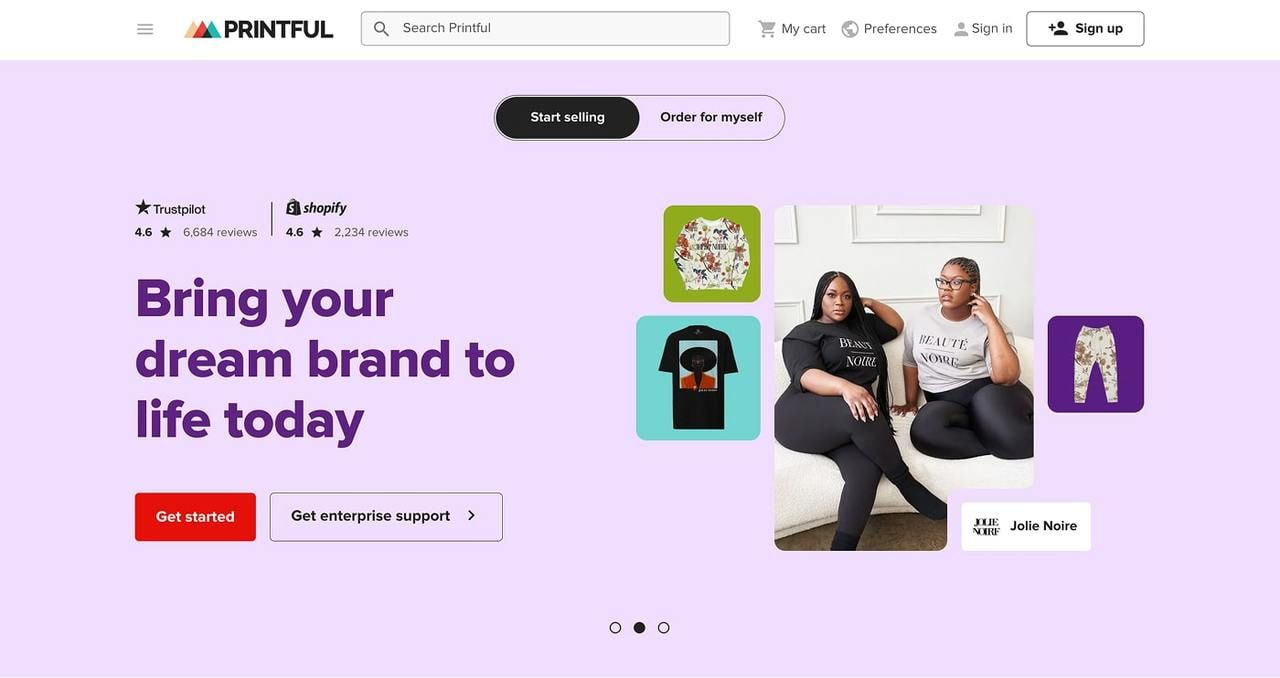
Printful turns original art into posters, apparel, mugs, and dozens of other products, then handles printing, quality checks, and shipping through its own production facilities rather than a rotating network of manufacturers.
Tip: Check out Printful’s guide to Print on Demand for artists before picking a product line.
-
The free plan charges nothing upfront; the artist sets the retail price and keeps the margin above the base cost.
-
The optional Printful Growth plan costs $24.99/month (free once a store passes $12,000 in yearly sales) and adds product discounts, free sample digitization, and priority print options.
Success story: UMAI Clothing scaled to six-figure monthly sales using anime-inspired streetwear and strategic ads with Printful’s fulfillment and support.
Printify connects professional artists to a global network of Print Providers, covering everything from canvas prints to t-shirts, with storefront integrations for Shopify, Etsy, and WooCommerce.
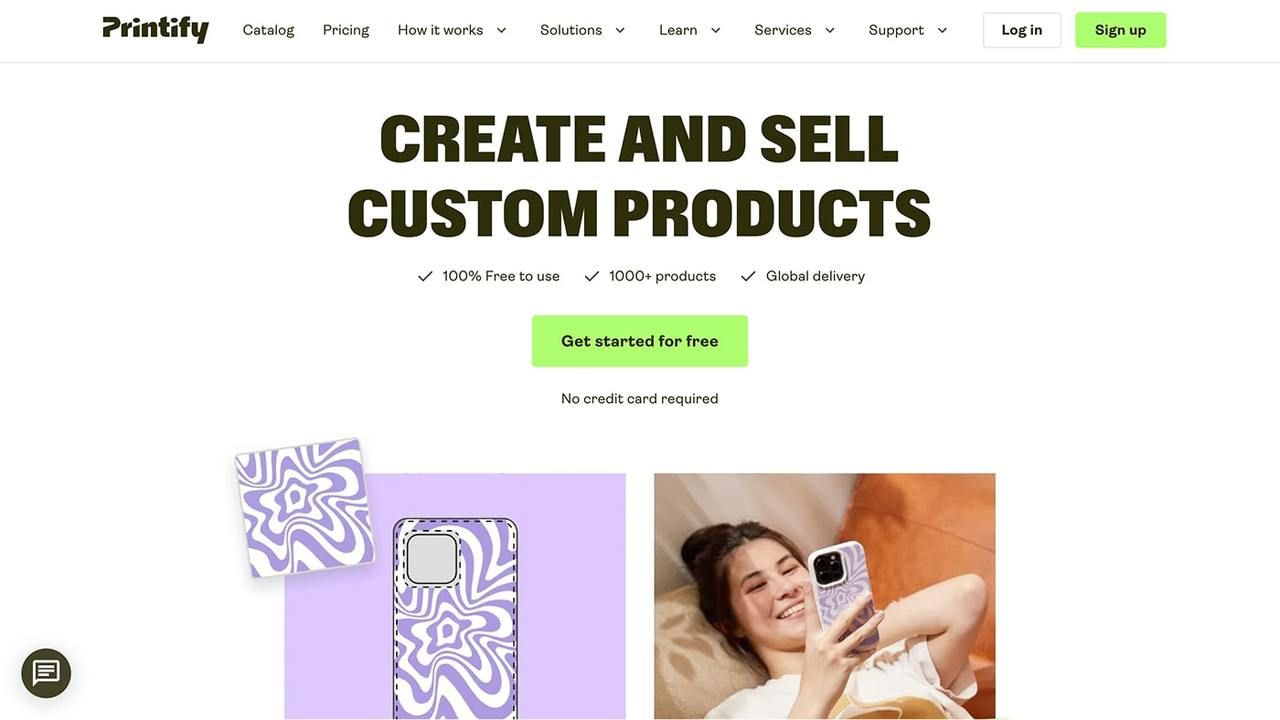
The free plan charges nothing until a sale happens. The Premium plan raises the monthly price to $39 as of February 2026 (up from $29), or $24.99/month billed annually at $299/year. It cuts most product costs by up to 20%, which raises margins for artists selling in volume.
Tip: Explore the best print-on-demand niches to watch in 2026.
Redbubble is a global POD marketplace built for illustrators, graphic designers, and digital artists who want to reach a broad audience without managing production. Artists upload a design once and sell it across prints, t-shirts, phone cases, stickers, and tech accessories.
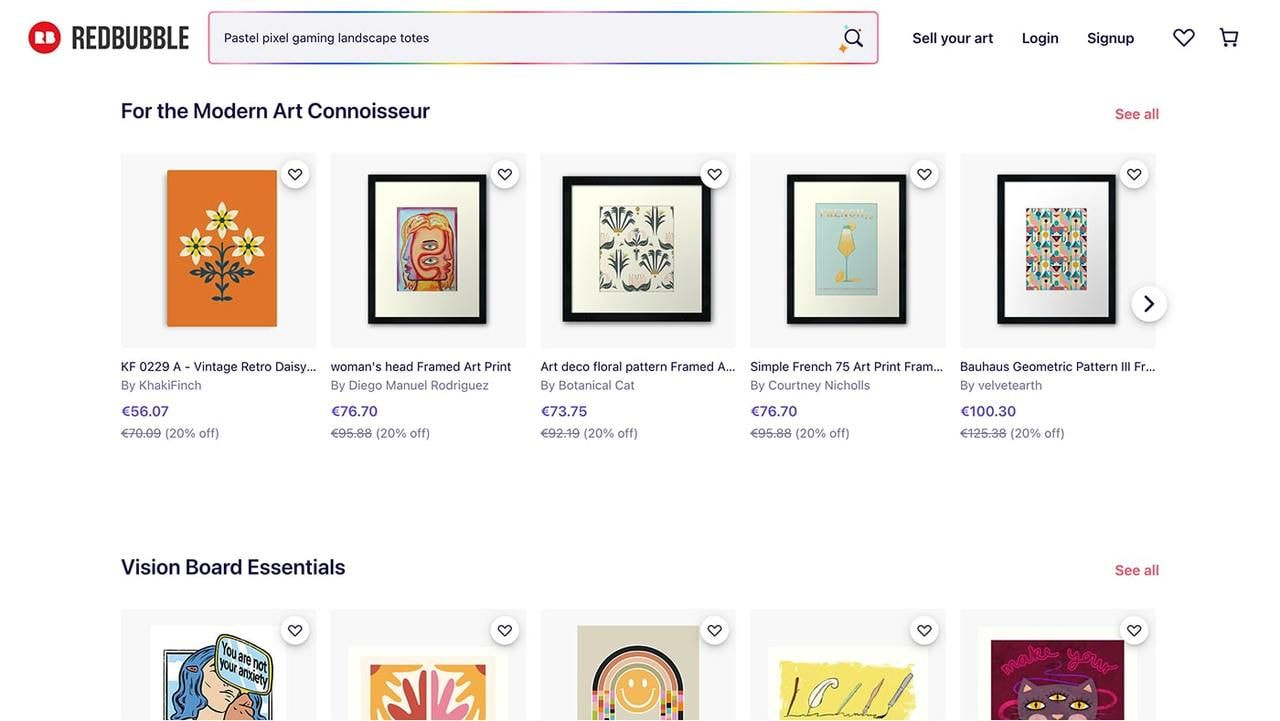
Source: Redbubble
The platform is free to join and defaults to a 20% artist margin on top of the base price. Since the 2025 fee change, Redbubble also takes a cut of total earnings – 50% for Standard-tier artists, 20% for Premium, and 0% for top-performing Pro-tier sellers.
There’s also a 50% penalty on any markup pushed above that 20% default. Sticking close to the default markup, and climbing the account tiers if the sales are there, is basically the only way to protect what’s left of the payout.
Online marketplaces
Etsy gives artists a large, built-in art subcategory covering prints, paintings, and illustrations, with full control over pricing and inventory. Etsy charges a $0.20 listing fee per item and a 6.5% transaction fee on the sale price, including shipping, so fees add up even on slow-moving listings.
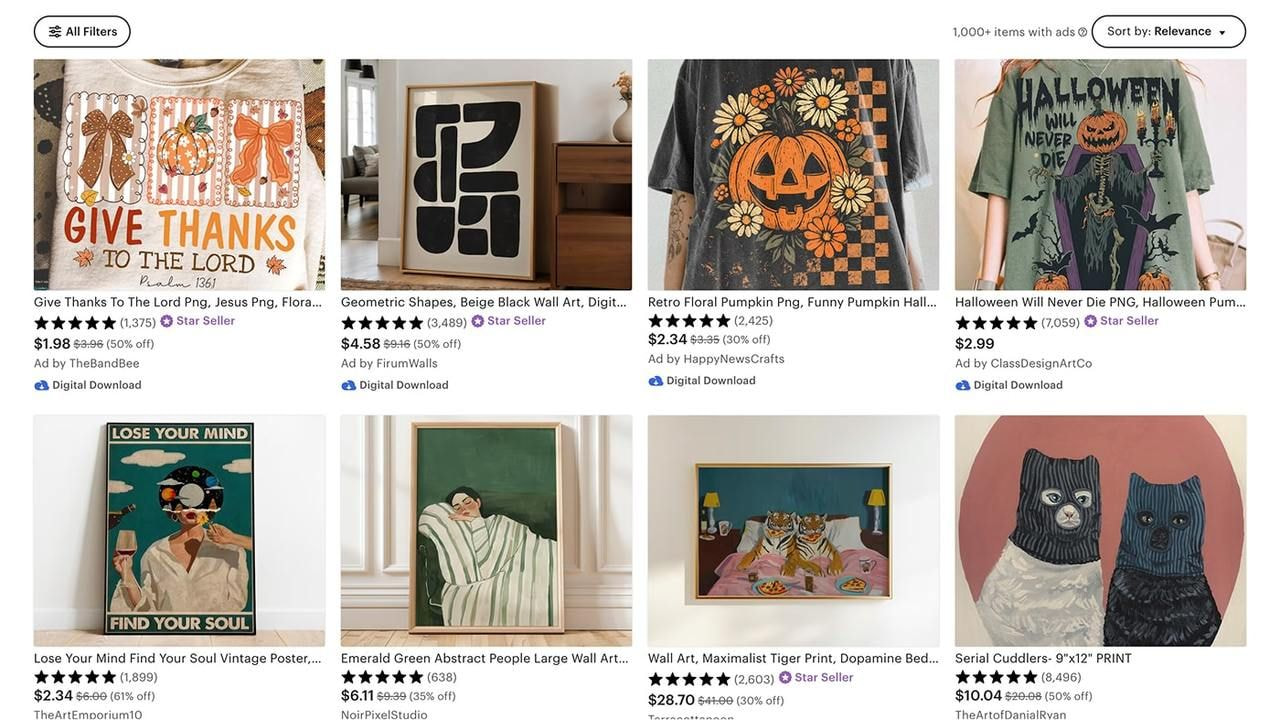
Source: Etsy
Tip: Explore Printful’s guides on how to sell art on Etsy and how to sell prints on Etsy.
Amazon Handmade lists handcrafted goods, including original art, on one of the world’s largest online marketplaces. Sellers apply for approval, and Amazon reviews each application to confirm the work is original and handmade. The flat referral fee is 15%, or $1 per item, whichever is greater, with no separate listing fee.
Tip: See how to sell art on Amazon for the application steps.
eBay runs a dedicated eBay Art category covering photographs, drawings, prints, paintings, sculptures, and posters. Sellers list work as an auction with a minimum price or use Buy It Now for an immediate sale. Auctions sometimes push prices higher and help test demand.
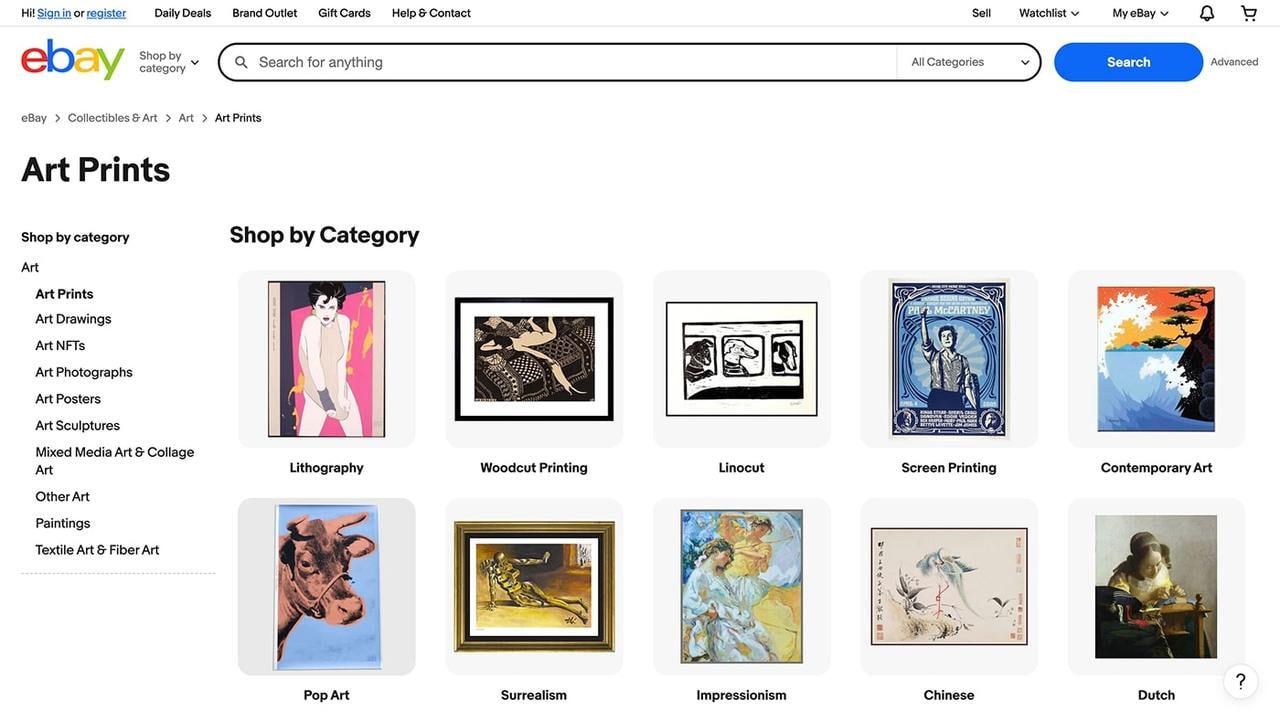
Source: eBay
eBay's Collectibles and Fine Art category now carries a final value fee of roughly 14-15% of the total sale, including shipping, plus a small per-order fee – a substantial jump from the category’s earlier 5% rate. Sellers still get 250 zero-insertion-fee listings a month.
Tip: For more insight, check our in-depth blogs on how to sell art on eBay and how to increase eBay sales.
eCommerce platforms
Shopify gives artists a full storefront, including website design, product listings, payment processing, marketing tools, and order management.
The Basic plan starts at $39/month, with additional transaction fees if the store skips Shopify Payments.
Tip: See the top ways of increasing Shopify sales.
Wix offers drag-and-drop site building with no coding required, plus built-in SEO tools and marketing integrations to drive traffic.
Four paid plans cover most artists: Light at $17/month, Core at $29/month, Business at $39/month, and Business Elite at $159/month. Artists use Wix to upload original art, set pricing, run promotions, and build online galleries around new collections.
WooCommerce turns a WordPress site into a full storefront with complete control over listings, inventory, payments, and promotions. It supports print collections, digital downloads, and original pieces. The plugin itself is free, but hosting, premium themes, and add-ons cost extra. With no platform fees, artists keep the full sale price.
Art-specific platforms
Saatchi Art, founded in 2006, is one of the world’s largest art marketplaces, listing over 1M pieces from more than 90,000 creators.
Buyers browse everything from paintings to prints to mixed media and can message or buy directly – no gallery owner standing in the middle. It takes a 40% commission on sales, lower than the roughly 50% cut typical of traditional galleries, while still delivering a global audience of collectors and a free art advisory service.
Artfinder is a tightly curated marketplace – every shop gets reviewed before it goes live. It focuses on original, one-of-a-kind pieces rather than prints or mass production.
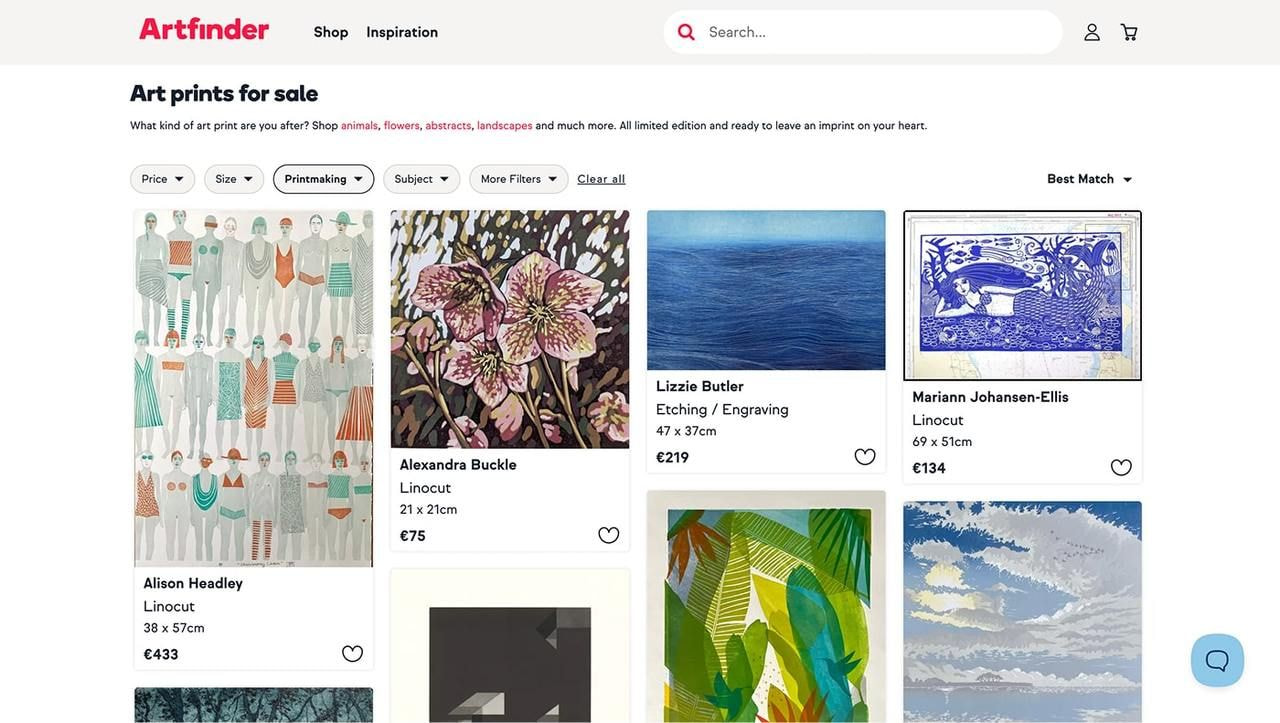
Source: Artfinder
Artfinder restructured its plans in late 2025, dropping the old free tier: Core now costs $14/month with a 45% commission, and Premium costs roughly $40/month with a 40% commission, with both plans including managed shipping.
Getty Images licenses digital art and photography to brands, publishers, and marketers, paying royalties each time a purchase happens. Artists apply to join the contributor program, and payouts vary based on licensing terms and exclusivity. This one’s built for licensing deals, not one-off sales to individual collectors.
Singulart is a curated web gallery connecting established and emerging artists with collectors worldwide, best suited to original paintings and large-scale pieces. Each artist gets a personal profile for pricing and story, and Singulart’s curatorial team reviews every application.
Selling requires a paid Silver, Gold, or Platinum subscription (roughly €30-€150/month) on top of a 50% commission per sale. The platform handles logistics, shipping, and client communication in return.
Fine Art America, alongside its sister site Pixels, serves a global audience of buyers looking for wall art, home decor, apparel, and digital art.
Artist profiles, marketing tools, and social integrations support promotion, and creators set their own prices. A free plan and a $30/year premium plan cover most needs.
Tip: Read Fine Art America vs Printful: artist profitability comparison for a side-by-side breakdown.
ArtPal, founded in 2011, connects more than 300,000 artists with buyers across paintings, ceramics, sculpture, photography, and jewelry through artist profiles and a secure checkout. There’s no membership fee or commission – about as low-risk as building a portfolio online gets.
Society6 shifted to a curated, invite-only model through 2025, closing thousands of open artist accounts to focus on a smaller, hand-picked roster. Existing approved artists earn a 10% commission on wall art, pillows, and framed prints, and 5% on everything else, with no monthly fees.
New artists can no longer sign up and simply upload as before, so check Society6’s current application status before counting on it as a starting platform.
Tip: Check our comparison between Society6 vs Printful before choosing a platform for selling your artwork online.
Other options

Instagram and Pinterest cost nothing to join, which makes either one a strong pick for the best place to sell art online for free.
Instagram’s visual format and reach make it a natural fit for showing off and selling artwork.
Meta retired native in-app Instagram Checkout in most markets as of September 2025. Instagram Shop now tags products and sends buyers to the artist’s own website or store to complete the purchase, so Instagram itself charges no selling fee; instead, the normal payment processing fees from the connected store apply.
Explore: Selling on Instagram vs Etsy: What’s right for you in 2026?
Pinterest functions as a visual search engine, and setting up a business account, listing products, and letting users shop directly from Pins costs nothing. Advertising is optional and auction-based, typically running $0.00-$0.20 per click or $2-$5 per 1,000 impressions.
Tip: Check out our Pinterest marketing guide to learn how to promote your brand.
Fair markets and local art fairs connect artists with buyers face-to-face, letting people see and feel a print or canvas before buying. These events also build exhibition history, offer a place to test pricing strategies, and let you learn from other artists in the same market.
A personal website puts an artist in full control of design, pricing, and promotion, unlike a marketplace listing. Builders like Wix or Squarespace keep setup costs to hosting and a domain while the artist keeps 100% of each sale, making their own site the strongest long-term option for building a recognizable brand.
Create and sell art with Printful
Ready to turn your art into a business?
Printful turns artwork into sellable products and connects that shop to buyers across major eCommerce platforms and marketplaces.
Here’s how to get started:
Step 1: Connect your store with Printful
-
Sign up for free with your email, Facebook, Apple, or Google account
-
Connect Printful to your business – go to Dashboard > Stores, select your preferred platform, and click Connect
Step 2: Choose your favorite product
Now that your account is all set up, it’s time to pick a product. Here are some of the most popular options:
Posters and canvas
Posters and canvas prints are great for graphic designers and painters – affordable, easy to ship, and popular with buyers looking to decorate their spaces with unique art.
Home decor
Turning your art into home decor – like pillows and blankets – establishes you in a growing market. These functional items are popular for home makeovers and thoughtful gifting.
Stickers
Custom stickers are a budget-friendly option that appeals to a broad audience. They’re decorative items that double as portable ads, showcasing your artwork on everyday objects like laptops and water bottles.
Custom clothing
T-shirts and hoodies turn your art into wearable designs. With space for bold prints, they’re a versatile way to reach style-conscious customers.
Step 3: Create your designs
After picking the product to feature your artwork, up next is prepping your designs for print.
No need for fancy tools or apps – just Printful’s Design Maker. Upload your art and adjust colors, size, and placement for a perfect fit. This tool makes it easy to customize and preview your design on real products.
Want more control? Prep your files in Photoshop, Illustrator, or Canva first, then upload them to Printful when ready. Before listing publicly, order a sample to check color accuracy and print quality – it’s the fastest way to catch an issue before a customer does.
Step 4: List your orders
Write clear, engaging titles and descriptions that reflect the artwork’s style, build a storefront that highlights the work clearly, and apply basic SEO practices to improve visibility in search results.
Final thoughts
There’s no single best place to sell art online. Marketplaces bring traffic, eCommerce platforms bring control, and print-on-demand services turn a design into a product line without upfront cost. Artists who combine two or three of these channels gain more reach, more pricing data, and a business built to outlast any one platform.


FAQs
Running a personal shop on Shopify or Etsy, paired with a print-on-demand service like Printful, is often the most profitable setup. It gives artists control over pricing and branding while removing inventory costs, allowing many creators to scale with lower overhead than a gallery representation.
Set up a storefront on a marketplace like Etsy or build an eCommerce site, then add high-quality product photos and SEO-friendly descriptions. Connect a print-on-demand service to sell prints, digital art, or products like apparel and home decor without managing production.
The answer splits by volume and value:
-
By volume, reproducible pieces sell most: art prints, canvas prints, and POD-friendly designs across wall art, phone cases, and apparel, since a single design can sell to hundreds of buyers at a lower price point.
-
By value, original paintings and limited edition prints sell for far more per piece but reach a much smaller pool of collectors on platforms like Saatchi Art or Singulart.
Abstract, botanical, and minimalist styles tend to move fastest as reproducible wall art, while original work sells on an artist’s exhibition history and strong reputation rather than subject matter alone.
Etsy suits prints, stickers, and other reproducible art goods well, since it’s a general handmade marketplace rather than an art-specialized platform.
Original paintings and one-of-a-kind pieces tend to perform better on curated platforms like Saatchi Art or Artfinder, where buyers arrive specifically looking for fine art rather than crafts.
For prints, Etsy’s built-in community of buyers helps many artists find their first customers without a personal website.
It depends on the goal.
-
Saatchi Art and Artfinder suit original work aimed at collectors rather than a general audience.
-
Etsy offers the lowest setup cost and an audience already searching for art, so it’s one of the best places to sell art prints online.
-
Shopify gives more control over branding but requires driving traffic independently.

Published author, scholar, and musician, Andris draws on over 11 years of experience in and outside academia to make complex topics accessible – from SEO and website building to AI and monetizing art. Devoted to his family and self-confessed introvert, he loves creating things, playing musical instruments, and walking around forests.

