



Table of contents
Your print-on-demand platform determines your print quality, shipping speed, and how much you keep from every sale. Switching later means rebuilding your listings and reordering samples, so it pays to pick right the first time.
In this Gelato vs Printify comparison, we break down pricing, product quality, shipping, and integrations side by side – and show where Printful fits into the picture. If you plan to sell custom products across different sales channels, this breakdown will help you decide which platform makes the most sense for your print-on-demand business.
Short answer:
-
Choose Printify if you want the biggest catalog, low base prices, and control over which Print Provider makes each order
-
Choose Gelato if you want hands-off local production and fast delivery, especially for wall art, cards, and custom photo books.
-
If the same quality on every single order matters most, pick Printful.
Key takeaways
-
Printify offers a larger catalog of 2,000+ products, including unique items such as doormats and scented candles, and lets sellers compare Print Providers by base price and production location.
-
Gelato automatically routes orders to its 250+ production partners in 32 countries and claims 86% of its 2025 orders were produced in the customer’s own country.
-
Gelato+ costs less than Printify Premium: $29.99 vs $39 per month, or $19.99 vs $24.99 per month billed annually.
-
Printify’s free plan gives you access to up to 5 stores, neck labels, custom packaging inserts, and gift messages. Gelato reserves branded labels and inserts for Gelato+ members.
-
Printify integrates with 11 sales channels and offers a free Pop-Up Store. Gelato connects to eight platforms plus its API and Order Desk.
-
Both offer global fulfillment on their free plans, shipping orders straight to your end customers.
Gelato vs Printify: Quick comparison
Both Gelato and Printify are popular print-on-demand companies, known for providing high-quality products, competitive pricing, and reliable sales channel integrations.
Here’s the Printify vs Gelato breakdown at a glance.*
|
Feature |
Gelato |
Printify |
|
Best for |
Hands-off local production and paper products |
Catalog size, provider choice, and margins |
|
Pricing structure |
Free to use, with Gelato+ costing $29.99/month (billed monthly) or $19.99/month (billed annually) |
Free to use, with Printify Premium costing $39/month (billed monthly) or $24.99/month (billed annually) |
|
Product variety |
||
|
Print quality |
Consistent quality through local production |
High-quality prints from worldwide printing partners |
|
Shipping and fulfillment |
Localized production across 32 countries with worldwide shipping |
Global fulfillment with Economy, Standard, Priority, and Express shipping options (Economy and Express in the US only) |
|
Integrations |
Etsy, TikTok Shop, Shopify, Amazon, WooCommerce, Squarespace, Wix, BigCommerce, and API solutions |
Etsy, TikTok Shop, eBay, Amazon, Shopify, Squarespace, Wix, WooCommerce, PrestaShop, BigCommerce, Big Cartel, Printify Pop-Up, and API solutions |
|
Branding options |
Packaging inserts and branded labels (only available with Gelato+) |
Packaging inserts, branded labels, gift messages |
|
Print providers |
250+ local production partners |
140+ global print facilities |
|
Customer support |
24/7 support via live chat and email |
24/7 support via chat and contact form |
*Prices as of October 2026.
Printful vs Printify vs Gelato: Which platform fits your goals?
Gelato and Printify aren’t the only players in the print-on-demand space. Here’s how they stack up once you bring Printful into the mix.
|
Best for |
Printful |
Gelato |
Printify |
|
Sellers who want variety |
Curated catalog focused on premium quality |
More limited product range |
Huge product catalog across many categories |
|
Brand-focused businesses |
Strong brand control with consistent branding |
Branding available, but more limited |
Flexible branding options that vary by provider |
|
Consistent product quality |
High consistency through in-house production |
Consistency supported through local production |
Depends on the chosen Print Provider |
|
Scaling long-term |
Built for scaling established brands |
Better suited for regional or niche scaling |
Flexible and cost-effective for growing businesses |
|
Hands-off fulfillment |
Fully managed production and fulfillment |
Automatic routing to local print partners |
Manual print provider selection |
|
Cost savings |
Product discounts on paid plans (up to 33% off), plus free digitization and up to 55% off bulk orders |
Up to 33% off products with Gelato+, plus lower shipping costs from local production |
Up to 20% off all products with Premium (up to 33% off new launches) |
Pro tip: Weighing Printful, too? Printful suits brands that need one quality standard across every order, with in-house production and a 0.24% reshipment rate. See how it compares head-to-head in Printful vs Gelato.
Gelato, Printify, or Printful: Which should you choose?
Now that you’ve seen how all three platforms compare, here’s how to pick the right fit for your print-on-demand business.
Choose Gelato if you:
-
Want automated, hands-off fulfillment
-
Focus on regional markets
-
Sell paper products like wall art, cards, calendars, or custom photo books
Choose Printify if you:
-
Want the largest product catalog and lower base prices
-
Prefer picking your own Print Providers
-
Prioritize profit margins and variety as you scale
Choose Printful if you:
-
Need consistent product quality across every order
-
Want in-house production – not third-party providers
-
Value advanced branding tools and a curated catalog
-
Are building a long-term brand with full control over the customer experience
Now, let’s dig into the Printify vs Gelato details, starting with what you’ll actually pay.
Gelato vs Printify pricing: Which plan pays off?
Both Gelato and Printify offer free plans, but their paid tiers unlock different perks and discounts that affect product costs, shipping, and premium features.
Gelato
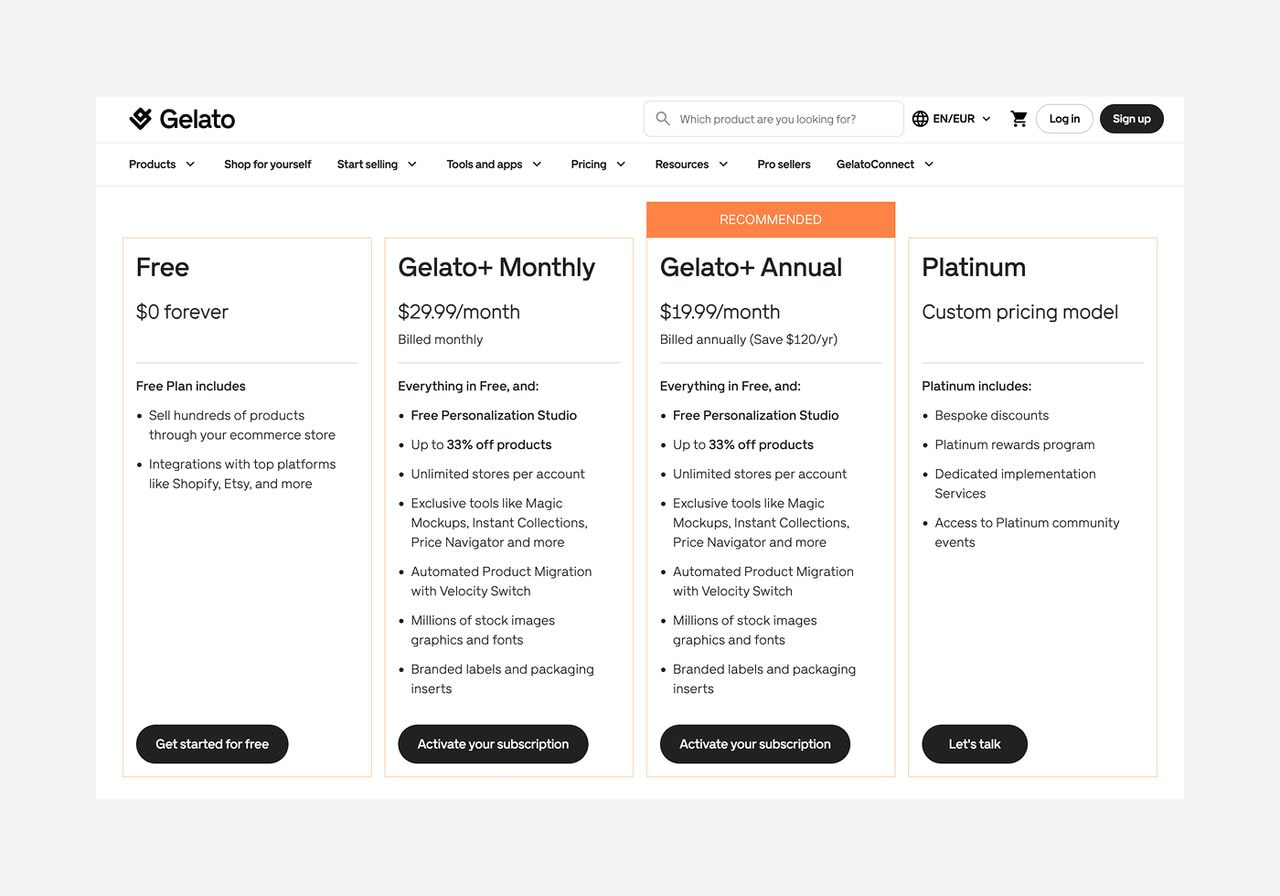
Gelato’s free plan lets you start selling at no cost. Gelato+ costs $29.99/month or $19.99/month when billed annually and gets you up to 33% off product prices, along with access to advanced design tools like Personalization Studio and Magic Mockups.
Local production keeps shipping costs down and delivery fast in many regions, compared to some Gelato alternatives. There are no platform fees, but branded labels and packaging inserts are Gelato+ only, and expedited shipping costs extra.
Printify

Printify’s free plan makes it easy to launch without upfront costs. The Printify Premium plan costs $39/month or $24.99/month when billed annually. It includes up to 20% off all products and up to 33% off new products, order management tools through Printify Connect, and early access to new features.
Does Printify Premium pay for itself? Here’s the quick math. Say a t-shirt costs you $12. A 20% discount saves you $2.40 per order, so the $39 monthly plan pays for itself at about 17 orders a month. On annual billing ($24.99/month), that drops to about 11 orders. Every order after that goes straight to your profit margins.
Printify delivers lower base prices across popular categories like t-shirts, hoodies, phone cases, and wall art, thanks to its competitive network of Print Providers. No platform fees, but final costs vary by chosen Print Providers, shipping speeds, or optional enterprise features.
Verdict: Gelato+ is the cheaper subscription, and local production can lower shipping costs in key regions. Printify’s Premium plan costs more per month, but it’s the better pick if you’re focused on cutting product costs, since its discounts stack on top of low base prices. Either way, you get free tools to start on both platforms.
Product quality and variety: Which platform gives you more to sell?
Product quality and variety shape how your store grows. Here’s how Printify vs Gelato compare in what you can sell and how each POD platform handles production.
Gelato

Gelato offers hundreds of custom products, with a strong focus on apparel, wall art, and stationery. This smaller catalog can appeal to sellers who prefer fewer decisions and a simpler setup.
Orders are mostly produced locally through its global print network, which cuts shipping distances. Print quality can vary from partner to partner, though.
For customization, Gelato offers branded labels, packaging inserts, personalized messages, and custom packaging for select products. Branded labels, inserts, and advanced design tools like Personalization Studio require Gelato+.
Printify

Printify stands out for its huge product catalog, offering 2,000+ print-on-demand products across apparel like t-shirts and hoodies, accessories, home decor, wall art, phone cases, and more. There’s even a dedicated eco-friendly section. With that much range, you can test new niches without switching platforms.
Print quality depends on the chosen Print Provider, but sellers can compare options using performance scores or go with Printify Choice for the best prices and fastest delivery. Customization features include neck labels, branded stickers, inserts, and custom packaging, with eco-friendly materials available on supported products.
Sellers can design and preview products and use Printify’s AI Image Generator in the free Product Creator.
Verdict: Printify’s extensive product range and flexible custom branding make it easier to diversify and scale. Choosing your own Print Providers also gives you more control over product quality, profit margins, and long-term customer satisfaction. Gelato wins if you mainly sell paper products and want fewer choices to make. Still shopping around? Check out these Printify alternatives.
Shipping and fulfillment: Which is faster?
Shipping is one of the biggest Printify vs Gelato differences. Both platforms support worldwide shipping with order tracking, making it easier to manage fulfillment across various sales channels. The key difference is who decides where each order is made – and that drives your shipping times and costs.
Gelato
Gelato relies on localized production across 32 countries, automatically routing orders to the nearest available print partner. This local printing model reduces delivery costs and supports reliable shipping, especially for international orders.
Sellers can’t manually pick print providers, but Gelato reports that 86% of orders get produced in the same country as the customer, 99% in the same region, and an average delivery time of 5-7 days with Economy shipping. That makes Gelato a strong option for sellers targeting specific regional markets.
Printify
Printify operates a global network of 140+ print facilities that support both domestic and international fulfillment. Unlike Gelato, sellers can choose their print providers, select locations closest to their customers, and optimize shipping costs and times.
Average delivery times are 2-8 business days for US orders, while international shipping ranges from 3-30 business days, depending on the provider and destination. For faster delivery, Priority and Express shipping are available on eligible products.
Verdict: Gelato wins on hands-off simplicity and fast regional delivery through local production. Printify, on the other hand, gives you greater control over fulfillment and shipping, optimizing delivery across markets.
Integrations and ease of use: Which is more beginner-friendly?
Both Gelato and Printify support selling across multiple sales channels, but they differ in how quickly you can get started and how far their tools go.
Gelato
Gelato integrates with popular eCommerce platforms, including Shopify, Etsy, WooCommerce, Wix, Squarespace, BigCommerce, Amazon, and TikTok Shop, along with API solutions for custom setups. The dashboard is clean and beginner-friendly.
For platforms without a dedicated integration, Order Desk connects Gelato to your fulfillment workflow.
Printify
Printify connects to mainstream platforms like Shopify, Etsy, WooCommerce, Wix, Squarespace, Amazon, eBay, PrestaShop, BigCommerce, Big Cartel, and TikTok Shop, plus API access. The Premium plan lets you connect up to 10 stores, which helps if you sell on multiple platforms.
Sellers who don’t want to build an online store from scratch can also start selling with the Printify Pop-Up Store. Available to sellers in 38 countries and territories, this free pop-up store lets you list and sell custom products without a separate eCommerce platform.
Verdict: Printify offers more native integrations and a free pop-up store, making it the easier starting point for most sellers. Gelato covers the major platforms but has fewer options if you sell across multiple channels.
Both are solid choices – but if integrations, branding, and production consistency all matter to you, there’s a third option worth considering.
Why choose Printful over Gelato or Printify
Gelato and Printify both rely on third-party print providers. Printful doesn’t.
Printful owns and operates its own fulfillment centers globally – every order goes through the same quality-controlled production process. No guessing which provider will handle your order. No inconsistency between batches.
For sellers building a brand, that consistency is non-negotiable. Printful also offers advanced branding tools – custom packaging, inside labels, packaging inserts, and a branded order tracking page. Because of this, you have full control over the entire customer experience, from unboxing to delivery updates.
Add in 21 native integrations, free tools in the Design Maker, and 24/7 support, and you have the infrastructure to scale without sacrificing the quality your customers expect.
It gets cheaper as you grow, too. Printful Growth ($24.99/month) takes up to 33% off custom premium products, 25% off sample orders, and 9% off product branding, with free digitization on embroidered samples. Ordering in bulk? Save up to 55%, plus free digitization on embroidery bulk orders.


How to start selling on Printful in 5 steps

Ready to get started on Printful’s print-on-demand platform? Here’s how:
-
Sign up for a free Printful account
-
Browse the Product Catalog, with options ranging from apparel and home decor to accessories
-
Design your custom products using the free Design Maker – add text, graphics, and branding elements
-
Connect your online store across 21 supported eCommerce platforms and marketplaces like Amazon, Etsy, Shopify, and more
-
Publish your products, promote them, and start fulfilling orders worldwide
Gelato vs Printify FAQ
Yes, Gelato is a legitimate print-on-demand platform. Its network of more than 250 production partners in 32 countries has delivered more than 10 million orders, and Gelato holds a 4.8/5 rating on Shopify. It’s a solid pick for local production and hands-off fulfillment, though its limited branding tools and smaller catalog feel restrictive as you grow.
Generally, yes, but Gelato’s print quality depends on the local partner that produces each order. Its strongest products are wall art, cards, and custom photo books. Before you launch, order samples to the regions where most of your customers live.
Gelato can be profitable when your retail prices cover product, shipping, and marketing costs while still leaving healthy profit margins. Pricing is where Gelato+ helps. It costs $19.99/month, billed annually, with up to 33% off products. Local production can also lower shipping costs for orders delivered within Gelato’s production countries.
There isn’t a single best option for everyone. Printful is a strong choice for sellers who prioritize consistent product quality, reliable fulfillment, and advanced branding, especially for building a long-term brand.
Printify offers more flexibility and cost control through its pricing plans and wide network of Print Providers, making it ideal for sellers focused on margins and product variety.
Gelato works well for businesses that want simple local production and straightforward fulfillment, particularly for regional or international markets.
It depends on the business model. Printful suits brands that need consistent quality, since it produces orders in its own fulfillment centers and reports a 0.24% reshipment rate. Gelato suits sellers focused on local production and paper products. And if you want the largest catalog and control over Print Providers, Printify is still the pick.
Shipping speed depends on location and product type. Gelato’s production model can deliver faster in specific regions, while Printify’s shipping times vary by Print Provider, with some offering express shipping in 2-3 business days.
Printful produces orders in its own fulfillment centers, so timing doesn’t depend on third-party providers. Most products are fulfilled in 2-5 business days, and over 97% of orders ship under 5 business days. Shipping time then depends on the product and destination. A t-shirt to the US, for example, takes 3-6 business days.
Printify is usually cheaper on base product prices, especially with its Premium plan. Meanwhile, Gelato can be a more cost-effective POD platform for local or regional orders due to lower shipping costs.
The Printify vs Gelato cost comparison really comes down to what you sell and where your customers live, so check both pricing plans against how many orders you expect each month.
Printful, Printify, and Gelato all integrate well with Etsy and Shopify. Printful suits sellers focused on consistent branding and quality, while Printify works well for those who want to expand beyond t-shirts into a wide range of products. Gelato is a good choice for Etsy sellers offering high-quality paper products and locally produced items.
Printify vs Gelato: The final verdict
For most sellers, the Printify vs Gelato decision comes down to priorities. Gelato is a strong pick for local production. Printify wins in variety, pricing flexibility, and experimentation.
But if you want consistent quality, in-house production, and brand control that doesn’t depend on third-party providers – Printful is built for that.
- Sign up for free
- 594 custom products
- Sell without inventory
Read next: How to switch from Gelato to Printful

Published author, scholar, and musician, Andris draws on over 11 years of experience in and outside academia to make complex topics accessible – from SEO and website building to AI and monetizing art. Devoted to his family and self-confessed introvert, he loves creating things, playing musical instruments, and walking around forests.

