



Table of contents
If you want to build a dropshipping business and stand a real chance of lasting, start with the numbers.
The right dropshipping statistics show where demand is growing, how buyer habits are changing, and where the pressure points sit for new sellers.
This article pulls together the most useful data for 2026, then turns it into plain-English lessons you can use in a real eCommerce business.
Key takeaways
-
Supplier quality still shapes trust, margins, and long-term growth
-
Fashion remains one of the strongest categories for branded selling
-
Mobile shopping, social commerce, and cross-border demand keep expanding
-
Most dropshipping stores fail because execution is weak, not because demand is missing
-
The sellers with the best odds treat dropshipping like a real brand, not a shortcut
What is dropshipping?
Before we get into the numbers, let’s define the model clearly.
Dropshipping is a business model where a store sells third-party products without keeping stock on hand. When a customer places an order, the supplier makes, packs, and ships the item for the seller.
That makes the dropshipping model attractive for small business owners, first-time founders, and eCommerce entrepreneurs who want to launch online businesses with leaner inventory management.
For many brands, dropshipping is the simplest way to test demand before investing more heavily in operations.
It also works well for an eCommerce business that wants flexibility:
-
Test products faster
-
Expand into new categories without bulk buying
-
Adjust your catalog as industry trends shift
That’s why both new sellers and established eCommerce retailers still use this business model. The barrier to entry is low, but the bar for doing online sales well is much higher than it used to be.
Valuable read: The best dropshipping products


Dropshipping statistics – Market share and beyond
The latest dropshipping statistics below cover market size, buyer behavior, platform shifts, and profitability – the numbers that actually shape how dropshipping businesses grow or stall.
Use these industry trends and stats to navigate your dropshipping journey, whether you’re launching your first online store or scaling an existing one.
1. The global dropshipping market size is on track to keep rising fast
The global dropshipping market size is valued at $590B in 2026, and forecasts suggest the market is expected to pass $2T by 2032. This dropshipping market growth tells you the model still has momentum.
More sellers are entering the space, more suppliers are building services around it, and the tools for launching and running an online store keep getting better.
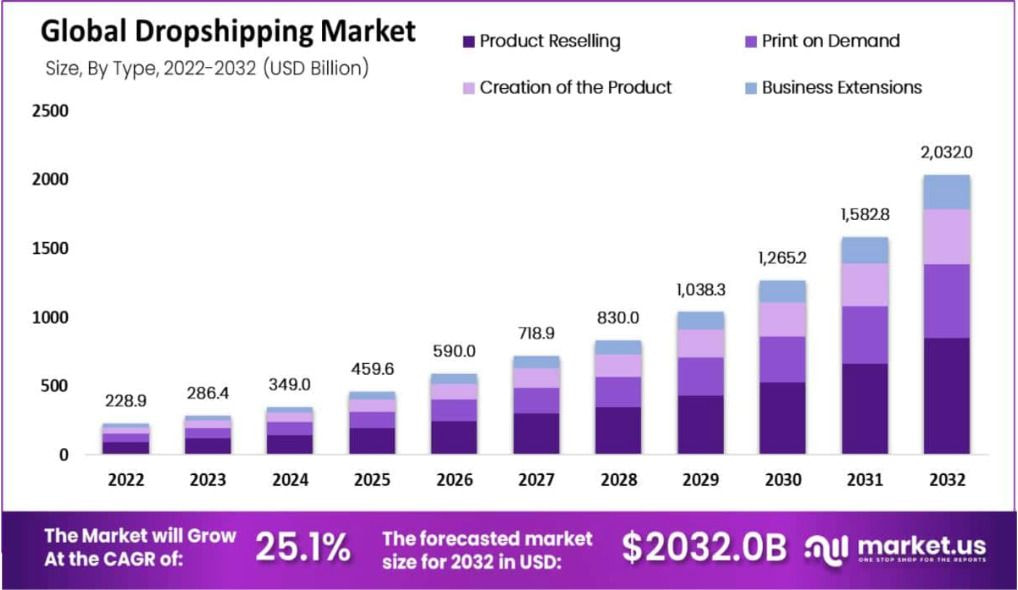
Source: Market.us
The bigger shift is how normal this has become. Dropshipping is no longer treated like a side route or a fringe experiment. It sits firmly inside the broader eCommerce market, catering to digital buyers worldwide, supported by smoother payments, simpler store setup, and stronger fulfillment infrastructure.
When conducting dropshipping market research, this is one of the clearest signals to start with.
Takeaway: This is proof of demand, not a guarantee of easy sales. A growing market gives you room to enter, but it also brings more competition. Pick a category with long-term potential, then focus on differentiation from day one.
2. The Asia Pacific region leads, and North America is still close behind
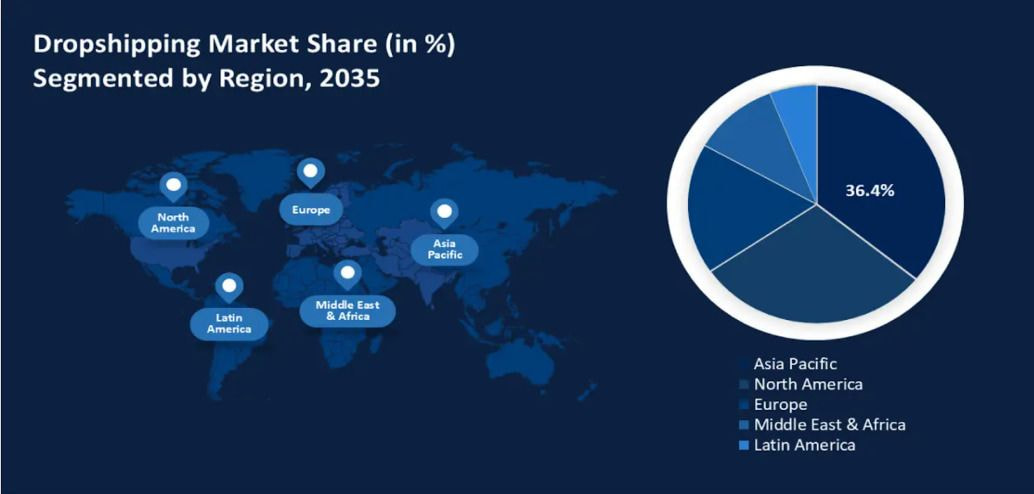
The Asia Pacific region held the largest market share in 2025 at 35.26%. The North American dropshipping market followed with nearly 33%.
On top of that, the Asia Pacific dropshipping market is expected to post the fastest regional growth through 2035, driven by expanding digital infrastructure and rising buyer demand.
Source: Research Nester
Geographical market share data shows where dropshipping is strongest today and where future market growth is likely to come from. It also explains why the global dropshipping market keeps expanding even as competition increases in mature regions.
Takeaway: Let this dropshipping market analysis guide your market focus. If you plan to sell internationally, first check where your products fit best, shipping is strongest, and buyer demand is already mature.
3. Fashion still holds the biggest market share
The apparel and fashion segment is expected to hold a 38.5% share through 2035, securing the largest market share among product categories. Makes sense – clothing and accessories are easy to brand, easy to refresh, and closely tied to trends, identity, and repeat buying.
In a crowded sector, this frees up room for better profit margins than many generic products can support.
For Printful sellers, this is one of the most useful dropshipping statistics in the article. Fashion works especially well when consumer demand is driven by self-expression, community, niche interests, and design.
It also benefits from customization services, which give sellers more ways to stand out without carrying stock.
Takeaway: If you want a category with strong branding potential, fashion is still one of the safest bets. Prioritize products that support customization, repeat purchases, and a clear visual identity.
Valuable read: Start a dropshipping business with Printful
4. Global eCommerce sales are expected to soar
Global eCommerce sales are projected to hit $7.89T by 2028, and retail eCommerce sales will account for 21.1% of total retail sales. That gives the whole category a strong tailwind.
The larger the digital economy gets, the more room there is for focused brands to carve out their place.
The bigger force behind the dropshipping market isn’t the model – it’s ecommerce growth, which changes how people shop online.
As more money flows through digital channels, more online stores enter the field, and the quality gap between average and strong sellers becomes easier to spot.
Takeaway: The opportunity is broad, but broad markets reward focus. Online shopping is still expanding; focus on a specific audience rather than trying to sell everything to everyone.
5. Online buying behavior keeps shifting toward phones and convenience
Last year, mobile phones drove 77% of visits to eCommerce websites, surpassing desktops by a long shot. More than three-quarters of internet users have made online purchases, and online shopping continues to feel ordinary to digital buyers across age groups. Mobile commerce is no longer just a trend – it’s a bare minimum expectation.
This shapes everything from page design to checkout flow. If your store is slow on mobile, cluttered, or hard to trust at a glance, you’ll lose people early.
Shopping online and product discovery now happen in tiny bursts throughout the day – scrolling on lunch breaks and, let’s be honest, scrolling all day, every day. Strong brands are designing for that reality.
Weaker ones still act as if buyers are sitting down at a desktop and studying every page.
Takeaway: Make mobile performance a priority. Check your store on a phone, simplify navigation, shorten your product copy where needed, and remove friction from checkout. If your store feels clunky on mobile, you’re likely losing buyers before they even reach the cart.
6. Social platforms now influence more buying decisions
Sales through social networks made up more than 17% of total online sales in 2025, and US social commerce is projected to exceed $100B in 2026.
That shift is shaping consumer behavior in real time, especially among younger digital buyers already used to discovering products within content feeds.
This is one reason social media matters so much to modern sellers. For many brands, a good social media account is now part storefront, part proof of life, and part sales channel.
Add influencer marketing to that mix, and you get faster trust-building, more social proof, and stronger reach without depending on a single channel.
Takeaway: Don’t treat social media as an afterthought. Post content that supports discovery and trust, whether through short-form video or product education. Your marketing should meet buyers where they already spend time.
7. TikTok Shop is turning social attention into commerce faster than most platforms
Speaking of social media channels, TikTok Shop’s sales are forecast to surpass $20B in 2026, making it one of the clearest signs of where digital retail is heading.
Short-form video is no longer just a discovery tool but a direct path to purchase for an increasing share of digital buyers worldwide. Live shopping is a form of entertainment.
For sellers, this is one of the most practical pieces of dropshipping news. The rise of TikTok Shop shows how social commerce dropshipping can work when product, content, and audience line up. It also reinforces a broader point about the dropshipping market: sellers who adapt to platform behavior tend to do better than those who stick to old traffic models.
Takeaway: If your product is visual, impulse-friendly, or easy to demonstrate, test TikTok early. You don’t need to build your whole business there, but this stat is reason enough to experiment with product-led video content and social-first selling formats.
8. Cross-border buying is normal now, which expands the opportunity
According to DHL, 59% of global online shoppers buy from stores in other countries, and 35% do so monthly or more. That’s a strong signal for dropshipping worldwide.
Customers are increasingly comfortable buying across borders as long as the experience feels clear, reliable, and worth the wait.
Why should this matter to you? Because the dropshipping market works especially well when reach is wide, and stock doesn’t have to sit in one place.
Cross-border demand gives online retailers and online businesses more room to serve niche audiences. It also means more online shoppers are comparing stores globally, which raises the importance of trust, delivery clarity, and presentation.
Takeaway: Think beyond your home market. If your supplier can deliver reliably across regions, explore international demand, especially in niches with strong online communities.
9. Supplier quality is still one of the biggest make-or-break factors
Delivery trust shapes conversion more than many beginners realize. 73% of global shoppers say they wouldn’t buy from an online retailer if they didn’t trust the delivery provider. 72% Say free delivery would improve their online shopping experience. Supplier quality sits directly inside that equation.
This is where dropshipping supplier vetting comes in. A reliable supplier affects shipping speed, product consistency, returns, and customer satisfaction. It also affects your reputation.
In a competitive market, fulfillment problems erase a lot of good marketing. Strong eCommerce fulfillment strategies start with choosing partners carefully and testing them before you scale.
Pro tip: Printful is the leading print-on-demand provider in the eCommerce industry. We offer 589 premium products, including apparel, accessories, and home & living items.
Takeaway: Order samples, test delivery times, review packaging, and assess print or product quality yourself. This is one of the few decisions that directly affects reviews, refunds, and repeat purchases.
10. More sellers are still choosing dropshipping as their main fulfillment model
Around 27% of eCommerce stores use dropshipping as their primary operational model, and the share of Shopify dropshipping stores has grown sharply in recent years. Shopify dropshipping stores increased from 5.16% to 12.82%.

Source: Pexels
What’s still attracting newcomers if the competition is so tough? The dropshipping platform setup is simpler than traditional retail. You can test products, launch faster, and avoid tying up money in stock.
Dropshipping doesn’t guarantee success. But it explains why more eCommerce stores continue to use this route to start selling online.
Takeaway: The model is still relevant, but ease of entry means you need sharper execution. Move fast, but not carelessly. Choose your niche with intention so your store doesn’t look like a copy of everyone else’s.
11. Success rates are low, and margins reward discipline more than hype
StatsUp says only 10% of sellers achieve success in their first year, and only 1.5% of dropshipping stores exceed $50K in monthly revenue. The reported average profit margin for many stores sits around 15%-20%, though some businesses do better and many do worse.
These numbers put the dropshipping success rate into perspective and point to a clear takeaway: stores that lack focus, quality, and consistency tend to struggle.
This is the point where the dropshipping business model’s profitability becomes less glamorous and more useful.
Your average monthly income, typical profit margins, and overall dropshipping profit margin depend on product choice, ad costs, pricing, returns, and supplier quality. In other words, the dropshipping market still offers room to grow, but it rewards discipline, not fantasy.
Takeaway: Start a dropshipping business with realistic expectations. Plan around testing, learning, and steady improvement rather than instant wins. Watch your margins closely to build a viable business model that can survive ad costs, returns, and slower early growth.
Valuable read: How profitable is dropshipping?
4 dropshipping lessons from those who are doing it right
Now that you have the data, here’s how to act on it. These lessons show what the numbers mean in practice for dropshipping businesses that want steady eCommerce sales.
Choose a niche with real demand, not one you guessed at
Good niche market dropshipping starts where clear demand meets room to differentiate. Fashion is the obvious example because it already leads by revenue, but the logic applies to any category.
Look for audiences with repeat interest, dropshipping products that benefit from branding, and enough margin room to support testing and growth.
That is why market validation matters early. Perform dropshipping industry research and study search demand, competitors, content angles, pricing, and audience fit. That homework will do more for online store success than copying a random trending product list.
Valuable reads:
Build a brand people understand at a glance
Many dropshipping websites still look interchangeable. The ones that convert have a clear point of view, a focused catalog, and product pages that make sense on the first read. Clarity is a competitive advantage when buyers are comparing options quickly.
Online shoppers in a crowded eCommerce market don’t slow down to figure out your store. They scan, compare, and move on.
In eCommerce dropshipping, when your visuals, copy, and offer are easy to grasp, people stay longer and buy more.
Treat marketing like part of the product
Many weak stores separate the product from the promotion. Strong sellers don’t. They understand that social media, email, short-form video, reviews, and landing pages are all part of the sale – not extras around it.
Effective marketing strategies don’t add polish after the fact – they help create demand in the first place.
Digital buyers move fluidly between search, video, marketplaces, and creator recommendations. If you want dropshipping sales to grow, your content has to do more than announce products. It has to explain why the store exists, who it’s for, and why the product deserves attention.
Choose tools and partners that remove friction
A good dropshipping platform should simplify your operation, not make it noisier. The same goes for every eCommerce platform you use. This is where dropshipping platform comparisons are worth doing carefully.
Look at:
-
Product quality
-
Support (ours is superb, by the way)
-
Shipping
-
Cross-channel inventory management
Better systems support steadier margins, smoother scaling, and more consistent delivery. If you want a viable business model, choose tools and dropshipping industry leaders like Printful that help you run cleanly from day one.
The future of dropshipping – What dropshipping statistics tell us
The fundamentals remain strong: the dropshipping market size is growing, more people are shopping online, and social commerce continues to offer brands new ways to reach customers and drive retail purchases.
The future of dropshipping businesses looks promising for those who take a thoughtful approach, carefully select products, and build stores customers can trust.
Long-term success and eCommerce growth come from clear branding, a reliable supplier like Printful, and a strong customer experience.
Ready to put these dropshipping statistics to work? Start a dropshipping business with Printful – it’s free to sign up, and you can launch your first product today.
Frequently asked questions
Yes, but only if you run it like a real business. The dropshipping success rate is low (roughly 10%) – most of the failures trace back to weak product choices, underestimated ad costs, and unreliable suppliers.
Sellers who invest in branding, smart pricing, and a dependable fulfillment partner like Printful have the strongest dropshipping strategies for long-term growth.
Apparel, accessories, and selected home and lifestyle products dominate dropshipping because they fit modern consumer behavior. They’re easily brandable, visually clear, and easy for buyers to understand at a glance.
Printful’s print-on-demand products are especially strong here, since sellers can create unique designs without holding inventory. For more context, check out our print-on-demand statistics here to understand why custom products continue to perform well.
Most people can start a dropshipping business for under $500. Plan for your store setup, samples, creative work, domain costs, and some marketing spend. If you’re learning how to start dropshipping, begin with one product or category, order samples through a fulfillment partner like Printful, and test before you scale.
Put your first dollars into a clean eCommerce platform and real product photos – those will drive more early sales than a stack of apps.
The biggest dropshipping challenges are weak suppliers, poor quality control, expensive customer acquisition, and thin profit margins. If delivery is slow or inconsistent, you lose trust and reviews suffer.
If your product looks generic, you lose pricing power. If your store is confusing, online shoppers leave before checkout. Most failures happen because sellers rush the basics – supplier vetting, product quality, and store experience.
About 10% of dropshippers succeed in their first year, and only 1.5% of dropshipping stores exceed $50K in monthly revenue. No universal database tracks every store and all the dropshipping stats, so this is a benchmark, not an official global answer.
The gap between success and failure comes down to execution – product-market fit, ad efficiency, supplier reliability, and patience through the first six months.

Zane is a sharp-witted writer with a deep interest in eCommerce, branding, and creative entrepreneurship. With a knack for blending humor, insight, and no-nonsense advice, she crafts engaging content that helps merchants learn and businesses grow. When she’s not dissecting industry trends, she's exploring philosophy, music, and the perfect balance between solitude and connection.

