



Table of contents
Here’s the simplest way to start selling with Print on Demand on Amazon Canada: create an Amazon Professional seller account, connect it to a print-on-demand service with local fulfilment, design your unique products, and list them on the marketplace. From there, it’s all about getting your first sale and growing your business with smart marketing.
This guide covers every step – from setting up your account and designing products to connecting with a Canadian fulfilment partner. Let’s get your eCommerce adventure started!
1. Set up your Amazon Canada seller account
Before selling on Amazon Canada, you need an official Amazon seller account. It’s where you’ll manage product listings, track orders, and watch your sales grow.
Step 1: Choose the Professional plan
Amazon offers two seller plans: Individual and Professional. To connect a print-on-demand (POD) partner and automate your business, you’ll need the Professional plan.
At C$29.99/month, the Professional plan unlocks the Amazon Selling Partner API (SP-API). This allows your POD partner to automatically receive and fulfil your orders without you lifting a finger. You’ll also get access to essential tools like bulk product listing, in-depth analytics, and Amazon Ads.
Step 2: Sign up for your Amazon seller account
Head to Amazon Seller Central and sign up. You’ll need:
-
Your business and legal information (name, address, and business type, like a sole proprietorship or corporation).
-
Your Canadian bank account details
-
A valid credit card for the monthly subscription fee
-
A clear copy of your government-issued ID (like a driver’s licence or passport) and a recent proof of address (like a utility bill or bank statement)
Amazon’s approval process usually takes anywhere from a few hours to a week. Once you’re ready, start building your store.
2. Choose your Canadian print-on-demand partner
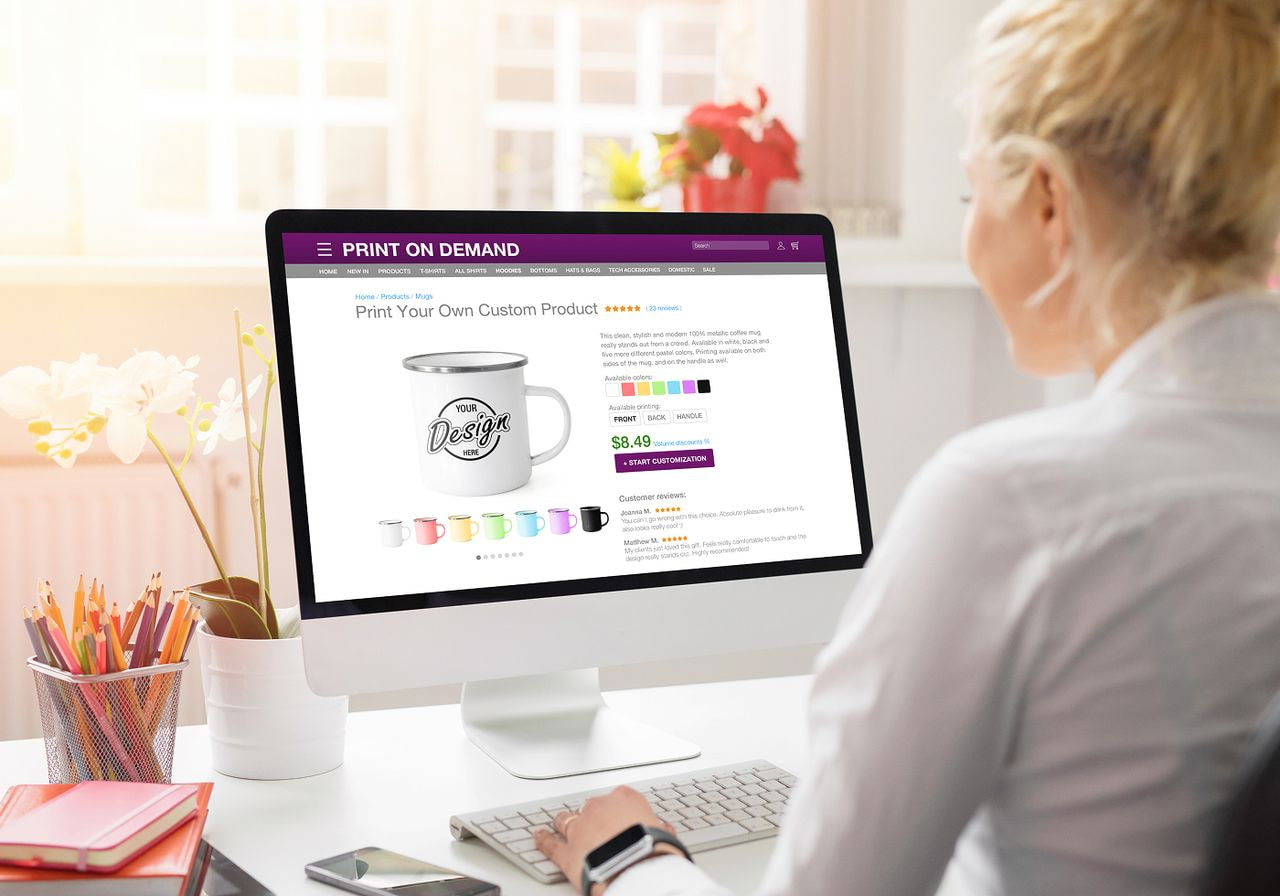
Choosing the right POD partner is one of the most important decisions you’ll make. Two popular options for sellers in Canada are Printful and Amazon Merch on Demand. They both work well but are built for different types of sellers.
Printful
Printful is a complete print-on-demand Canada solution that integrates seamlessly with your Amazon.ca account. Once connected, Printful takes care of the rest – printing, packing, and shipping every order automatically.
The biggest advantage for Canadian sellers? A Canadian fulfilment centre. Your orders are produced right here in Canada, leading to faster, duty-free shipping for your customers coast to coast. No surprise customs fees.
Best for: Sellers who want total creative control, premium branding options, and a huge product catalogue with local fulfilment.
Pros:
-
Canadian fulfilment. Faster shipping and no cross-border duties for your Canadian customers.
-
Superior product quality. Printful uses industry-leading equipment and materials with a catalogue of 589 premium products.
-
Free and easy-to-use tools. The built-in Design Maker lets you create stunning designs in minutes, no experience needed.
-
Your brand, your packaging. Printful ships everything under your brand name, with options for custom labels, personalised pack-ins, and other branding extras.
Cons:
-
Higher per-item cost. POD products cost more to produce than bulk-ordered stock, which can squeeze your margins – something to factor into your pricing from the start.
-
Production time. Each item is printed on demand, which adds two to five business days before the order ships.
Read more: How to sell on Amazon with Printful’s integration
Amazon Merch on Demand
Amazon Merch on Demand is Amazon’s built-in POD program. It’s fully hands-off – Amazon manages production, shipping, and customer service. You just upload your designs and collect royalties.
Best for: Sellers who want the most automated experience possible and aren’t focused on building their own brand.
Pros:
-
Fully managed by Amazon. Fulfilment, shipping, returns, and support are all handled for you.
-
Prime eligibility. Products can qualify for Amazon Prime shipping – a big draw for Canadian customers.
-
Simple setup. No need for a third-party service; start directly from your Amazon account.
Cons:
-
Zero branding control. Everything ships in Amazon packaging, so building a recognisable brand experience is nearly impossible.
-
Strict tier system. New sellers are capped at just 10 designs and must make sales before uploading more.
-
Limited product selection. The product catalogue is much smaller compared to a dedicated partner like Printful.
3. Create and list your products

Accounts sorted? Here’s where it gets good: bringing your ideas to life and listing them for sale.
Step 1. Design your products
Your designs capture a shopper’s attention – sellers who do well don’t just make pretty things, they design for a specific person with a specific identity. A Montréal coffee shop regular. A trail runner in Squamish. A proud Newfoundlander. The tighter your focus, the easier it is to write a listing title, choose the right keywords, and build a following.
The great news is you don’t need to be a professional graphic designer. Design your own products using Printful’s free Design Maker. It’s packed with free graphics, fonts, clipart, and a built-in mockup generator to help you create professional-looking items.
A few tips for creating great designs:
-
Quality first – resolution matters. Use high-res files to keep your prints crisp and professional.
-
Keep the text readable. Pick fonts that are easy to read, even on smaller products.
-
Stay consistent. Stick to a cohesive colour palette to create a put-together brand look across all products.
Good mockups do a lot of the selling for you – they help customers picture the product and make your store feel worth trusting.
Step 2. Choose what products to sell
Start with what your target audience already wants. Here are some of the top-selling gems Canadian shoppers are hunting for – and the niches where they tend to do well.
Custom shirts
A reliable classic. Custom shirts have consistent, year-round demand and work as a canvas for almost anything – witty takes on Canadian winters, artistic designs inspired by the Rockies, local inside jokes. They’re also affordable to produce, which keeps margins healthy.
Designs that convert in Canada: regional pride, outdoor and nature themes, francophone culture for the Québec market, and niche communities(curling, ice fishing, or backcountry skiing).
Custom hoodies
A wardrobe staple for most Canadians. Custom hoodies are perfect for everything from a cool autumn evening to a cozy night in. Because they’re a higher-value item, customers are willing to pay more, giving you greater profit potential.
Designs that convert in Canada: university and college gear, local sports leagues, outdoor communities, or merch for creators and musicians with an established following.
Baby and kids’ clothing
The demand for custom clothing for little ones is constant. Parents, grandparents, and friends are always looking for cute and unique gifts for baby showers, birthdays, and holidays like Canada Day. And since kids grow fast, repeat customers come naturally.
Designs that convert in Canada: province pride, bilingual English/French designs, and Canadian wildlife.
Phone cases
Lightweight, high-demand, and practically design themselves. Canadians are always looking for ways to protect and personalise their devices, making phone cases a solid impulse and repeat buy.
Designs that convert in Canada: city skylines (Toronto, Vancouver, Montréal all have loyal buyers), nature and landscape themes for the outdoors crowd, and dry Canadian humour. If a shirt design is already working for a niche, a matching phone case is a low-effort way to expand your catalogue.
Personalised notebooks
A solid gift for students, writers, and planners. Custom notebooks move well around back-to-school (August-September in Canada), the holidays, and as teacher gifts in June.
Designs that convert in Canada: profession- or hobby-specific designs – nurses, architects, birders, bullet journalers.
Mugs
Mugs sell on sentiment as much as design. The reliable occasions – Father’s Day, Mother’s Day, the winter holidays – are well-worn but still convert.
Designs that convert in Canada: niche-specific designs for the nurse who needs a dark-humour pick-me-up, the remote worker who lives by their morning coffee. A mug that makes someone think “that’s exactly me” is the one that gets bought, photographed, and shared.
Not sure where to start? Check out Amazon.ca Best Sellers and New Releases in your target category. Note what’s selling, what the gaps are, and what design angle nobody’s tried yet. That’s your opening.
Once you’ve picked your products, publishing through Printful is straightforward – your designs, product details, and mockups sync directly to your Amazon account.
Read more: 22 Best-selling items on Amazon


Step 3. Write your product listings
A strong listing is your best salesperson. Here’s what every Amazon.ca listing needs:
-
Stock Keeping Unit (SKU). Your unique code for each product variant. Create a simple system (e.g., HOCKEY-TEE-RED-L) so inventory stays easy to track.
-
Product title. Lead with the main keyword, then layer in specifics: product type, design, material, occasion (e.g., “Men’s Canadian Maple Leaf T-Shirt – Soft Cotton, Canada Day Gift”). Think about what someone would actually type into the Amazon search bar.
-
Product description. What is it and why would someone love it? Use bullet points to highlight specific parts of the product. Lead with the benefit, not the feature: “Stays soft wash after wash” lands better than “100% cotton.” Include “Printed in Canada” – for Canadian buyers, that’s a trust signal.
-
Product photos. High-quality mockups or lifestyle shots that show the design clearly.
-
Search terms. Add keywords that Canadian shoppers would use to find your product. Use the Search Terms field (under the Keywords tab in Seller Central) for variations Canadians search – regional terms, spelling differences, occasion-based phrases like “Canada Day gift for him.”
-
Product ID. If your POD partner doesn’t provide a Universal Product Code (UPC), apply for a Global Trade Item Number (GTIN) exemption from Amazon.
On pricing: add up the base product cost, shipping fees, and Amazon’s referral fee (typically 8-15%) – that’s your floor. Next, add your profit and some room for future discounts.
You’ll also need to register for and remit GST/HST (and PST where applicable) with the Canada Revenue Agency (CRA), so factor that in from day one.
4. Manage and grow your business

Launching your store is just the beginning. Building a successful print-on-demand business on Amazon requires ongoing effort. The sellers who achieve something sustainable treat the first few months as a testing phase – running small experiments and doubling down on what works.
Market your store
Your products are live – now you need to get them in front of Canadian shoppers. Amazon gives you a built-in audience, but you still need to stand out.
Share your listings on Instagram, TikTok, and Pinterest. Match the platform to the niche: trail running gear lives on Instagram, funny mugs belong on TikTok, teacher gifts do well on Pinterest. If you have a blog or website, link back to your Amazon store.
Run promotions around key Canadian shopping moments – Canada Day in July, back-to-school in August, and Boxing Day in December are the highest-intent windows outside the main holiday season.
Amazon’s Sponsored Products ads are worth using from the start. Even a small daily budget (C$5-C$10) tells you quickly which listings get clicks and which need work – think of early ad spend as paying for data, not just visibility.
Optimise your listings
Your listings aren’t set-and-forget. Regular updates are a free and effective way to improve visibility.
-
Refresh titles and descriptions. Are you using keywords that Canadians are searching for?
-
Test your images. Try new mockups or lifestyle photos to see what converts best.
-
Add new variations. More colours or sizes mean casting a wider net.
-
Watch your competition. See what other successful sellers in your niche are doing and learn from them.
-
Track your conversion rate, not just traffic. Low clicks = keyword problem. Lots of clicks but no sales = copy or image problem. Knowing the difference tells you exactly where to focus.
Stay updated
eCommerce moves fast. Check your Amazon Seller Central dashboard regularly for policy updates. Keep an eye on market trends in Canada – what designs are popular right now? What are people excited about?
Printful constantly adds new products and features to help you sell better. Keeping your store fresh with new designs gives customers a reason to come back.
Final words
Selling print-on-demand products on Amazon.ca is one of the lowest-risk ways to launch an online business in Canada. No inventory, no shipping headaches – Printful handles it all.
Printful’s local Canadian fulfilment means fast, duty-free shipping – which leads to stellar customer experience (and reviews!). Test your ideas, build your brand, and scale on one of the world’s largest marketplaces.
Sign up to Printful for free and start your Amazon Canada journey today!
Frequently asked questions
Yes, it can be. With Print on Demand, you have no upfront inventory costs, so the financial risk is very low. Your profit depends on your product pricing, design quality, and marketing efforts. Selling in C$ and shipping locally with Printful means competitive prices and faster delivery – both of which help build a loyal customer base.
First, create an Amazon Professional seller account on Amazon.ca. Once approved, connect a print-on-demand service like Printful through our official Amazon integration. From there, use our free tools to design your products, publish the listings to your store, and start marketing.
Yes. Print on Demand is a fully permitted business model on Amazon, as long as you follow their listing policies and avoid copyrighted or trademarked material in your designs. Use a third-party fulfilment service like Printful or Amazon’s own Merch on Demand program – both are fully supported.
Amazon charges a referral fee on each sale, – typically 8%-15%, depending on the product category. For a C$100 sale, this would be roughly C$8-C$15. Factor in the product’s base cost and shipping fees from your POD supplier.

Printful is an on-demand printing and fulfillment service that helps businesses create and ship custom products.

