


Table of contents
The history of the t-shirt is, in many ways, a story of how people choose to present themselves to the world. What started as military-issue underwear in the late 19th century became, decade by decade, a canvas for rebellion, identity, and culture.
Here's how it happened.
Key takeaways
-
The t-shirt originated as official US Navy underwear in 1913 and became a staple of soldiers' uniforms during World War II before civilians adopted it.
-
Marlon Brando and James Dean turned it into a fashion staple and symbol of youthful rebellion in the 1950s.
-
Screen printing in the 1960s created the graphic tee, and with it, the t-shirt's role as a medium for self-expression.
-
The introduction of print-on-demand t-shirts in the 2010s meant anyone could produce their own custom t-shirt without a minimum order or printing contract.
-
The industry is expected to reach $221.5 billion by 2032, driven by personalization, the growing desire for sustainable t-shirt production, organic cotton, and Print on Demand.
The birth of the modern t-shirt
The t-shirt’s origins date back to the late 19th century. In the beginning, t-shirts served a single purpose: skin protection beneath a uniform.
The first manufactured t-shirts emerged during the Spanish-American War. The 1913 US naval uniform regulations officially introduced a white buttonless crew-neck undershirt with short sleeves that could be worn on its own at sea.
The Navy's criteria were practical. The garment needed to:
-
Dry faster than flannel.
-
Breathe in tropical heat.
-
Stay clean enough to inspect.
Cotton t-shirts met all three. Sailors working in submarines or hot-climate postings began removing their uniform jackets and wearing the undershirt alone – the earliest documented case of a t-shirt crossing from undergarment to outer garments.
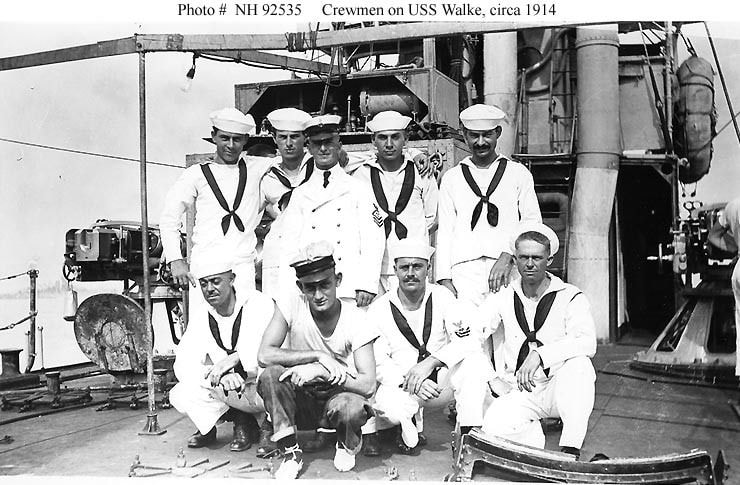
Crewmen of the USS Walke, 1914. Source: Victoria and Albert Museum. Originally from the Naval History and Heritage Command.
Earning its place in the wardrobes of the 20th century
The t-shirt underwent its biggest transformation in the 20th century, changing from a simple garment buried beneath uniforms to a fashion staple recognized in every corner of world culture. The evolution of t-shirt fashion across these decades tracks almost perfectly with broader social upheavals: war, rebellion, commercialization, and identity politics.
1920–1940: From the sailor shirt to military heroism
The word "t-shirt" entered the English language officially in 1920, when F. Scott Fitzgerald became the first person to use it in print. In his novel This Side of Paradise, Fitzgerald listed a student's wardrobe as including "one sweater or t-shirt, one jersey, one overcoat."
That single line gave the garment its name in the Merriam-Webster dictionary and marked the beginning of the t-shirt's cultural journey beyond military dress.
Through the 1930s, t-shirts spread beyond the navy into civilian labor. The garment moved steadily from military issue to workwear staple, adopted by miners, farm workers, and stevedores for whom it offered breathability, low cost, and easy washing.
By the Great Depression, the t-shirt was the default garment for farm and ranch chores and for any situation where lightweight fabric and modesty were required.
In 1938, department store giant Sears began selling white cotton t-shirts for 24 cents, advertising them for the first time in retail history as both an undershirt and an outershirt. The 1938 Sears catalog lists the garment as a "Gob style all-purpose shirt" – gob being slang for sailor – keeping the naval association intact while explicitly marketing it as legitimate outerwear.
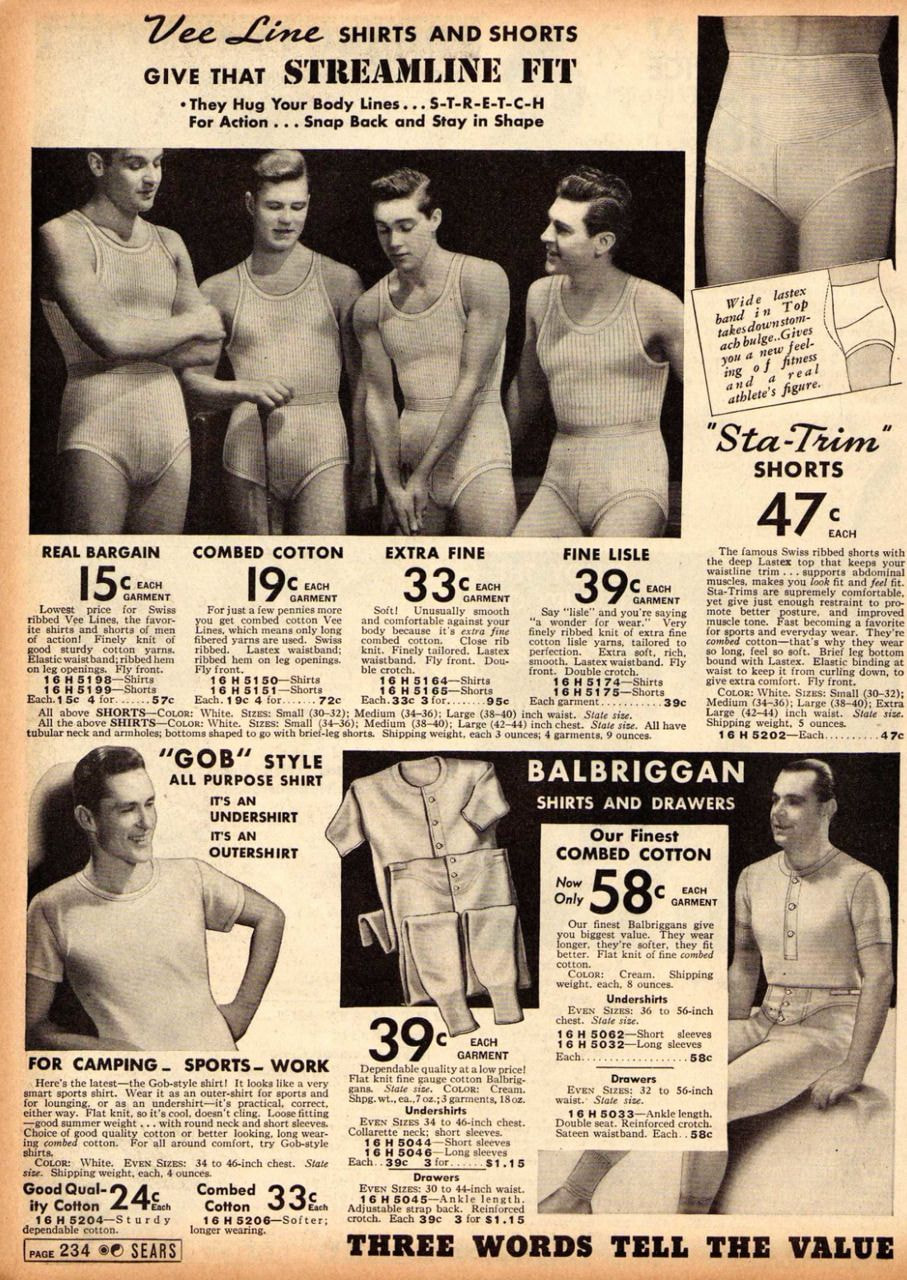
Sears 1938 catalog
Meanwhile, the t-shirt made its first appearance as outerwear on screen in The Wizard of Oz (1939), where Oz workers wore bright green t-shirts screen-printed with the word "OZ" for less than ten seconds of screen time. It would take another four decades for color and print to go mainstream.

1939’s The Wizard of Oz. Source: The Nerdist
In 1941, Sears pivoted its marketing toward wartime sentiment with the slogan "You don't need to be a soldier to have your own personal t-shirt." By then, magazine covers showing US Army soldiers in their standard undershirts drove t-shirt sales sharply upward, associating wearing a t-shirt with heroic masculinity rather than mere utility.
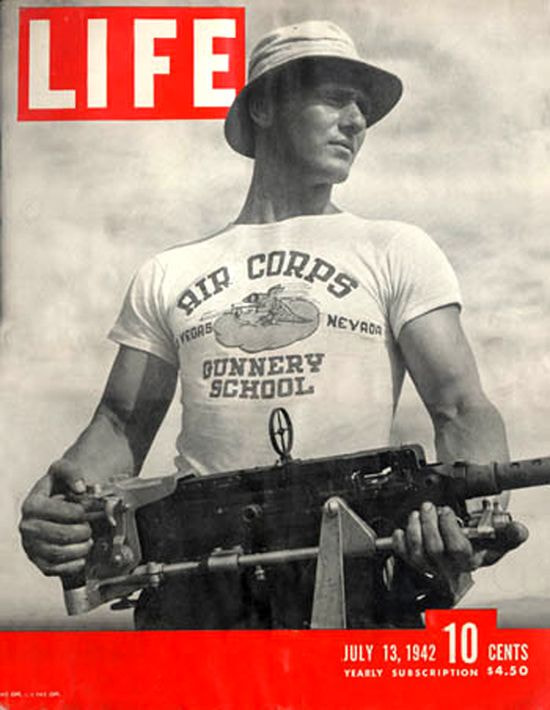
Source: Victoria Albert Museum
The 1950s: The t-shirt as a symbol of youthful rebellion, as seen on TV
In the 1950s, the humble t-shirt shed its identity as a standard undershirt and became a symbol of something new: youthful rebellion.
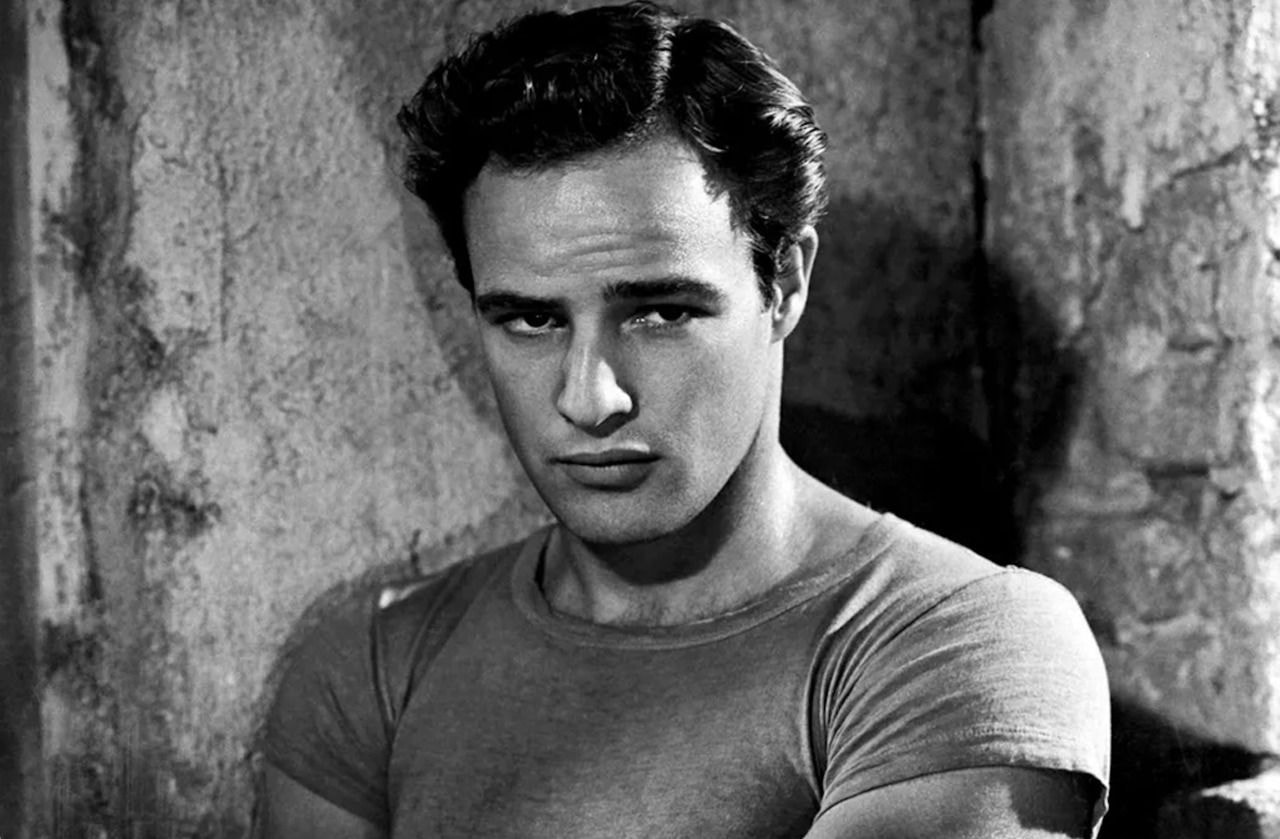
The catalyst was Hollywood. In 1951, Marlon Brando appeared in A Streetcar Named Desire wearing a plain white t-shirt, projecting raw physical intensity in a way that tailored shirts never could.
Source: Heddels
Four years later, James Dean wore one in Rebel Without a Cause (1955), and the image was permanently locked into cultural memory. Both roles coded the white t-shirt as the unofficial uniform of working-class defiance, pushing back against the polished, buttoned-up fashions of earlier decades.
P.H. Hanes Knitting Company and Fruit of the Loom ramped up production to meet demand, distributing cotton t-shirts to a mainstream market that had never before considered wearing a t-shirt as an intentional style choice. The modern t-shirt's identity as a cornerstone of casual wear was firmly established in this decade.
1960–1970: The rise of the graphic tee
If the 1950s made the t-shirt respectable as casual clothing, the 1960s made it a medium. The rise of the graphic tee was the direct result of one major technological development: the introduction of multicolor screen-printing machines in the early 1960s.
Did you know?
Screen printing on fabric dates back to the Song Dynasty (960–1279 CE), when Chinese artisans stretched silk over frames and pushed ink through cut stencils to decorate fabric with crisp, repeatable designs.
Multi-color garment screen printing machines in the early 1960s made it economically viable to reproduce complex graphic designs on t-shirts in large quantities.
The cost per unit dropped sharply, the range of print designs expanded, and the t-shirt became accessible to anyone who wanted to put a message on their chest.
In 1959, plastisol ink was invented – a more durable, vibrant formula that bonded to fabric under heat. By the early 1960s, t-shirt printing entered a new era of quality and color.
Students, activists, and creatives adopted graphic tees over the decade.
In cinema, the graphic tee stepped into the spotlight when Jean Seberg wore a "New York Herald Tribune" printed t-shirt in the 1960 French New Wave film Breathless – a sartorial cult classic that remains one of the earliest examples of a graphic t-shirt as a deliberate fashion statement rather than a protest tool.
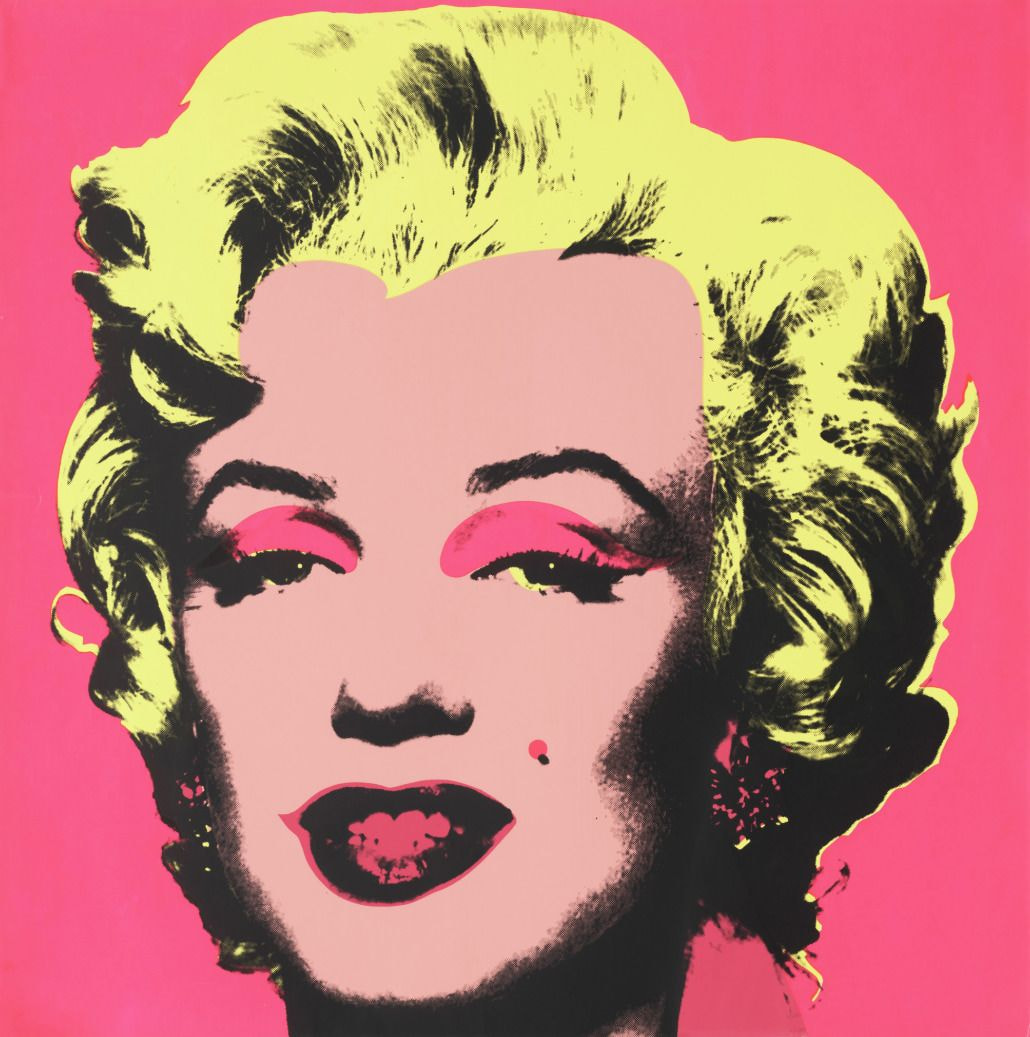
Andy Warhol brought the technique into high art through silkscreen, producing iconic repeated portraits, like his Marilyn Monroe series at MoMA, and adapted his Campbell's Soup Can imagery onto t-shirts around 1962, marking the moment the t-shirt entered the fashion world's conversation about wearable art.
Andy Warhol’s Marilyn Monroe. Source: MoMa
Meanwhile, British artists were pushing screen printing further, using fluorescent and metallic inks in hand-screen-printed psychedelic posters, some pouring rainbow blends directly onto the screens.
Band t-shirts arrived in the same decade and immediately rewired the t-shirt industry. Before 1964 was even underway, the Wall Street Journal forecast that American teenagers would spend $50M on Beatles merchandise that year.
This later proved to be a massive underestimate. The Reliant Shirt Corporation paid $100,000 for a license and sold over a million Beatles t-shirts in three days. When the band's chaotic merchandising deal collapsed into litigation, canceled orders alone were valued at $78M.
The Rolling Stones' tongue logo and Pink Floyd's prism design followed as the next must-have garment in this niche, cementing band t-shirts as a loyalty badge.
In 1969, Harvard students protesting against the Vietnam War wore t-shirts screen-printed with red fists and the word "strike.” These garments are now held in the Harvard University Archives.
Pop stars, rock legends, and political movements all recognized that t-shirts spoke to the average person in a way no other garment could.
The invention of affordable synthetic dyes during the 1960s made tie-dye accessible to anyone with a t-shirt and a bucket, turning self-expression into a DIY practice that no manufacturer could replicate or control.
1980–2000: The t-shirt becomes a wardrobe staple
Every corner of pop culture in the 1980s, from hip-hop and grunge to high fashion and corporate branding, claimed the t-shirt as its own. On the West Coast, groups like N.W.A built a visual identity around oversized silhouettes and a harder aesthetic distinct from New York's hip-hop style. This became the blueprint for a global streetwear movement.
Pop stars from the Backstreet Boys to Britney Spears performed in t-shirts, cementing casual wear as the dominant language of youth culture.
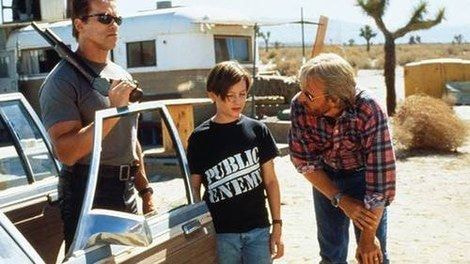
In the early 1990s, grunge bands like Nirvana and Pearl Jam made the distressed, oversized band t-shirt a deliberate rejection of 1980s tailored fashion, and the Public Enemy crosshair logo t-shirt appearing in Terminator 2 (1991) confirmed that band and rap tees had crossed into mainstream cinema.
Source: Highsnobiety
Kate Moss, the defining figure of the 1990s supermodel era, returned again and again to the same pairing: a white t-shirt, blue jeans, designer accessories.
Fashion designer Katharine Hamnett had already shown the way in the early 1980s. Her oversized slogan t-shirts confronted issues from nuclear disarmament to social justice, turning the humble tee into a high-fashion political statement years before celebrity slogan culture went mainstream.
Brands recognized the same potential. Nike's swoosh, the Apple logo, and Calvin Klein's wordmark moved off billboards and onto millions of chests, transforming wearing t-shirts into a form of brand allegiance that advertising alone could not engineer.
The t-shirt as a canvas for self-expression
In the 21st century, the t-shirt shifted from a shared cultural symbol into a vehicle for individual identity. Two trends defined this era: the slogan t-shirt and the rise of custom t-shirt popularity, both made accessible through digital printing and POD.
2000–2010: Time for the slogan tee
The slogan t-shirt had existed since the protest era of the 1960s, but the 2000s gave it a different, shallower engine: celebrity culture. Paris Hilton, Britney Spears, and their contemporaries turned the printed t-shirt into a tabloid fixture, with each slogan photographed, reported on, and immediately replicated on the high street.
The garment's role went from self-expression to self-promotion. What you wore on your chest was a punchline, a provocation, or a personal brand.
However, in 2006, fashion designer Henry Holland catapulted the concept into the industry itself. His "fashion groupie" t-shirts featuring rhyming couplets that name-checked figures like Gareth Pugh and Giles Deacon debuted at London Fashion Week and were instantly picked up by the fashion press.
What separated Holland's approach from celebrity slogan culture was the target. The joke was on the fashion world, not the public, which made it something designers and editors took seriously rather than dismissed.
2010–2020: The custom t-shirt’s rising popularity
The 2010s changed who could make a t-shirt. For most of the garment's history, producing a printed t-shirt meant either a bulk screen printing order or access to industrial equipment. Digital printing and the introduction of Print on Demand removed both roadblocks.
Platforms like Printful, Printify, Redbubble, and Merch by Amazon arrived on the scene and made it easy for an independent artist, a community organizer, or a small brand to go from design to finished t-shirt without a warehouse, a print contract, or upfront stock.
The cultural effect was quick as custom t-shirts became the default medium for niche communities, activist campaigns, and internet subcultures that would never have had access to branded apparel before. Memes, fan art, and social movements all found the t-shirt a natural fit.
Did you know?
The custom t-shirt market grew to $6.46B by 2024 and is projected to reach $9.82B by 2030.
What's next for the t-shirt?
A garment that began as naval-issue underwear in 1913 now drives a $185.2B global market. That shift from utility to cultural symbol to global commodity took just over a century, which is fast by any measure of fashion history.
There are two main aspects that define the t-shirt industry in the mid-2020s.
The first is sustainability. What was once a niche selling point has become a must-have for many shoppers. 61% of global consumers actively try to have a positive environmental impact through their purchasing choices. Brands that promote organic cotton, recycled materials, and transparent supply chains win these customers’ loyalty.
The second is production access. DTG and direct-to-film (DTF) printing now make small batches of custom t-shirts as cost-effective as bulk screen-printed orders were a decade ago. An independent designer today can start a t-shirt business with a single design, something that would have required a warehouse and a wholesale contract as recently as 2010.
The t-shirt has survived every decade it has passed through by becoming whatever that era needed it to be – underwear, workwear, protest banner, band merch, luxury staple, or an activist canvas. There is no reason to think the next decade will be any different. The story that started on a navy vessel in 1913 is still being written one custom t-shirt at a time.
Frequently asked questions
The t-shirt got its name from its T shape. Lay one flat, and it forms a capital T, with a short-sleeved body with two sleeves extending horizontally from a straight torso.
The first manufactured t-shirt dates to between the Spanish-American War of 1898 and 1913, when the US Navy adopted a white cotton crew-neck design as standard undershirt issue for sailors.
The garment existed as a practical undergarment long before it became everyday wear. The word "t-shirt" entered the Merriam-Webster dictionary in 1920, following F. Scott Fitzgerald's first published use of the term in This Side of Paradise.
As for who invented the t-shirt, there’s no specific person cited as the ultimate creator. Every record of military t-shirt history indicates it was more of a natural evolution and group effort rather than the idea of a single person.
Marlon Brando and James Dean are most directly credited with popularizing wearing a t-shirt as a standalone outer garment. Brando's appearance in A Streetcar Named Desire (1951) and Dean's in Rebel Without a Cause (1955) presented the white t-shirt as a symbol of youthful rebellion rather than underwear.
Mass manufacturers Hanes and Fruit of the Loom scaled production to meet the surge in consumer demand that followed.
T-shirts can be made from a variety of materials, both natural and synthetic. The most common are cotton, polyester, and blends of the two, but some higher-end shirts even contain linen, bamboo, or silk.
The introduction of multi-color garment screen printing machines in the early 1960s made it financially possible to reproduce complex graphic designs on t-shirts in large quantities. The development of plastisol ink in 1959 added durability and color vibrancy.
This t-shirt printing breakthrough coincided with an era of political activism and music culture that needed a blank canvas for their messages, and the graphic tee filled that role immediately, from anti-war protest shirts to band t-shirts for The Beatles and The Rolling Stones.
The t-shirt's evolution into a tool for self-expression happened gradually over several decades. Protest movements in the 1960s used screen-printed graphic tees to communicate political positions.
Tie-dye in the same era made customization accessible to everyone. The slogan t-shirt trend of the 2000s, amplified by celebrity visibility, made text-based messaging mainstream. Finally, POD technology in the 2010s let everyone produce their own personal t-shirt design without minimum orders or printing equipment.
Three trends define the t-shirt industry in 2025:
-
Personalization: Customers want t-shirts that are made just for them – not generic, mass-produced apparel.
-
Sustainability: Buyers increasingly seek organic cotton and recycled-material t-shirts, and brands with transparent, carbon-neutral supply chains hold a competitive advantage.
-
AI-assisted design: Tools that generate and adjust t-shirt designs automatically are making it faster and easier for t-shirt businesses to get new styles published and ready for sale.

Published author, scholar, and musician, Andris draws on over 11 years of experience in and outside academia to make complex topics accessible – from SEO and website building to AI and monetizing art. Devoted to his family and self-confessed introvert, he loves creating things, playing musical instruments, and walking around forests.

