


Table of contents
Pricing embroidered products isn’t one-size-fits-all. Some sellers charge per stitch, others use flat-rate pricing. Then there are material costs, digitizing fees, packaging, and profit margins to consider to run a profitable embroidery business.
If you’re feeling overwhelmed, you’re not alone. This guide on how to price embroidered products walks you through every step – whether you're just starting out or refining your current strategy.
How to price embroidery products
1. Calculate your base costs

If you want to run a successful embroidery business, make sure to calculate every dollar needed to cover costs and profit.
With Printful’s print-on-demand model, the total cost of embroidery production is already built into the base price – no need to calculate these expenses yourself.
Still, understanding what goes into these numbers can give you more confidence when you price your embroidery products.
So, how much does embroidery cost? Let’s break it down:
Material costs
Every best-selling embroidered product requires several raw materials: the blank item itself, stabilizers, backing, and thread. These elements make up the base item cost, although other factors, such as product type and thread color, can impact the final price. More on that later.
Embroidery machine costs
Factor in ongoing costs to use your embroidery equipment, like machine maintenance, thread changes, electricity, and repairs. If you stitch by hand, then account for the tools required to complete each design.
Quick read: What is embroidery? Welcome to our thread talk
Embroidery time and labor
One embroidery job involves more than hooping and stitching – it includes setup, monitoring, finishing, and quality checks. Plus, more detail usually means more time and labor.
File digitization fees
If you work with third-party embroidery services, they often charge a fee to convert your design into a stitch-ready file – a process called digitization.
Printful charges a one-time digitization fee for each new design. Once digitized, sellers can reuse it as many times as needed without paying again.
Other overhead costs
Besides production, make sure to account for everyday business expenses that impact your total cost, like:
-
Platform fees, like monthly subscriptions for Shopify or listing fees on Etsy.
-
Taxes and payment processing fees.
-
Shipping costs if you offer free delivery.
-
Marketing costs to attract customers.
-
Custom packaging.
2. Choose your embroidery pricing model
With the base cost calculated, let’s decide how much to charge for embroidery products in your store. Your pricing method should cover total expenses, reflect your item’s value, and be simple enough for customers to understand.
Here are common pricing options in the embroidery industry:
Per-stitch pricing
You charge based on how many stitches are in the design – typically per thousand stitches. This is common in custom embroidery services, where the stitch count increases in proportion to the design complexity.
-
Pro: Accurate way to price custom embroidery designs with high stitch count.
-
Con: Harder to estimate, and customers may not understand why one small-looking design has a higher price than another just because there are more stitches.
The industry average for the stitch count method is $1-$3 per thousand stitches.
Flat rate (cost-per-product or per-design)
Also known as fixed-unit pricing, this method involves charging a consistent price – either for the full product or for each embroidery placement – regardless of the thread count, design complexity, or the time required for the embroidery work.
-
Pro: Easy to understand for customers, and you don’t need to calculate the number of stitches for each design.
-
Con: You might undercharge for more detailed designs with a high stitch count.
If you use Printful, this is the model you’ll follow. Each product has a base price that includes one embroidered placement. You only need to calculate your profit margin to cover your business expenses and stay competitive.
Hourly pricing (labor-based)
You charge an hourly rate based on the time it takes to complete the embroidery work.
-
Pro: Helps you get paid fairly for time-consuming jobs.
-
Con: Hard to estimate the total cost upfront, which can confuse customers.
Tiered or hybrid pricing
This method adjusts the cost per item based on order quantity and stitch count. The more complex the design and the higher the number of units ordered, the more affordable the rate per product.
For example, if a design requires up to 5,000 stitches and the order is for 1-5 items, you might charge $18 each. But for 6-20 items with a 5,000-15,000 stitch count, the price could drop to $15 per item, since the order size offsets the added complexity.
-
Pro: Encourages bulk orders and balances complexity with attractive pricing options.
-
Con: Each tier needs to cover costs and maintain your profit margin.
3. Adjust for complexity and order type

Even with a pricing model in place, multiple factors can affect your final embroidery rates. Certain products, placements, and requests take more time and materials – your pricing strategy should reflect that.
Product type
Every blank item has a different price. A custom hat will cost less than a jacket, which may require stronger backing and longer stitch times.
Placement
Extra embroidery placements, such as the back or sleeve, increase stitch count and machine time.
On Printful, each embroidered product includes one standard placement in the base price, and additional ones cost $2.95 each.
Design complexity
The number of stitches, color changes, specialty threads, or advanced techniques will impact the final cost of embroidery.
For example, some Printful products offer two embroidery options. The first is standard, which is included in the base product price.
The other is unlimited color embroidery, which uses a special technique to create highly detailed designs with gradients. It comes at an extra cost of $3.95.
Order size
Consider differentiating the prices between one-off and bulk orders to balance your overhead expenses and attract more customers.
To help you reduce costs, Printful waives digitization fees for bulk orders of 25 or more of the same embroidered product.
Personalization
Allowing personalization – like letting customers add names or initials – requires extra setup and possibly re-digitization, which justifies a higher price.
Quick read: Personalized gift ideas to woo your loved ones
Rush orders
Faster turnaround often means working overtime and reprioritizing tasks – another reason to charge higher embroidery prices.
4. Add your profit margin
The next step is setting a selling price that supports your business growth and attracts potential customers. If the price is too high, people may walk away. Too low, and you might not cover your costs.
Many embroidery shops aim for a 30-60% profit margin, though your ideal range depends on your niche, order size, and how much customers value your work.
For flat rate pricing, it's easy to apply a consistent markup. For example, if the base material costs a total of $20 and the margin is 50%, you’d sell it for $30.
With Printful, this process is even simpler. Just edit the retail price inside your dashboard, and Printful will automatically display your expected profit per sale.
But if you run your own embroidery service and use more complex models like stitch count pricing, you need to review each project to determine cost and margin.
In that case, offering price quotes for custom jobs can help you stay flexible while ensuring each order remains profitable.
5. Check competitor and market prices
Beyond calculating your profit margin, it’s important to research what others are charging. This helps you understand how your products fit within the embroidery industry and provides a benchmark for setting competitive prices.
Browse platforms like Etsy, Amazon, eBay, and embroidery business websites. Pay attention to:
-
Product type and quality.
-
Stitch complexity and thread count.
-
Shipping fees, delivery times, and packaging.
-
Price ranges and the frequency of discounts offered.
Many embroidery shops use budget pricing for simple items, while others charge more for premium designs. This is where your pricing strategy matters: will you compete on price or lead with value?
Quick read: Best-selling embroidery items on Etsy: What’s trending?
Additional tips to price your embroidery:
-
If possible, look at sold listings, not just active ones. This shows what customers are actually buying – not just what sellers hope to sell.
-
Factor in production times. If you’re faster than others, you might justify a higher price.
-
Study reviews. What do customers praise or complain about? Use that insight to justify your selling price.
-
Check for bundles. Some sellers group products to offer perceived value while increasing sales.
-
Analyze positioning. Brands with strong packaging, branding, or photography often command higher prices, even for similar embroidery work.
6. Run example calculations

To help you price with confidence, let’s walk through a few practical examples using different approaches.
In these examples, customers will pay for shipping and sales tax at checkout, so they don’t impact your profit margin.
Example 1: Small, simple logo on a polo shirt (flat rate pricing)
Let’s say you use Printful to sell a premium embroidered polo shirt through your online store.
-
Base product price: $20.35
-
Digitization fee: $6.50
-
Estimated online store fee: $1.00
-
Estimated payment processing fee: $1.59 if you use PayPal (2.89% × $45 = $1.30 + $0.29)
-
Total estimated cost: $29.44
-
Selling price: $45.00
-
Profit: $45.00 - $29.44 = $15.56
-
Profit margin: (15.56 ÷ 45) × 100 = 34.6%
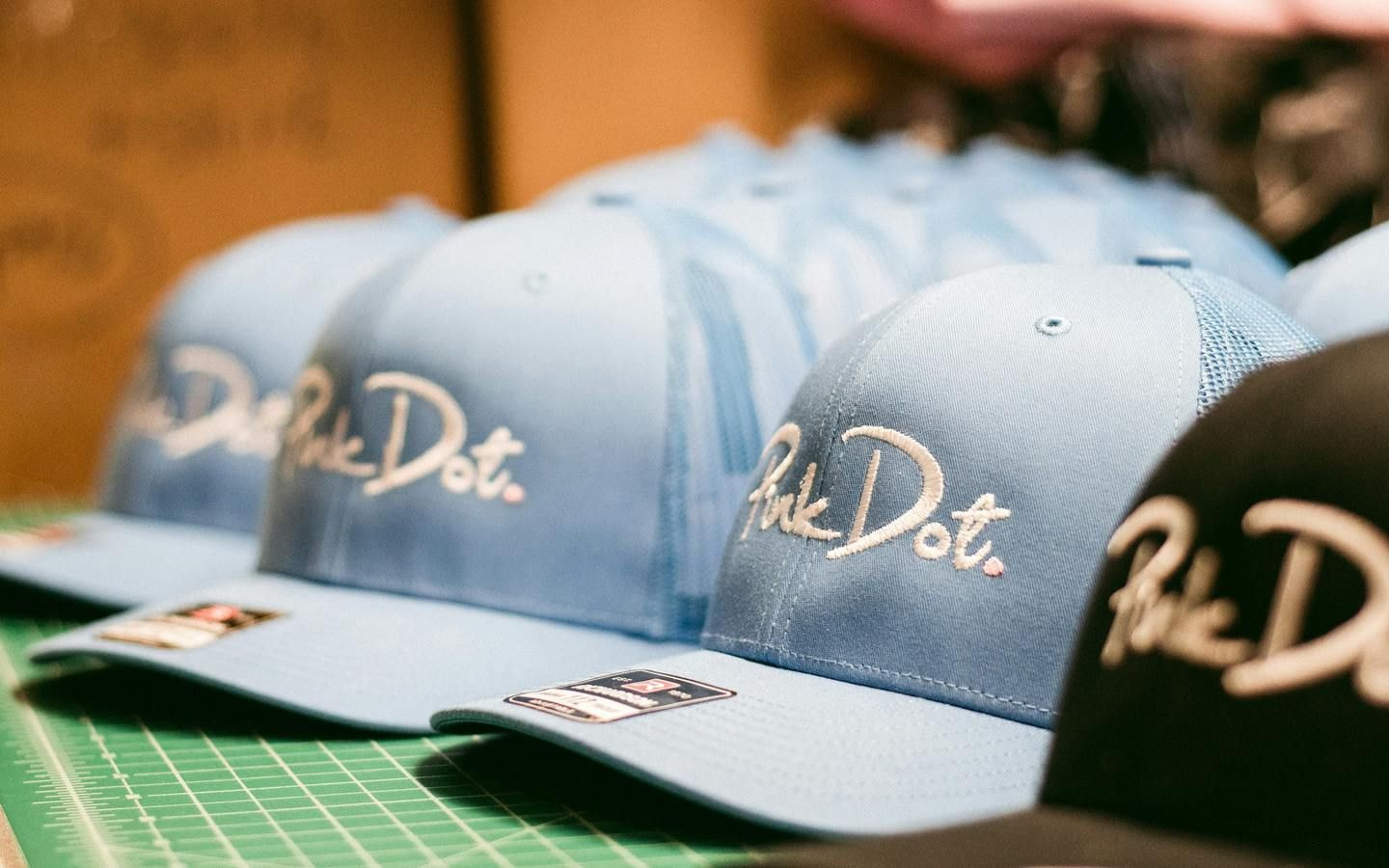
Example 2: Bulk order of 50 embroidered hats
A customer orders 50 distressed dad hats with embroidery using Printful. Because of the large quantity, Printful waives the digitization fee, and you receive a bulk discount on the product price.
-
Base product price per hat: $14.09 after the 6% bulk discount
-
Digitization fee: $0 (waived for over 25 items)
-
Estimated online store fee: $1.00
-
Estimated payment processing fee: $0.95 if you use PayPal (2.89% of $23 = $0.66 + $0.29 = $0.95)
-
Total estimated cost per hat: $16.04
-
Selling price per hat: $23.00
-
Profit per hat: $23.00 - $16.04 = $6.96
-
Total profit (50 hats): 50 × $6.96 = $348.00
-
Profit margin: (6.96 ÷ 23) × 100 = 30.3%
Quick read: Best custom hats for embroidery
Example 3: Custom logo on a hoodie (stitch count pricing)
You run your own embroidery business and receive a custom order for a detailed logo design embroidered on a midweight fleece hoodie. The design goes on the back and is relatively large, with 12,000 stitches.
-
Blank hoodie: $18.00
-
Number of stitches: 12,000
-
Stitch pricing: $1.50 per 1,000 stitches (12 × $1.50 = $18.00)
-
Digitizing fee: $15.00
-
Estimated online store fee: $1.00
-
Estimated payment processing fee: $3.03 if you use PayPal (2.89% of $95 = $2.74 + $0.29 = $3.03)
-
Total estimated cost: $55.03
-
Selling price: $95.00
-
Profit: $95 - $55.03 = $39.97
-
Profit margin: (39.97 ÷ 95) × 100 = 42.1%
Conclusion
Learning how to price embroidery starts with knowing your costs, picking the right pricing method, and adjusting for complexity, quantity, and profit margin. Whether you do it yourself or sell with a print-on-demand partner, a clear strategy helps you stay competitive and profitable.
Want an easier way to sell custom embroidery? Try Printful. We handle production, so you can focus on growing your brand and setting prices that work.
FAQ
To calculate embroidery expenses, add up all base costs, such as the blank product, digitizing fee, and business overhead expenses. Then apply a profit margin – typically 30-50%. At Printful, most production costs are already included, so you mainly need to set your retail price.
Top-selling embroidered items include t-shirts, sweatshirts, hoodies, tote bags, towels, and custom hats. These products are practical, wearable, and giftable, which boosts their appeal.
Read next:



Maisha is a content writer with 6+ years of experience in turning complex topics into clear, search-optimized content. She believes readability always wins, no matter how SEO trends shift. Outside of writing, she’s usually trying new recipes (but never following them), watching niche YouTube videos, or planning food-fueled adventures.

