



Table of contents
The platform is huge and full of opportunities – you get a storefront that embodies your brand. But how much does it cost to sell on Shopify? Most new sellers spend around $50-$150 per month before product costs, advertising, and payment fees.
A growing store often spends $250-$500, while a scaling brand may spend $800-$1,500 and up. Your final budget depends on your Shopify plan, apps, theme, domain, transaction fees, and several costs sellers often miss. Let’s break them down.
How much does it cost to sell on Shopify in 2026?
The answer depends on how you want to sell online. A social-selling setup starts at $5 per month. A full Shopify online store starts at $29/mo with annual billing, and $39 when paid monthly.
Add apps, a domain, and payment processing fees to estimate the real cost.
The prices below reflect the current Shopify pricing plans for US sellers.
| Shopify expense | Typical cost | What to know |
|---|---|---|
| Monthly plans | $5-$399/mo | Shopify Starter costs $5. Full-store plans start at $29 per month with annual billing. |
| Apps | $0-$500 and more a month | The total depends on your app stack. |
| Transaction fees | 0%-2% on standard full-store plans | Shopify applies extra fees when you use a third-party payment provider. |
| Payment processing | From 2.5%-2.9% + $0.30 per standard online card sale | Rates depend on the plan. |
| Themes | $0-$400 and up as a one-time cost | Start with a free theme. Upgrade when the design limits create a measurable problem. |
| Domain | Around $11-$14 per year for a .com | The exact price depends on the extension and availability. |
These figures cover the core Shopify costs. They exclude products, shipping, advertising, taxes, and custom development. Shopify operates as an eCommerce platform, not a marketplace, so your budget also depends on how you build and promote the store.
Shopify plans explained

There are several Shopify pricing plans. The right Shopify plan covers your current needs without adding unnecessary subscription fees. Upgrade when the added features or lower credit card fees save more than the higher monthly fee.
Shopify Starter
Shopify Starter gives creators a simple online store, shareable product links, and Shopify checkout. Shopify designed the starter plan for selling through social media, email, SMS, and messaging apps.
The old Shopify Lite plan remains available only to existing users.
The Starter plan works best when you need a fast entry point rather than a custom storefront.
-
Price: $5/mo
-
Features: Product links, order management, analytics, mobile selling, and a 5% fee with Shopify Payments
-
Best for: Sellers testing demand without building a full website
Basic
The Shopify Basic plan gives new brands a full online store with unlimited products, web hosting, a free SSL certificate, and built-in commerce tools.
-
Price: $29/mo when billed yearly or $39/mo with monthly billing
-
Features: Standard online credit card rates from 2.9% + $0.30, ten inventory locations, analytics, and social selling
-
Best for: Most new small businesses building a branded eCommerce store across multiple sales channels
Grow
Grow adds staff accounts, lowers credit card fees, and offers stronger shipping discounts.
-
Price: $79/mo when billed yearly or $105/mo with monthly billing
-
Features: Five staff accounts, rates from 2.7% + $0.30, and up to 87% off shipping with supported services
-
Best for: Stores with regular online sales and a small team
Advanced
The Shopify Advanced plan adds more control for larger operations and international customers.
-
Price: $299/mo when billed yearly or $399/mo with monthly billing
-
Features: 15 staff accounts, standard online card rates from 2.5% + $0.30, live third-party shipping rates, and regional storefront customization
-
Best for: Scaling stores with international sales or more complex shipping needs
Shopify Plus starts at $2,300/mo on a three-year term or $2,500/mo on a one-year term. The Shopify Plus plan targets complex businesses that need B2B tools, unlimited staff accounts, deeper checkout customization, or multiple stores.
Most sellers won’t need Shopify Plus at launch. These advanced plans make sense only when the operational savings justify the larger monthly fee. For Shopify Plus, compare platform fees with development and app savings before signing a longer term.


Shopify transaction fees and payment processing

Your checkout creates two separate costs: payment processing fees and transaction fees. Every seller processing online transactions should understand the difference before choosing a payment method.
Shopify Payments vs third-party gateways
Shopify Payments lets eligible sellers accept payments directly through the platform. If you use a third-party payment provider, Shopify adds third-party transaction fees on top of the provider’s own processing fees.
| Payment setup | Shopify Payments | Third-party payment provider |
|---|---|---|
| Payment processing | Shopify charges the card rate for your plan | The provider charges its own processing fees |
| Extra Shopify transaction fees | None for eligible orders processed through Shopify Payments | 2% on Basic, 1% on Grow, or 0.6% on Advanced |
| Best fit | Most eligible stores that want to accept payments online | Stores that need a specific gateway or operate where Shopify Payments remains unavailable |
Sellers using Shopify Payments pay the credit card rate but do not pay an additional transaction fee for eligible online payments.
Stores using non-Shopify Payments gateways pay both Shopify’s third-party transaction fees and the gateway’s credit card fees.
Those higher transaction fees make third-party processors more expensive for many sellers. Review Shopify’s third-party transaction fee rules before choosing a gateway.
How processing fees change as you scale
Small rate differences matter as revenue grows.
-
The Basic Shopify plan charges 2.9% + $0.30 for standard online card payments
-
Grow drops the percentage to 2.7%, and the advanced Shopify plan drops it to 2.5%
At $25,000 in monthly card revenue, the 0.2% difference between Basic and Grow equals $50. That matches the difference between their annual-billing subscription fees.
Stores using a third-party payment provider reach the upgrade point faster because higher plans also reduce transaction fees.
Shopify costs that most sellers don’t account for

Your Shopify subscription sets the base cost. The advertised monthly fee gives you the starting point. The actual total cost often rises through apps, themes, a domain, email, taxes, and international selling.
Apps: The highest hidden cost
The Shopify App Store lists over 16,000 Shopify apps. A new Shopify store may need only free tools. A larger operation may add paid apps for reviews, email, subscriptions, returns, analytics, bundles, or loyalty programs.
Budget $0-$100 per month at launch and $100-$500 and up as your store grows. Add custom apps only when a clear operational need justifies the development cost. Review your Shopify apps every quarter and remove tools that no longer earn their place.
Planning to sell through a Shopify marketplace connection, too? Shopify Marketplace Connect lets you manage listings, orders, and inventory across Amazon, eBay, Walmart, and Target Plus from your Shopify admin.
The app is free to install. Your first 50 marketplace-synced orders each month are free, then Shopify charges 1% per additional synced order, capped at $99/mo.
Themes: A one-time cost often ignored
The Shopify Theme Store lists more than 800 free and paid themes. Current premium ones cost $350-$420.
Start with one of Shopify’s free themes – $0 doesn’t mean low quality. These themes give you a clean, mobile-friendly storefront with product pages, navigation, collection layouts, and basic customization options.
The limitations show up when you need more advanced filters, specialized product-page layouts, built-in upsells, or deeper visual control. Upgrade when a paid Shopify theme replaces apps, improves navigation, or solves a merchandising problem. The Shopify Theme Store offers enough options for most brands without custom design work.
Domain, email, and other smaller fees
A .com domain typically costs $11-$14 per year through Shopify. Shopify includes email forwarding for Shopify-managed domains, but it does not provide full email hosting. A branded inbox requires a third-party host.
The different Shopify fees vary by store setup. Shopify offers hosting and SSL inside the plan, but sellers still need to budget for:
-
Shopify Email or another email-marketing tool
-
Product photography
-
Returns
-
Development
-
Advertising
-
Tax services
-
Currency conversion
Shopify Tax also deserves attention. For stores created on or after May 13, 2026, Shopify Tax remains free until the store reaches $100,000 in lifetime sales.
After that, Shopify Tax charges 0.35% on taxed US orders and 0.25% on taxed orders from Canada, the UK, and the EU. Either way, the fee never exceeds $0.99 per order.
If you sell to international customers, review currency conversion and payout currency settings. Multi-currency payouts to non-domestic bank accounts may add fees.
If you use Managed Markets for international orders, Shopify also charges a 1.5% currency conversion fee, also called a foreign exchange (FX) fee. Managed Markets adds separate transaction and payment-processing fees, too.
Actual Shopify costs at different revenue levels
Your budget should match your sales stage. These ranges give small businesses a practical starting point, but exclude inventory, fulfillment, payment fees, shipping, taxes, and ads.
| Store stage | Typical setup | Monthly platform budget |
|---|---|---|
| New seller | Basic, free theme, domain, and three to five apps | $50-$150 |
| Growing store | Grow, a premium theme spread across its useful life, and 8-10 apps | $250-$500 |
| Scaling store | Advanced, larger app stack, and development support | $800-$1,500+ |
Match your plan to your revenue, not your gut. At $0-$5,000/mo, Basic covers the essentials. Once you’re clearing $5,000-$50,000/mo, Grow’s lower card rates and staff seats start paying for themselves.
Past $50,000/mo, Advanced’s live shipping rates and bigger team support are worth the higher bill. And if your checkout, B2B, or multi-store needs outgrow all three, that’s your cue to look at Shopify Plus.
Selling on Shopify with Print on Demand
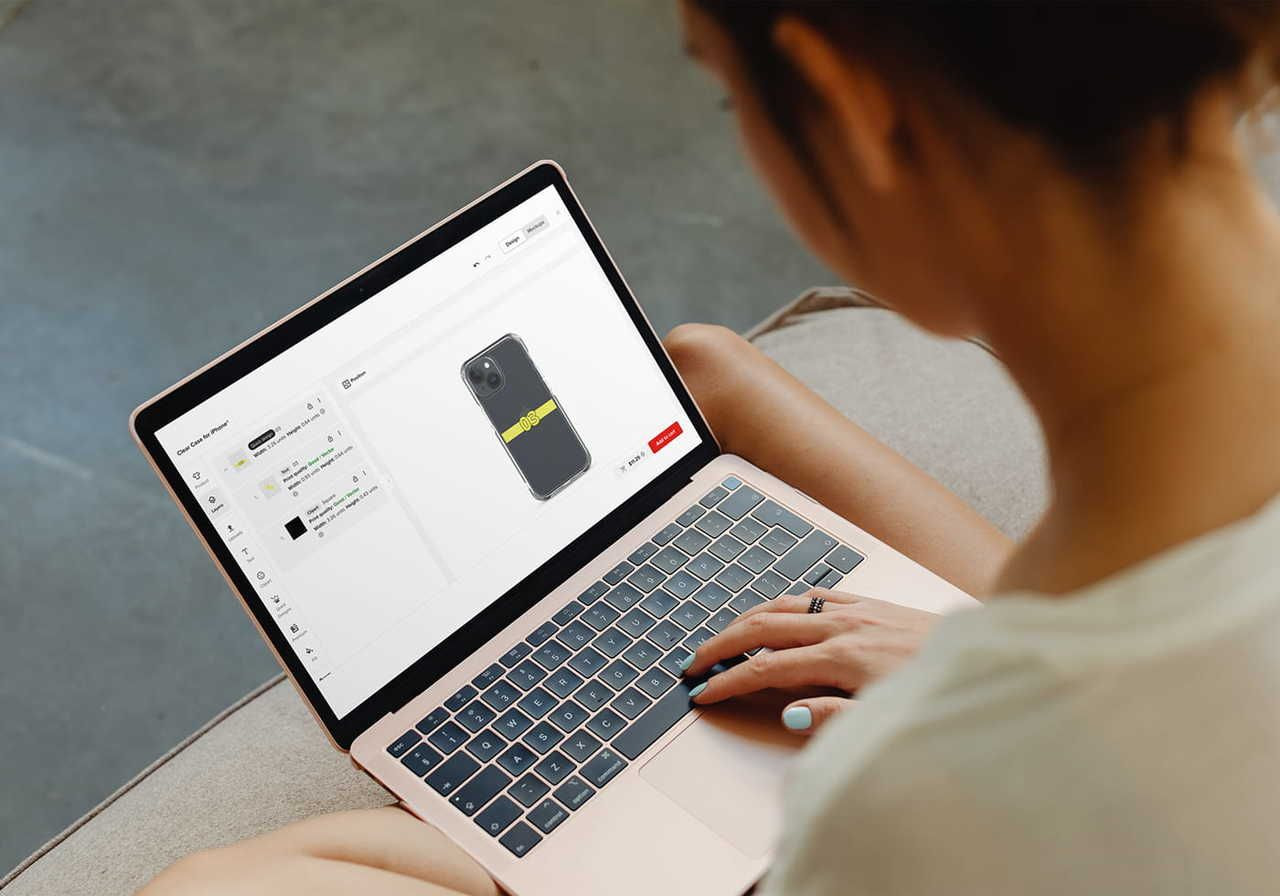
Print on Demand lowers startup costs because you don’t buy products before the first sale. Connect Printful to your Shopify store, design and publish items, and pay for fulfillment when customers order.
Why POD reduces your Shopify startup costs
Traditional retail requires an upfront bet. You order stock before you know which products, colors, sizes, or designs customers will buy. That creates inventory costs, storage needs, and the risk of paying for items that never sell.
Print on Demand changes the sequence. With Printful’s Shopify integration, you create products digitally and add them to your Shopify store without pre-ordering a batch.
When a customer orders, Printful produces, packs, and ships the item. You pay for fulfillment after the sale – or more correctly, your customer pays for the entire thing, and you keep the profits.
POD helps new brands:
-
Launch without buying bulk inventory
-
Test several designs before investing more time in a collection
-
Add or remove products without clearing unsold stock
-
Compare niches, price points, and product types using real sales data
-
Scale order volume without renting warehouse space or packing orders manually
POD doesn’t remove every cost. You still need to budget for your Shopify plan, a domain, samples, payment-processing fees, and marketing. But it keeps the largest traditional retail expense – inventory – out of your launch budget.
Realistic startup cost for a Shopify + Printful store
You don’t need a large budget to launch a Shopify store with Printful. Start with the essentials, keep your monthly costs controlled, and add paid tools only when the store gives you a reason.
Here’s what a lean launch budget looks like:
| Expense | Cost |
|---|---|
| Basic Shopify plan with annual billing | $29/mo |
| Printful app | Free |
| Standard .com domain | Around $11-$14/year |
| Free Shopify theme | $0 |
| Essential apps | $0-$20/mo |
A lean Shopify and Printful store can launch for under $50 in recurring monthly costs, excluding samples, fulfillment, shipping, taxes, advertising, and card fees. Besides, the first three months cost you only $1/mo, so you can learn the ropes and prepare like a pro.
Connect Printful through the Shopify integration, add your products, and start your online store without buying inventory upfront.
FAQ
Most new sellers spend $50-$150 per month for a full online store using Basic, a domain, and essential apps. Sellers also pay credit card fees on orders, and additional Shopify fees when a store uses a third-party gateway, premium tools, or international features.
A full Shopify online store starts at $29/mo when billed annually or $39/mo with monthly billing. Add a domain, apps, and optional paid themes. Shopify includes hosting and SSL, so sellers don’t need to pay separately for those services.
A new store on the eCommerce platform often costs $50-$150/mo before product costs, ads, and online transactions. A growing store often costs $250-$500, while a scaling brand may spend $800-$1,500 and above. The right Shopify plan depends on sales volume and operational needs.
If you are asking, “How much does Shopify cost?”, “How much is Shopify a month?”, or “Is Shopify free to sell?”, the answer starts at $5 per month for Starter or $29 per month for a full-store plan with annual billing (and three months only $1/mo).
Your total cost also includes apps, a domain, payment processing, and possible Shopify fees.
Time to crunch the numbers and get the ball rolling
Your first store doesn’t need an oversized budget or a complicated setup. Shopify gives new merchants three months at $1/mo after the free 3-day trial.
Use that window to test the process, not just the price tag. Sign up for Printful, connect it to Shopify, publish a small collection, and see how customers respond. If the numbers work, you’re ready to scale. If they don’t, you’ve lost $3, not $3,000.
Shopify’s not your thing? Check out our integrations with other top eCommerce platforms and marketplaces.

Zane is a sharp-witted writer with a deep interest in eCommerce, branding, and creative entrepreneurship. With a knack for blending humor, insight, and no-nonsense advice, she crafts engaging content that helps merchants learn and businesses grow. When she’s not dissecting industry trends, she's exploring philosophy, music, and the perfect balance between solitude and connection.

