



Table of contents
The best business to start with little money is usually a no-inventory model – like Print on Demand, freelance services, tutoring, digital products, or social media management.
These business ideas let you use existing skills, free resources, and low-cost tools instead of paying for rent, staff, or bulk stock. This guide compares low-cost businesses to start by budget, from $0 to $10,000.
Why start a low-cost, no-inventory business?
By launching a business with little money, you’re essentially testing the waters – making sure your idea has traction before you pour significant money into it. Instead of paying for rent, staff, or expensive equipment, you can focus your budget on basic expenses and marketing to win your first customers.
For product-based businesses, the biggest savings come from skipping inventory. You’re not stuck buying products upfront or paying for storage, which means there’s no risk of unsold stock draining your budget.
Business models like freelancing, digital products, or Print on Demand let you start lean, test demand, and scale once revenue comes in.
Let’s explore some of the best low-cost business ideas for different budgets.


Best business to start with little money: Quick answer
The best business to start with little money depends on what you already have: skills, time, equipment, an audience, or local contacts.
-
If you want the lowest-risk product route, Print on Demand comes first because you can sell custom products without buying inventory upfront.
-
If you want income faster, service-based businesses usually work better because you can charge for time and expertise.
|
Budget |
Best fit |
Why it works |
|
$0 |
Print on Demand |
Sell products online without inventory, storage, or production equipment. |
|
$0 |
Freelance services |
Use existing skills and online platforms to find first clients. |
|
$0-$100 |
Pet sitting |
Start locally with trust, availability, and word of mouth. |
|
Under $500 |
Digital products |
Create once, sell repeatedly, and build recurring revenue with bundles or templates. |
|
Under $500 |
Cleaning service |
Use basic supplies, local promotion, and repeat bookings for steady income. |
|
$5,000 |
Consulting business |
Turn expertise into higher-ticket business consulting, coaching, or advisory offers. |
|
$10,000 |
Digital agency |
Combine web development, SEO, ads, and content into packages for small businesses. |
What is the cheapest business to start? Choose a model that uses what you already know, avoids inventory, and lets you validate market demand before spending more.
The best business ideas at this stage have low setup needs, clear buyers, and a path to repeat purchases or referrals.
5 Businesses you can start with no money
A good business to start with no money uses your time, skills, audience access, or creativity instead of startup capital. These business ideas still need effort – but they don’t require a loan, warehouse, or brick-and-mortar shop.
1. Print on Demand
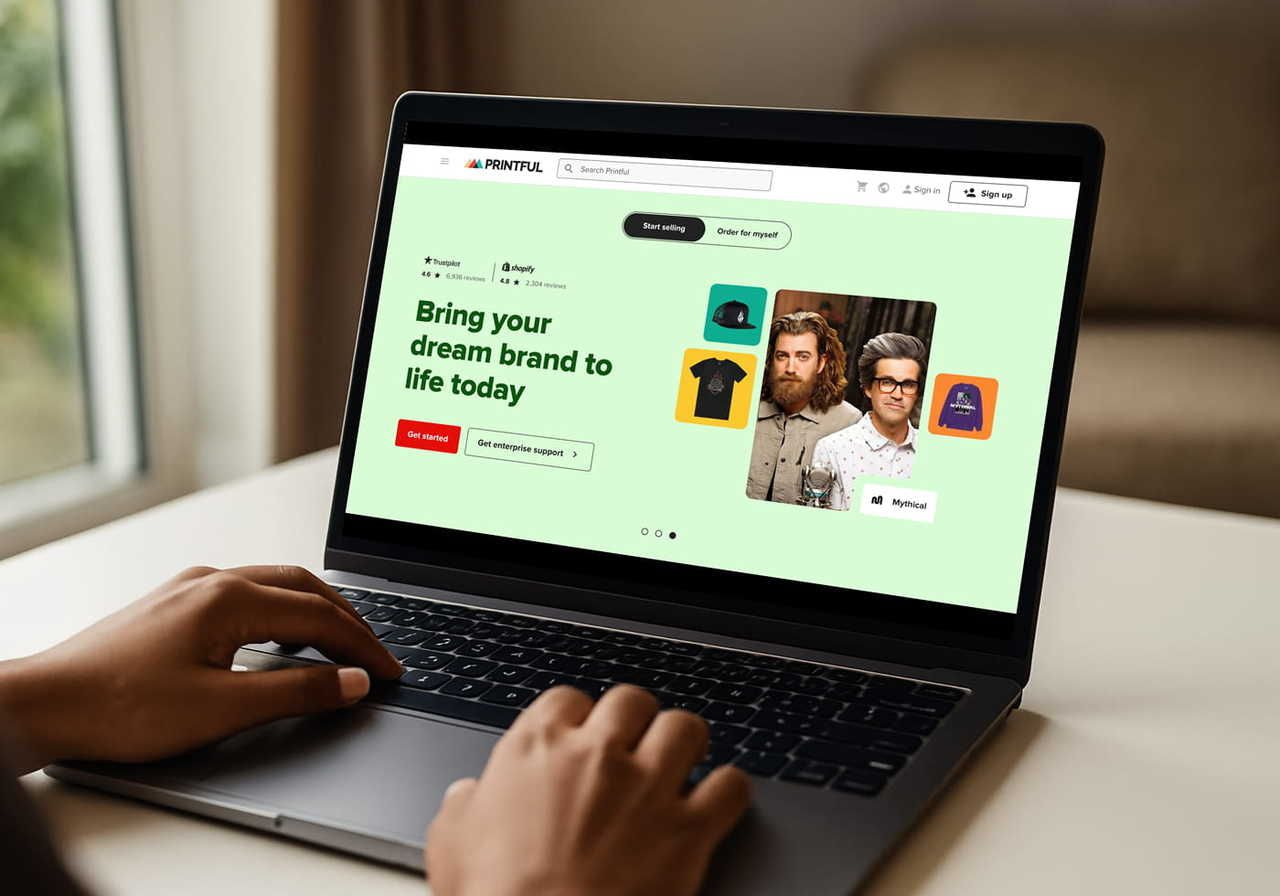
Print on Demand is the strongest product-based option for anyone looking to start their own business with little or no money. Create custom designs for apparel, accessories, home decor, or gifts, then publish them to an online store. When a customer orders, the product is printed, packed, and shipped for you.
This makes Print on Demand one of the best low-cost businesses to start because you don’t buy stock upfront or guess which sizes, colors, or designs will sell. Instead, you test market demand with real products and improve based on clicks, carts, and orders.
Great for: Artists, creators, niche communities, influencers, designers, and small business owners who want branded products without inventory.
-
Startup costs: $0 to start with Printful. Optional costs include samples, a domain, or store setup on Etsy, Shopify, or another channel.
-
Skills needed: Niche research, basic design judgment, product selection, and digital marketing.
-
Earnings potential: Highly variable, depending on the niche, pricing, traffic, and conversion rate. Printful merchant House of Chingasos reported more than $200,000 in store sales.
-
Challenge: A crowded market rewards specific niches and strong branding. Generic quotes on basic shirts rarely stand out.
Print on Demand is a profitable small business idea because it supports testing. Start with t-shirts, mugs, hoodies, or posters, then expand only after buyers show what they want.
If Amazon fits your sales strategy, explore how to sell on Amazon with Printful – we offer direct integration with this retail giant.


Valuable read: Printful customer success stories
2. Dropshipping business
The dropshipping business model also avoids inventory, but it usually gives you less control over product quality, shipping times, and branding. That makes it useful for testing products, but weaker for long-term brand building than custom product models.
-
Startup costs: $0-100 (optional store setup costs on platforms like Shopify).
-
Skills needed: Product research, niche targeting, and digital marketing.
-
Earnings potential: Highly variable – revenue depends on sales, margins, and customer acquisition costs. There is no verified standard monthly income for a new dropshipping store; test profitability after advertising, refunds, and fees. See the Shopify dropshipping guide for planning assumptions.
-
Challenge: Supplier issues, like long shipping times or inconsistent quality, can impact customer satisfaction, so vet your partners carefully.
-
How to start: Focus on a narrow niche, order samples before promoting products, and compare supplier reviews before driving traffic to the store. Use market research tools like Google Trends, TikTok search, Amazon results, and competitor reviews to avoid selling products with weak demand or poor customer feedback.
-
To find suppliers, compare listings and fulfillment terms on Shopify Collective or supplier directories such as SaleHoo, then order samples before listing products.
Valuable read: Useful market research tools for startups and established businesses
3. Freelance services

Freelance services are among the best businesses to start when you have little or no money but already know how to write, design, edit, organize, teach, code, or manage projects. Sell skills instead of products, which keeps startup costs low and lets you earn before building a large brand.
Great for: Writers, educators, organizers, and task-focused self-starters.
-
Startup costs: $0-$50 (optional software or tools).
-
Skills needed: Communication, subject expertise, and time management.
-
Earnings potential: Writers on Upwork typically charge $30-$59 per hour, depending on experience and project scope. These are client rates, not guaranteed take-home income.
-
Challenge: Building a steady client pipeline takes time. Expect slow months early on until you secure repeat clients or referrals.
-
Pro tip: Create an online portfolio to showcase your work and attract potential customers.
Use online marketplaces like Upwork, Fiverr, Contra, or LinkedIn services to find early work, but don’t rely only on platforms. Ask other business owners for referrals, join niche communities, and build a direct outreach habit.
4. Social media management
Many small business owners need help running their social media accounts, but can’t afford agencies.
Find clients through LinkedIn business searches, local business associations, and Google Maps listings with outdated social accounts. Pitch a small monthly content package first.
If you’re savvy with Instagram, TikTok, or other platforms, offer services like social media marketing or content creation.
-
Startup costs: $0 (optional: scheduling tools like Buffer or Canva Pro).
-
Skills needed: Audience engagement, copywriting, analytics.
-
Earnings potential: Upwork lists social media management projects around $500-$7,000/month depending on scope and seniority. Figures are client charges, not net earnings.
-
Challenge: Algorithms and trends change quickly, so staying current is essential to keep client accounts growing.
Quick tip
Use your social media accounts to position yourself as a go-to expert in your niche.
5. Pet sitting

This can become your new business if you’re an animal lover, student, remote worker, or anyone with flexible hours.
-
Startup costs: $0-$50 for flyers, a booking form, or basic pet-care supplies.
-
Skills needed: Reliability, communication, comfort with animals, and schedule management.
-
Challenge: Trust matters. Owners want references, clear updates, and proof their pets are safe.
You can also add dog walking, feeding visits, or overnight care. These service add-ons help create a steady income from repeat clients. Create a profile on Rover or Pawshake where available, list services and availability, and ask your first clients for reviews.
Quick tip
Start with neighbors, family contacts, and local Facebook groups. Use photos, short updates, and repeat booking offers to build a customer base.
Marketing tips for a $0 business
-
Build your audience through organic social media posts, reels, or threads that showcase your expertise.
-
Offer free or discounted services in exchange for testimonials.
-
List your services on freelancer platforms or free online directories.
-
Join niche communities on LinkedIn, Reddit, or Discord.
-
Ask for referrals early – word of mouth is powerful and free.
How to scale $0 business ventures
Every small business idea can grow into a profitable operation with automated processes, software, or strategic hires.
-
Freelancers → Agencies or productized services.
-
Social media managers → Full-service digital marketing.
-
Tutors → Paid online courses or memberships.
-
Virtual assistants → Boutique consulting firms or team-based operations.
4 Businesses to start with under $500
A $500 budget lets you buy simple tools, samples, software, and local marketing materials. These are still low-cost start-up businesses, but the extra budget helps you look more professional and reach buyers faster.
1. Cleaning services or a personal organizer business

A cleaning service can start with basic supplies, a small local radius, and repeat bookings. Add house cleaning, move-in cleaning, fridge clean-outs, or closet organization to create packages instead of one-off jobs.
Set up a free Google Business Profile and post specific offers in neighborhood Facebook groups, Nextdoor, or local service directories such as Thumbtack where supported.
This works well for busy families, landlords, Airbnb hosts, and small business owners who need reliable help.
-
Startup costs: $150-$300 for basic supplies (cleaning products, gloves, vacuum).
-
Skills needed: Time management, reliability, attention to detail.
-
Earnings potential: Thumbtack reports average house-cleaning job prices of $185-$324 in the US. Your income depends on booked jobs and supply, travel, and labor costs.
-
Challenge: Growth can be limited by your available hours until you hire staff or build systems for recurring contracts.
Quick tip
Bundle weekly house cleaning with add-ons like laundry folding, fridge clean-out, or pantry organization. Recurring packages help stabilize income and make scheduling easier than chasing one-time jobs every week.
2. Online tutoring or course creation
Use platforms like Teachable or Thinkific to create paid online courses or tutor students via Zoom. Focus on high-demand subjects like math, test prep, or writing. Over time, this can grow into a profitable online business.
-
Startup costs: $200-$500 for a paid teaching platform, webcam/mic upgrades.
-
Skills needed: Subject expertise, clear communication, basic tech fluency.
-
Earnings potential: Preply reports an average online tutor rate of $18.30/hour, with rates varying by subject and experience. Course income depends on enrollments and fees.
-
Challenge: Competition is high, especially in test prep and popular subjects – specializing in a niche helps you stand out.
Start by offering tutoring services one-on-one, then turn repeated lessons into worksheets, recorded modules, or online courses. This way, you’ll validate what students need before building a full course.
Quick tip
High-demand subjects, test prep, career skills, and adult upskilling usually work better than broad “learn anything” offers.
3. Photography services

Offer headshots, product photos, or coverage for corporate events. Build an online portfolio and start with free tools to edit and deliver work. A photography business can work great as a side hustle with weekend gigs or scalable packages.
-
Startup costs: $300-$500 (entry-level DSLR or smartphone accessories, editing software).
-
Skills needed: Eye for detail, basic photography and editing, and people skills.
-
Earnings potential: Thumbtack reports average portrait photography prices of around $277/session and event photography – $756/event. Earnings vary after editing, travel, and equipment expenses.
-
Challenge: With so much competition, a clear niche helps you differentiate your business and avoid the pitfalls of being too broad.
-
Pro tip: Focus on specialized services like brand shoots for small businesses, Airbnb hosts, or pet portraits. Use Instagram to showcase your work and build your social media presence.
4. Digital products
Create printables, digital planners, or design templates to sell on Etsy or your online store. No inventory needed – just tools like Canva and a platform to host your files. This can become a really profitable business since you create downloadables once and sell them again and again.
-
Startup costs: $100-$300 (design tools like Canva Pro, Etsy fees, branding kit).
-
Skills needed: Visual design, niche targeting, and light marketing.
-
Earnings potential: Etsy listings show digital planner prices ranging from $1 to $ 20+, depending on the product. For illustration, 50 sales of a $20 template would generate $1,000 in gross sales before marketplace fees, refunds, and taxes.
-
Challenge: Sales depend on steady traffic from search (keywords on Etsy or Google) or discovery platforms like Pinterest. Without consistent marketing, even great designs can sit unsold.
Digital products work best when you choose one buyer and one repeat problem. For example, wedding planners need timelines, checklists, and client templates. Teachers need worksheets and classroom systems.
Small business owners need pricing calculators, content calendars, and onboarding forms. Specific products usually outperform broad templates because they match clear search intent.
Marketing tips for a $500 business
-
Promote through local Facebook groups, neighborhood boards, and community events.
-
Partner with schools, gyms, or small shops to reach niche audiences.
-
Print flyers or cards for $50-$100 and leave them where your target clients are.
-
Build a simple website and optimize your Google Business Profile.
3 Businesses to start with $5,000
At this level, the goal changes. You’re no longer only testing. You’re investing in proof, trust, equipment, certifications, or lead generation. The best business ideas in this range still avoid heavy inventory, but they use the budget to look credible faster.
1. Gardening or landscaping business

Offer services ranging from basic lawn care to full-scale design projects. With a $5,000 budget, you can invest in professional equipment and insurance, giving your business credibility from day one. Seasonal demand, plus repeat maintenance contracts, makes this a profitable small business idea with steady cash flow.
-
Startup costs: $2,000-$4,500 (basic landscaping tools, trailer/truck rental, insurance, marketing).
-
Skills needed: Physical stamina, design or plant knowledge, and project coordination.
-
Earnings potential: Thumbtack reports average landscaping project prices around $1,147-$2,465. Monthly revenue depends on project volume, seasonality, and equipment and labor costs.
-
Challenge: Seasonal demand can cause income swings, so diversify services (e.g., snow removal, holiday light setup) to balance revenue.
-
Pro tip: Start small – like lawn care or seasonal cleanup – and upsell design packages. Build trust with local businesses or residential clients and grow via word-of-mouth and social proof.
2. Niche consulting or life coaching
Turn a specific skill into a consulting business that solves one expensive problem for one audience. Instead of selling vague advice, offer business consulting, career transition coaching, financial planning, operations support, or life coaching with a clear outcome. Clients pay more when they understand the result, timeline, and process.
-
Startup costs: $1,500-$3,500 (certification program, branding, website, coaching tools).
-
Skills needed: Deep knowledge in your niche (career, wellness, finance, etc.), empathy, and sales.
-
Earnings potential: Upwork lists typical business consultant rates of $28-$98/hour, with some specialist rates above that. Package revenue depends on client demand and the work involved.
-
Challenge: A strong personal brand and trust signals (testimonials, certifications) are crucial to attract high-paying clients.
-
Pro tip: Package your offer around one measurable result – for example, “three-month job search strategy,” “monthly cash-flow cleanup,” or “SEO audit for local service websites.” Clear outcomes help potential clients compare your value against doing nothing.
Real-world example: Christian, a former Accenture consultant, shared on Reddit how he launched a successful solo consulting career after leaving corporate.
Within a year, he built his practice to $400,000 in annual profit by systematically reaching out to his network, customizing proposals, and leveraging freelance brokers. His story shows how consulting can quickly become a high-income path for those with deep expertise and an outreach strategy.
3. Digital marketing specialist

Offer a high-demand service like search engine optimization (SEO), online ads, or email marketing. With a $5,000 budget, you can invest in professional certifications, specialized tools, and some initial advertising to build credibility and attract clients who need results fast.
-
Startup costs: $3,000-$5,000 (certification, premium tools, SEO or ad software, branding, legal setup, light ad spend).
-
Skills needed: SEO, online advertising, content strategy, and client communication.
-
Earnings potential: Upwork lists digital marketer rates of $15-$45/hour. Your total monthly billings depend on available client work; subtract software and marketing expenses to estimate profit.
-
Challenge: Results take time – clients may expect instant return on investment (ROI), so set clear expectations and use case studies to prove value.
-
Pro tip: Start as a solo specialist with one core service (for example, website SEO audits). Create simple before-and-after case studies to show the difference your work makes, then upsell related services. Over time, you can expand into a full digital agency as demand grows.
This idea works because many businesses need traffic but don’t have time to learn SEO, paid ads, analytics, or conversion tracking. Start with one service, like SEO audits or Meta ad setup, then add social media management, email, or landing pages after you can show results.
Marketing tips for a $5,000 business
-
Launch a clean, SEO-optimized website with lead generation tools.
-
Run small paid ad tests on Meta or Google ($200-$500) to validate your offer.
-
Collect and showcase social proof early (before/after photos, testimonials, client wins).
-
Use niche landing pages or portfolios to attract higher-paying clients.
3 Businesses to start with $10,000
A $10,000 budget gives you room to combine tools, contractors, software, and lead generation. Keep the model lean by avoiding inventory-heavy ideas unless you already have confirmed demand.
1. Digital agency
Build a full-service agency that handles everything from design to web development and digital marketing. With $10,000, you can hire contractors, invest in premium tools, and deliver specialized services to clients who prefer one trusted partner instead of juggling freelancers.
-
Startup costs: $6,000-$10,000 (branding, software licenses, contractor payments, marketing materials).
-
Skills needed: Project management, client communication, quality control, and industry expertise.
-
Earnings potential: Upwork lists business website projects around $2,000-$8,000 and eCommerce projects around $5,000-$15,000. Agency profit depends on project scope, contractors, and recurring costs.
-
Challenge: Client management can be demanding – clear contracts and boundaries help prevent burnout or clients adding extra tasks outside the original agreement.
-
Pro tip: Position yourself as a one-stop shop. Bundle digital marketing services like SEO or social media management for clients who prefer a streamlined solution.
A digital agency works best when it sells a clear package, not “everything marketing.” For example, combine web development, SEO setup, content, and analytics for local clinics, coaches, restaurants, or contractors.
A narrow offer helps you avoid vague proposals and makes delivery easier to repeat.
2. App or software business

At this level, you can go beyond simple eBooks or online courses and create a polished app, membership platform, or software-based tool.
While you won’t build the next Facebook with $10,000, you can hire developers to create a minimum viable product (MVP), design high-quality digital assets, or launch a subscription-based resource hub in a high-demand niche (fitness, finance, AI tools).
-
Startup costs: $4,000-$9,000 (MVP development, design, platform fees, marketing).
-
Skills needed: Subject expertise, project management, and digital marketing.
-
Earnings potential: Software revenue has no reliable fixed launch average. For context, Upwork estimates custom web application projects at $10,000-50,000 in client development costs, not creator earnings.
-
Challenge: Tech development often takes longer and costs more than planned – validate your idea with a simple MVP before scaling.
-
Pro tip: Start lean with a single tool or feature that solves a specific problem. Test demand, then reinvest profits to expand.
If you want predictable income, build around subscriptions, usage limits, templates, or a membership platform. Software rarely becomes profitable from launch day, so validate demand with a landing page, waitlist, prototype, or manual version before paying developers.
Start with a Carrd or Webflow landing page, capture email signups using Mailchimp, prototype in Figma, and test a paid pilot through Stripe Payment Links before investing in development.
3. Specialized service-based business
Launch a higher-end service business that needs professional equipment and setup. Examples include a mobile car detailing business, a pet grooming service, or a small moving company. A $10,000 capital lets you invest in quality tools, a vehicle setup, liability insurance, and branding.
-
Startup costs: $5,000-$10,000 (equipment, vehicle setup, insurance, marketing).
-
Skills needed: Reliability, customer service, niche expertise.
-
Earnings potential: Thumbtack reports average mobile car detailing job prices ranging from $144 to $254. Revenue depends on bookings, service type, and operating expenses; this is not a monthly earnings guarantee.
-
Challenge: Upfront equipment and insurance costs can be high, so ensure you have enough recurring customers to cover fixed expenses.
-
Pro tip: Focus on recurring needs – like repeat car detailing clients or pet grooming packages – to create steady cash flow.
Specialized service-based businesses can achieve strong margins by solving recurring problems. Mobile detailing, pet grooming, moving help, and premium cleaning all work better when customers book again monthly or seasonally – it creates steady income and reduces the need to find new buyers every week.
Real-world example: Jennifer launched her mobile dog grooming business with just a small van and a handful of clients. Through word-of-mouth and consistent service, she grew her customer base, added more vans, and generated a six-figure income within a year.
Marketing tips for a $10,000 business
-
Run multi-channel campaigns (paid ads + SEO + social media marketing).
-
Build authority through long-form content (blogs, YouTube, podcasts).
-
Develop strategic partnerships with influencers or local businesses.
-
Set up automated funnels (webinars, retargeting ads, email drip campaigns).
Your step-by-step guide to launching a successful low-cost business
Once you compare the best business ideas by budget, move from research to action. A low-cost launch still needs structure: validate demand, write a plan, set up finances, choose marketing channels, and track results. Treat this section as your checklist for setting your own business up for success.
1. Choose a viable idea that aligns with your skills
Start with market research – don’t start with a logo. Look for proof that people already search, buy, complain, or ask for help in the category. A good business idea sits at the overlap of existing skills, buyer urgency, and manageable launch costs.
Ask yourself:
-
What skills or expertise do I already have that others would pay for?
-
Is there a high demand for this service or product in my area or online?
-
Can I test the business model with a minimal upfront investment?
For example, if you’re detail-oriented, a virtual assistant business could be a good business idea. If you love fitness, launching a personal training business or online courses may be a natural fit.
To make sure your idea has potential, research demand using tools like Google Keyword Planner, Google Trends, or social media platforms to see what people are searching for and engaging with.
2. Create a simple business plan

Even the most profitable small business ideas can fail without a roadmap. A business plan doesn’t need to be long or complicated – it just needs to outline:
-
Your target audience
-
Your offer (products or services)
-
Startup costs and funding options
-
Your marketing plan
A simple business plan should fit on one page. Include the buyer, offer, price, first expenses, marketing channel, delivery process, and success metric. For a service, that metric might be booked calls. For an online store, it might be product page visits, add-to-cart rate, or first orders.
3. Explore funding options
While many small businesses begin with self-funding, you don’t have to rely solely on savings. Options include:
-
Small business loans or microloans
-
Grants for small business owners in specific industries
-
Crowdfunding platforms
-
Partnerships or angel investors
If you need startup capital, start with the smallest amount that proves demand. Self-funding works best when the first test costs little. Small business loans, grants, crowdfunding, or angel investors make more sense after you can show traction, a clear offer, and basic revenue projections.
For more resources, see the US Small Business Administration (SBA) for loan programs and guides.
4. Build your brand and online presence
A strong brand and digital presence set you apart from competitors. Depending on your idea, start with:
-
A professional website
-
Active social media accounts
-
An online portfolio (for creative work like design, writing, or photography business services)
Choose the channel your buyers already use. Local services need Google Business Profile, reviews, and neighborhood groups. Creative work needs an online portfolio. Product models need clear product pages, checkout, and traffic.
Don’t build five channels before one starts bringing leads or orders.
5. Consider legal structures, licenses, and permits
Choosing the right legal structure (sole proprietorship, LLC, corporation) affects your taxes and liability. Research which licenses or permits apply to your industry – for example, a cleaning service or daycare may require specific approvals.
Registering properly from the start prevents compliance issues down the line.
Valuable read: How to start a business in the US: Taxes and legal requirements handbook
6. Set up your business finances for success
Separate your business and personal finances immediately. Open a business bank account, set up bookkeeping (or use accounting software), and track every expense. To stay organized, you can also invest in simple invoicing or payroll systems early.
A separate business bank account makes income, expenses, tax prep, and profit tracking easier. Use accounting software from the start, even if the business is small. Clean records help you see which offers make money and which ones only create work.
What are the key success factors for low-cost businesses?
The easiest business to launch is not always the easiest to grow. Low-cost models work when you control expenses, validate demand early, and build a repeatable way to find customers.
These success factors apply across product, digital, and service models.
Passion and persistence
Most business owners start small, but those who thrive bring energy and resilience. Passion keeps you motivated, while persistence helps you overcome slow months and setbacks. Treat your small business idea as a long-term commitment, not a quick win.
Continuous learning and adaptation
Markets, tools, and customer expectations shift quickly. Whether you’re offering tutoring services, launching a personal training business, or running digital marketing services, ongoing learning is critical. Adapt your business model, refine your offers, and keep pace with industry changes to stay relevant.
Networking and customer feedback
Growth comes from relationships. Networking with local businesses, online communities, and industry peers opens doors to referrals and partnerships. At the same time, customer feedback is a free resource that helps refine your services and build loyalty – satisfied clients become your best marketers.
These success factors apply across all profitable business ideas and budgets. Combined, they turn a small business into a sustainable, scalable venture.
Clear demand
Before spending on branding or tools, confirm market demand. Look for searches, active competitors, paid listings, reviews, community questions, and buyer complaints. Demand does not mean copying competitors. It means proving people already spend money in the category.
Repeatable customer acquisition
A low-cost launch needs a simple way to reach people every week. That might mean SEO, social media, referrals, local partnerships, online marketplaces, or direct outreach. The channel matters less than consistency and measurable results.
Feedback loops
Customer feedback is one of the best free resources for improving a new offer. Ask buyers what almost stopped them, what they compared you with, and what they wanted next. Those answers help improve pricing, product pages, service packages, and follow-up offers.
Start a business with little money and get recurring revenue

The best business to start with little money is one that lets you test your ideas without risking your savings. With Printful, launch your own Print on Demand business for free, create custom products, and sell through your online store without buying inventory or managing shipping.
Choose products, add your designs using Printful’s free Design Maker, and focus on attracting customers. We’ll handle printing, packing, and fulfillment, giving you more time to grow a profitable business.
The best businesses to start with little money: FAQ
The easiest option to start a business is a service or no-inventory model you can launch with skills you already have. Print on Demand, freelancing, tutoring, pet sitting, and social media management – start quickly, test your own business idea, and keep upfront costs low.
To make $10,000 a month, sell products or services with strong margins, repeat demand, and a clear buyer. Print on Demand, digital products, consulting packages, online courses, and specialized services can work if you price correctly, reach enough potential clients, and convert traffic into orders.
Yes, an LLC can get grant money if it meets the grant’s eligibility rules. Requirements often depend on location, industry, owner background, business stage, or community impact. A new business with little or no money to spend should compare grants with microloans, self-funding, and low-cost testing before choosing a funding route.
The most successful small businesses solve a specific problem, control costs, and reach customers consistently.
Strong options include Print on Demand, cleaning, tutoring, consulting, digital marketing, pet care, and digital products. The best choice depends on your skills, budget, market demand, and dream business goals.

Zane is a sharp-witted writer with a deep interest in eCommerce, branding, and creative entrepreneurship. With a knack for blending humor, insight, and no-nonsense advice, she crafts engaging content that helps merchants learn and businesses grow. When she’s not dissecting industry trends, she's exploring philosophy, music, and the perfect balance between solitude and connection.

