


Table of contents
Choosing the right print-on-demand platform is vital for your eCommerce store. Whether you’re just launching or scaling up, your platform affects product quality, shipping costs, and profit margins.
This guide walks you through the top Printify alternatives, helping you find a reliable print-on-demand (POD) partner that delivers high-quality products and the custom branding your business needs.
Why search for an alternative?
Choosing a print-on-demand partner is rarely a one-and-done decision. As your online store grows, your requirements for production speed and branding depth will shift.
While Printify is a powerhouse for variety and price, exploring alternatives allows you to diversify your supply chain and fine-tune your operations, considering several key factors:
-
Cost efficiency: Printify typically offers the most competitive prices in the industry. However, other print-on-demand services may provide better value for specific niches or by removing monthly fees for premium features.
-
Quality control: While the merger with Printful allows for more in-house production options, using a print provider network can still lead to inconsistencies. Choosing an alternative with a strictly centralized production model ensures identical results for every order, which is crucial for building trust.
-
Shipping options: Some alternatives may offer better shipping options than Printify, reducing costs and keeping more profit for yourself by using localized global fulfillment networks.
-
Customer support: Since Printify and Printful now offer a similar, high-standard support experience, looking for an alternative is less about better support and more about finding a partner whose specific tools or account management style fits your workflow.
-
Customization and branding: Alternatives may provide different customization options for branding and packaging, such as unique packaging inserts or specific types of branded labels.


Top 10 Printify alternatives
There’s no shortage of print providers for your print-on-demand business, and many appear similar at first glance. To choose the right partner, you need to consider the details. Factors like consistent quality, custom branding – including branded labels and packaging inserts – and the structure of the global fulfillment network are what define the customer experience for your online store.
1. Printful

Source: Printful
At Printful, we fulfill orders in our own global facilities, giving us direct control over product quality. Unlike middleman models that rely on external providers, our in-house approach ensures consistent results and reliable support.
We offer a curated catalog of over 475 premium products, from apparel to home decor, and supplement our capacity with a vetted network of partners to keep shipping times fast – even during peak seasons.
Sustainability is a key part of our operations. Print on Demand reduces waste because products are only created after an order is placed.
To support this commitment, we offer a dedicated eco-friendly POD collection made with at least 70% organic or recycled materials. Many products in our Catalog use fabrics or blank products certified under OEKO-TEX® STANDARD 100, and we also use inks certified under OEKO-TEX® ECO PASSPORT. We have also transitioned to post-consumer recycled (PCR) packaging, helping you build a brand that resonates with environmentally conscious consumers.
Pricing
Printful free plan: $0/month. Best for new sellers, with access to over 475 products and the free Design Maker.
Printful growth: $24.99/month. Includes up to 33% off product pricing and 9% off product branding. Becomes free for a year after reaching $12K in annual sales.
Branding costs: Extra placements, custom inside labels ($0.99), and packaging inserts are available for additional fees to help strengthen your brand.
Tip: Compare Printful vs Printify in our blog.
Production
Printful stands out by owning its global fulfillment centers. This in-house production model ensures consistent quality and reliable customer support – advantages that middleman models often can’t match.
We also work with a vetted global network of partners to maintain fast shipping times for your customers, even during peak demand.
|
Pros |
Cons |
|
Over 475 premium-quality products |
Higher product base prices |
|
Owns the production process |
Shipping costs can vary by region |
|
Excellent eCommerce integrations |
Smaller catalog than network-based peers |
Tip: Explore more on how to start an online store with Printful on our blog.

Source: Printful
2. Print Aura

Source: Print Aura
Print Aura is a print-on-demand fulfillment company offering over 250 customizable items, including apparel, accessories, and home goods.
It’s often recommended as an alternative to Printify for sellers who want white-label options and more control over custom branding for their online store.
Pricing
Standard plan: $0/month. No membership or subscription fees are required to start selling and using core features.
Product costs: You pay the base price of the item plus printing. For example, a basic t-shirt starts at around $7.25.
Branding add-ons: Options such as neck labels and custom pack-ins are available for an additional fee ($0.50-$1 per item).
Shipping: Starts at roughly $5.50 for US domestic shipping, with additional costs for international orders.
Production
Print Aura operates as a middleman, outsourcing production to third-party print providers. This allows for a diverse product range, but product quality can sometimes vary across categories. Despite this, it’s a popular choice for entrepreneurs seeking localized US fulfillment with fixed, predictable shipping rates.
|
Pros |
Cons |
|
Various branding options |
Varied product quality |
|
No signup or subscription fees |
Only accepts USD |
|
Suitable for small businesses |
Limited eCommerce platform integrations |
Explore: Check out 7 Printful branding tools for your brand in our blog.
3. Teelaunch
Source: Teelaunch
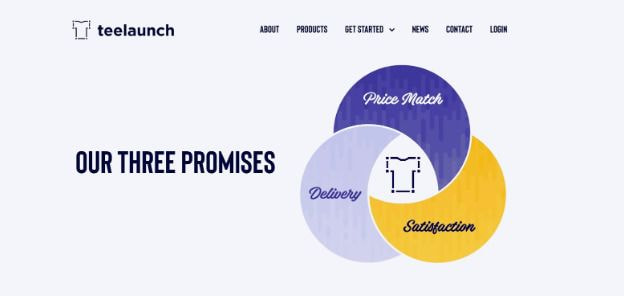
Teelaunch is one of the best POD alternatives to Printify if you focus on unique, niche product categories. Many sellers use it alongside other print-on-demand companies to offer specialty items like electronics or home goods that aren't available elsewhere.
Pricing
Teelaunch doesn’t charge a subscription fee; you only pay for products after they’re sold. It offers competitive retail prices, and its straightforward pricing model helps merchants maintain healthy profit margins without worrying about hidden monthly fees.
Production
Teelaunch acts as a middleman, outsourcing production to third-party manufacturers. This approach allows for a wide product range, including unique items like Bluetooth speakers and laser-engraved cutting boards.
Because they use various specialized partners, shipping times and print quality can vary depending on the specific item ordered.
|
Pros |
Cons |
|
Access to unique product categories |
No product branding (inserts/labels) |
|
No upfront costs |
Only uses USD |
|
Seamless Shopify and Etsy integration |
Limited to only a few eCommerce platforms |
4. Gelato
Source: Gelato
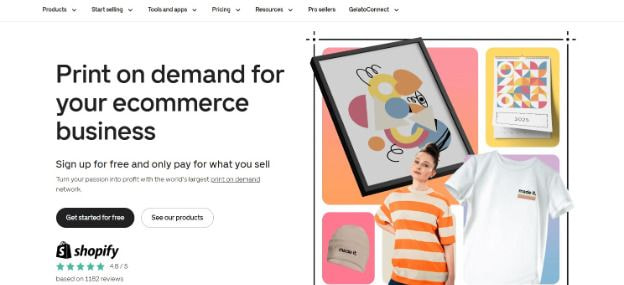
Gelato is a global print-on-demand service that’s well-known for its extensive global network of production partners, making it a strong Printify alternative for those selling to international customers.
Pricing
Gelato Free: $0/month. Includes access to the global print network, two eCommerce store connections, and 24/7 support.
Gelato+: $23.99/month (or $19.99/month billed annually). Offers up to 25% off all products, unlimited store connections, and premium mockups.
Gelato Platinum: Custom pricing. Designed for high-volume sellers, providing custom product discounts, a dedicated account manager, and smart shipping pricing.
Branded shipping: Branded labels and packaging inserts are available starting at $0.49 per order for subscribers.
Production
Gelato is a middleman, outsourcing production to third-party manufacturers in 32 countries. This global fulfillment model significantly reduces shipping costs and carbon emissions, though it limits Gelato's direct control over production quality compared to in-house models.
|
Pros |
Cons |
|
Extensive global network |
Variable product quality |
|
Free design tools and premium mockups |
Dependence on third-party manufacturers |
|
Wide product assortment |
Higher product base prices on some items |
Valuable read: Gelato vs Printful comparison.
5. Zazzle

Source: Zazzle
Zazzle is a large marketplace and print-on-demand company, distinct from platforms like Printify due to its strong focus on customer-led customization.
It lets shoppers modify fonts, colors, and text on an artist's design before purchasing, making it a popular choice for party supplies, invitations, and personalized gifts.
Pricing
Seller account: $0/month. It’s free to join the marketplace and list your designs.
Royalty system: You set your own royalty rate, typically between 5%-15%.
Marketing royalty fee: Zazzle deducts a fee (often 35%-50% of your royalty) if they drive the traffic to your product through their own ads or associates.
Zazzle Plus: $19.95/year. Provides unlimited free shipping to customers on most products, helping increase your conversion rates.
Production
Zazzle handles manufacturing in-house for a large portion of its catalog, providing a higher level of reliability than platforms relying on a rotating network of third-party print providers. This vertical integration allows them to offer complex custom products that standard print-on-demand services can’t easily replicate.
|
Pros |
Cons |
|
High level of product customization |
The market is highly competitive |
|
Massive built-in customer base |
Royalties can be lower than self-hosted stores |
|
In-house manufacturing for many items |
Complex interface for new sellers |
6. Redbubble

Source: Redbubble
Redbubble is a marketplace-based print-on-demand platform, ideal for artists who want to reach a global audience without building a standalone storefront or handling complex logistics.
Pricing
Redbubble uses a tiered fee system based on your account type:
Redbubble Standard: 50% platform fee on monthly earnings.
Redbubble Premium: 20% platform fee on monthly earnings.
Redbubble Pro: No platform fees.
Excess markup fee: For Standard and Premium accounts, a 50% fee applies to any earnings from a markup set above 20%.
Production
Redbubble acts as a middleman, using a global network of third-party manufacturers. This ensures worldwide shipping and localized fulfillment, but it also means that product quality and print quality can vary depending on which facility handles the order.
|
Pros |
Cons |
|
Zero upfront costs to start |
High platform fees for Standard accounts |
|
Strong organic search traffic |
Limited control over the customer experience |
|
Diverse artist community |
Excess markup fees on higher margins |
Valuable read: Printful vs Redbubble comparison.
7. Society6

Source: Society6
Society6 is a curated marketplace that focuses on high-quality art prints, home decor, and lifestyle products. It’s known for its aesthetic-driven artist community and gallery feel, attracting a more design-conscious target market.
Pricing
-
Artist commission: Society6 has standardized earnings. Artists earn a flat 5-10% commission depending on the product category.
-
Art prints: Unlike other categories, artists can set their own custom markups on art prints.
-
Free plan: Allows only up to 10 design uploads.
-
Paid plans: To upload more designs (up to 100 or 10,000) and set custom pricing, you must subscribe to one of the two pricing plans (Basic, at $4.99/month or Pro, at $12.99/month).
-
Shipping fees: As of 2025/2026, shipping fees are no longer deducted from artist earnings, making payouts more predictable.
Production
Society6 doesn’t own its production facilities; it collaborates with a network of third-party manufacturers to fulfill orders. This model allows them to offer a very wide product assortment – from furniture to custom apparel – but results in less oversight of output and quality than in-house print-on-demand companies.
|
Pros |
Cons |
|
Premium art-focused audience |
Lower profit margins due to fixed royalties |
|
Excellent for home decor and prints |
Higher retail price for customers |
|
Strong brand prestige |
Limited custom branding options |
Tip: How to know when to leave Society6 to start your own online store.
8. Spreadshirt
Source: Spreadshirt
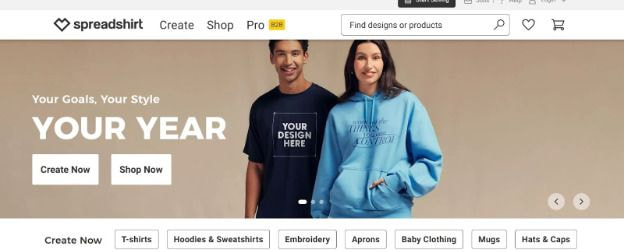
Spreadshirt is a versatile eCommerce platform that offers a unique dual-path for creators: you can sell through the Spreadshirt Marketplace to access massive daily traffic or launch your own white-label Spreadshop for full brand control.
It’s a robust print-on-demand company for those who want to reach a global audience with ten different currencies.
Pricing
-
Spreadshop: $0/month. There are no subscription fees for running your own independent shop. You set the retail price and keep the profit above the base cost.
-
Marketplace: $0/month. You earn a fixed design commission for every sale made on the Spreadshirt Marketplace.
-
Volume commission: High-volume Spreadshop owners can earn a volume commission of up to 40% back on the base price of products sold, significantly boosting their profit margins.
-
Standard wholesale prices: Spreadshirt offers consistent pricing on its 200+ items, with basic t-shirts starting around $12.99.
Production
Spreadshirt manages its own production across five global factories, offering service in over 150 countries. This in-house infrastructure ensures high product quality and faster fulfillment than platforms relying on third-party print providers.
Because they own the facilities, they can maintain tighter oversight over every order for your print-on-demand business.
|
Pros |
Cons |
|
No subscription fees |
Marketplace commissions can be low |
|
Owns the production process |
Storefront customization takes time |
|
Global reach with 10 currencies |
Design review process can be strict |
9. Spring (previously TeeSpring)

Source: Spring
Spring excels at social commerce. Since its relaunch, it has prioritized print-on-demand integration options, including YouTube, Instagram, and TikTok, making it a top choice for influencers and digital marketers looking to sell merchandise directly to their fanbases.
Pricing
-
Physical products: $0/month. You set the retail price and keep 100% of the profit above the base cost.
-
Digital products: $0/month to list. Spring charges a 20% processing fee and a small transaction fee per digital sale.
-
Payouts: Earnings are requested via the dashboard and processed via Payoneer or PayPal.
-
Service fee: While listing is free, Spring now takes a 15% service fee to handle storage and fulfillment on top of the base costs.
Production
Spring acts as a middleman, sourcing products from a network of third-party vendors. While this enables a massive product range – including digital goods – it means product quality and shipping times can vary depending on which third-party print provider fulfills the order.
For creators focused on community-led sales rather than a traditional online store, this trade-off is often acceptable for the ease of use.
|
Pros |
Cons |
|
Top-tier social media integrations |
Variable product quality |
|
Supports digital product sales |
20% service fee on digital goods |
|
No upfront costs |
Limited standalone branding tools |
Tip: Check out our Printful vs Spring comparison.
10. CustomCat

Source: CustomCat
CustomCat is a Detroit-based print-on-demand company known for having some of the lowest standard wholesale prices and fastest fulfillment in the industry. It’s a powerful, reliable Printify alternative for high-volume sellers who prioritize speed and profit margins over complex branding.
Pricing
-
CustomCat lite: $0/month. Free access to the entire product catalog at standard wholesale prices.
-
CustomCat pro: $30/month (or $25/month billed annually). This subscription plan unlocks 20-40% discounts on the entire catalog to maximize your profit margins.
Production
CustomCat produces everything in-house in the US using advanced DIGISOFT® digital printing technology. This ensures more consistent quality and allows them to ship most orders within 2-3 business days.
While their worldwide shipping is reliable, their primary logistics strength lies in the US market, making them ideal for brands targeting North American customers.
|
Pros |
Cons |
|
Market-leading base prices |
Limited custom branding (no inserts/labels) |
|
In-house DIGISOFT® printing |
Focused primarily on the US market |
|
Fast 24-48-hour fulfillment |
The product catalog is smaller than some print-on-demand companies |
How do you choose the right Printify alternative?
Selecting the best Printify alternative requires a deep look at your specific business model and long-term goals. While variety is important, the stability of your supply chain is what protects your brand reputation. To make an informed choice, evaluate potential partners based on these six pillars:
Product range
Look for platforms offering a diverse product range that matches your niche. If you sell specialized home decor or custom clothing, ensure the company has proven expertise in those specific product categories.
Production model
Decide if you prefer a print-on-demand company with in-house facilities or one that uses third-party print providers. In-house production usually offers more consistent quality and tighter control over the fulfillment process for your print-on-demand business.
Pricing and profit
Evaluate the base price of core items alongside any monthly fees. Higher upfront costs on a subscription plan might be worth it if they unlock lower per-unit prices that significantly boost your profit margins as you scale.
eCommerce integration
Your partner must offer easy integration with your chosen eCommerce platform, whether it’s Shopify, Etsy, or WooCommerce. Seamless syncing is essential for automating order flows and inventory management.
Global shipping
Check the footprint of their global fulfillment network. If you have international customers, localized production is the best way to reduce shipping costs and delivery times.
Customer support
Prioritize print-on-demand companies that offer reliable customer support and comprehensive seller resources. Having a partner who responds quickly to production issues is vital to maintaining high customer satisfaction.
That’s all from us
Finding the right printing partner is a major milestone in your eCommerce journey. Once you’ve narrowed your list to a few strong candidates, the best next step is real-world testing. Order samples to personally check print quality and fabric feel, and reach out to each support team to test their responsiveness.
Doing this homework before you start selling custom products sets your brand up for success from day one. With a reliable partner handling production and logistics, you’re free to focus on what matters most: building a commercially strong and meaningful brand. Best of luck in your search!
Tip: Check 21 Trending products to sell online on our blog.
FAQ
For Etsy sellers, sustainable print-on-demand platforms like Printful and Gelato are the top choices. Printful offers superior custom branding, such as branded labels and packaging inserts, that help your shop stand out.
Gelato provides a massive global fulfillment network, allowing you to reach international customers with lower shipping costs and faster delivery times.
Printful and CustomCat are leaders in product quality because they own their production facilities.
Unlike platforms that rely on a network of third-party print providers, these companies have direct oversight of the digital printing process, providing consistent quality and more reliable results for every order your online store receives.
Yes, several sites like Printify offer free access. Printful, Print Aura, and Teelaunch allow you to start a print-on-demand business with no upfront costs or subscription fees.
You only pay the base price when you make a sale, which is ideal for maintaining high profit margins when starting out.
Most companies like Printify use a global network to manage worldwide shipping. Gelato and Spreadshirt have extensive global fulfillment centers that produce items closer to the end customer.
This strategy reduces shipping costs and delivery times while helping you provide a better experience for your international customers.

Published author, scholar, and musician, Andris draws on over 11 years of experience in and outside academia to make complex topics accessible – from SEO and website building to AI and monetizing art. Devoted to his family and self-confessed introvert, he loves creating things, playing musical instruments, and walking around forests.

