


Table of contents
Jacquard knitting is a colorwork technique that knits two or more yarn colors into the same row, so the pattern becomes part of the fabric instead of a print on top. It’s the method behind holiday sweaters, varsity cardigans, and branded knitwear that doesn’t crack or peel.
This guide is for brand owners and content creators weighing knitwear for their next collection. It covers how the stitch works, the four backing types, how jacquard compares to intarsia, Fair Isle, printing, and embroidery, and how to make your own custom jacquard pieces with Printful.
Jacquard knit basics
A jacquard knit fabric builds its pattern one row of stitches at a time. Each row can use two or more yarn colors, and any yarn not visible on the face of the fabric is carried along the back or knitted into a backing.
Because each row can switch colors, the method produces anything from simple checks to detailed motifs. Repeat patterns, logos, and all-over graphics all work, since the machine places every stitch.
If a clothing label says jacquard knit, the garment’s pattern was knitted in with colored yarn, usually on a machine. The pattern is part of the fabric’s structure, so it can’t crack, peel, or wash off the way a print can, and the raised texture is visible and tactile.
The name also applies to woven fabrics like brocade and damask, which are made on a loom rather than knitted. The two share a history, but this guide focuses on knit fabric.
Where the name comes from: A short history of jacquard
The technique takes its name from Joseph-Marie Jacquard, a French weaver who developed a loom attachment in 1804-05, according to Britannica. His device used a series of punched cards, and the holes in each card decided which threads lifted on every pass. That gave weavers precise control over complex patterns and let them repeat a pattern exactly without picking threads by hand.
Britannica notes that the system was later adapted to patterned knitted fabrics. In knitting, the same idea applies: a set of instructions chooses which needles work on each row. Earlier machines relied on mechanical controls, and today’s electronic machines read a digital pattern file and select needles automatically.
How the jacquard stitch works
AI-generated image.
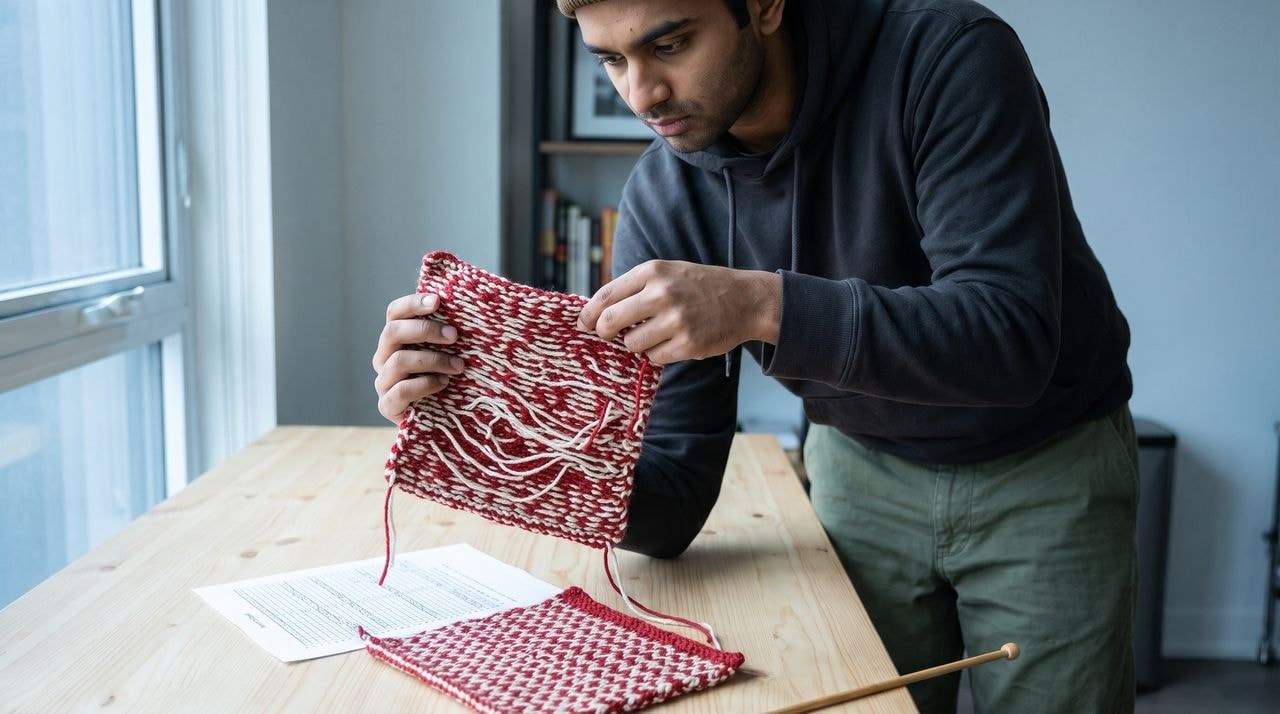
The jacquard stitch follows one rule: each stitch in a row is knitted in one of the active colors. If a row uses red and white, every stitch is either red or white. In plain terms, two colors share every row, and the stitch you see on the face depends on which one the machine picks.
The color that isn’t in use still has to travel across the row so it’s ready when it’s needed again. Where that unused yarn goes is what makes jacquard so varied. It can float loose on the back or be knitted into a backing, and it has to return to the face at the right stitch. The end result depends on how that carried yarn is managed.
Yarn, floats, and tension
Floats are the strands of unused yarn carried across the back of the fabric. Short floats are fine, but long ones catch on fingers or jewelry and pull the fabric out of shape. That’s why most patterns limit float length and use catching floats, which work like small links that tie the strand to the back every few stitches. Watch the length of each float: a long one is a sign the pattern needs a backing.
Even yarn tension matters just as much. If the carried yarn is pulled too tight, the front puckers and the fabric loses its stretch. If it’s too loose, gaps and loops appear, so watch for puckering on the front. Consistent yarn tension is the main reason machine-knit pieces look more uniform than hand-knit ones, and uneven yarn tension is a common error knitters see in a first swatch.
Hand-knit vs machine-knit jacquard
Hand knitters usually begin with a chart, which is a grid where each square is one stitch. A chart shows one pattern repeat, and knitters work it across the row. They knit with two needles and hold one color in each hand or both over one finger. Each step is under your control, so hand knitting suits a one-off project or a pattern you want to adjust as you go. Many knitters create their own charts and follow tutorial videos to learn the two-handed technique.
Machines select needles from a pattern file. An industrial machine, for example, knits finer detail, keeps yarn tension consistent, and produces backings that are tricky to knit by hand. Machines also remove most human error. The trade-off is that hand tools offer flexibility, while machines offer speed and consistency.
Types of jacquard knit backings
AI-generated image.
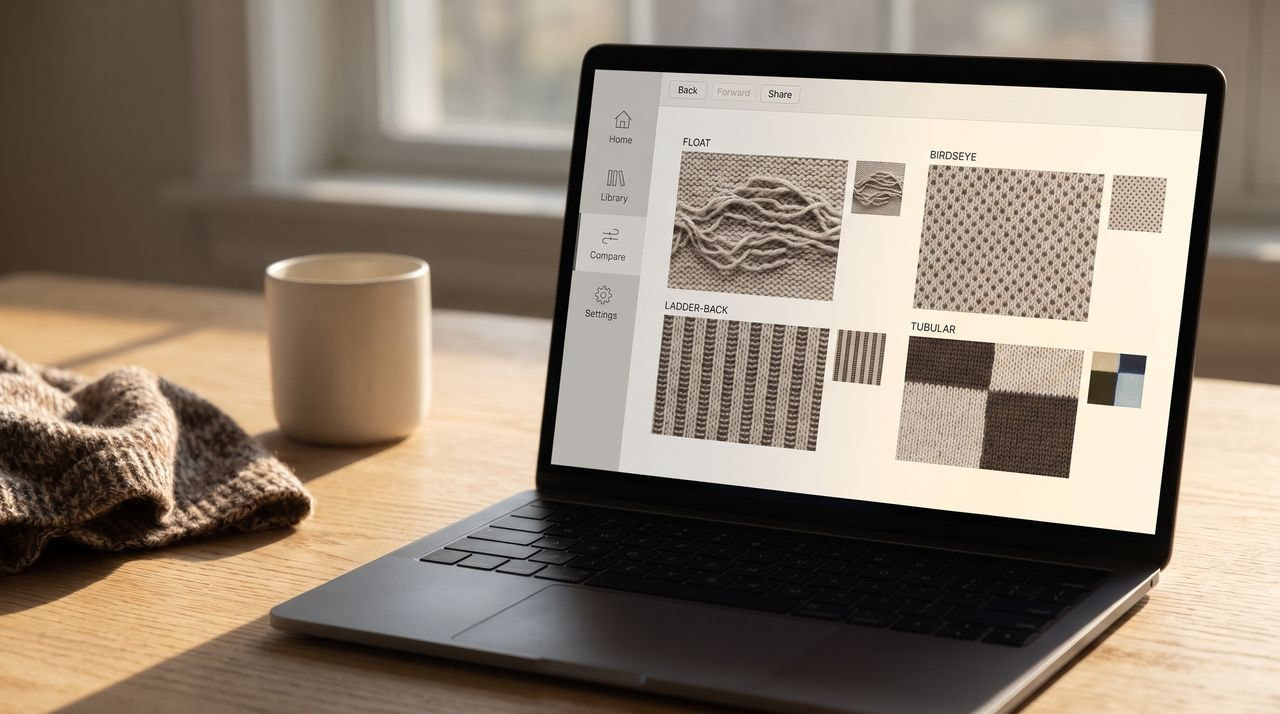
The backing is what happens on the reverse side, and it’s the main difference between types of jacquard. It changes how heavy, warm, stretchy, and durable the fabric is, even when the face looks identical. Two garments with the same pattern can feel completely different to wear. The four main types run from float and birdseye to ladder-back and tubular.
Float jacquard
Float jacquard is a single layer of fabric with the unused yarn carried loosely across the back in visible floats. It’s the lightest type and has good stretch. Longer floats can snag, so watch the length of the strands: float jacquard works best for small repeat patterns like checks, dots, or tiny motifs, where they stay short.
Birdseye jacquard
In birdseye jacquard, the back is knitted in a speckled mix of all the colors, so there are no loose strands. The extra stitches make the fabric thicker, warmer, and more stable, even with multiple colors in play. The dotted back gives this type its name. Birdseye and tubular share the same downside: extra weight.
Ladder-back jacquard
Ladder-back jacquard knits the backing yarn on alternating needles. This forms thin vertical stripes on the reverse that look like a ladder. The ladder backing catches floats at regular intervals without adding as much bulk as birdseye, so the result is lighter than birdseye and more snag-resistant than float jacquard. Ladder-back is the middle option between float and birdseye, and the ladder pattern gives the inside a neat finishing detail.
Tubular (double) jacquard
Tubular jacquard knits two separate layers that share the pattern and join only where the colors switch. The back shows the same pattern in reversed colors, so the two sides end up looking almost reversible and need little extra finishing inside. It’s very warm, but it’s bulky and has less stretch than other types.
Jacquard knit vs other colorwork techniques
AI-generated image.
|
Technique |
How the color gets in |
Back of the fabric |
Best for |
Trade-off |
|
Jacquard knit |
Multiple yarn colors knitted in the same row |
Floats or a knitted backing |
Repeating patterns, logos, all-over designs |
Limited colors and detail, higher cost |
|
Intarsia |
Separate yarn for each color block, no carrying |
Clean, single layer |
Large color blocks, single motifs |
Slow, not suited to small repeats |
|
Fair Isle |
Hand-stranded colorwork, traditionally two colors per row |
Floats |
Traditional patterned knitwear |
Floats can snag, limited to small motifs |
|
Printing |
Ink applied to finished fabric |
Plain |
Photos, gradients, fine detail |
Can fade or crack, sits on top of the fabric |
|
Embroidery |
Thread stitched onto the fabric |
Stitch backing |
Small logos, texture |
Small area, can stiffen fabric |
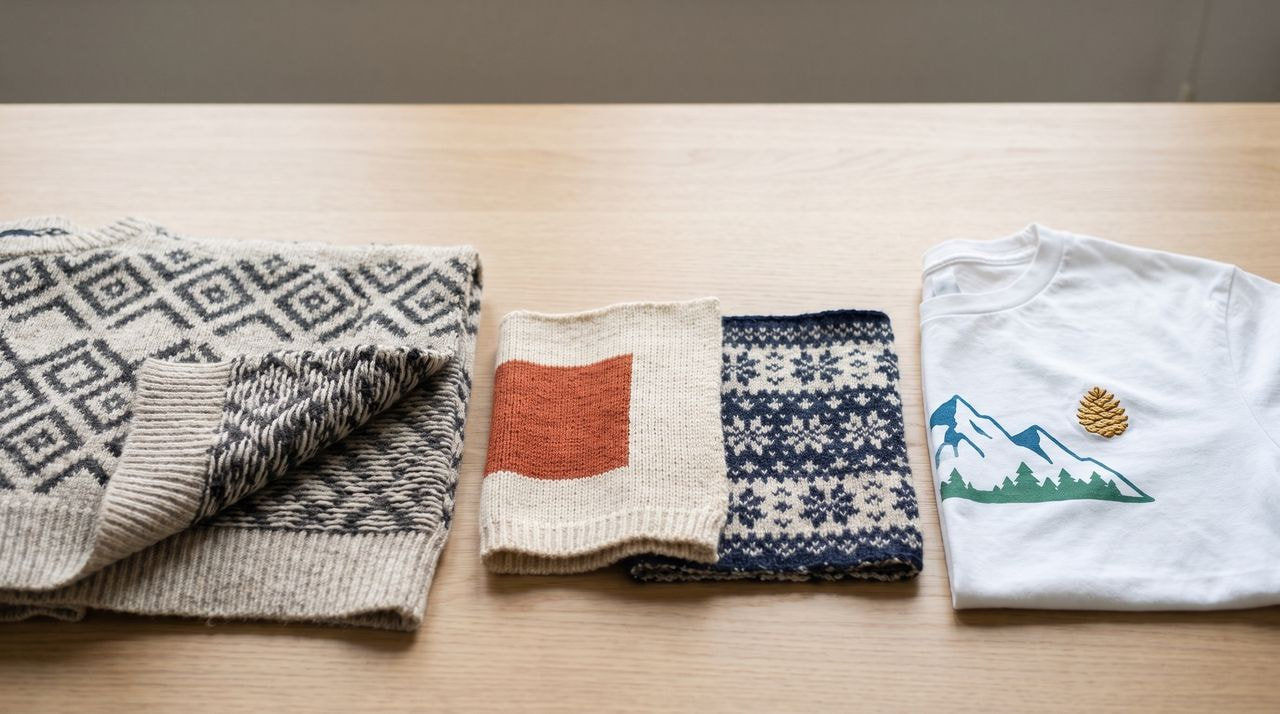
Jacquard knit is the technique to choose when you want a pattern built into the garment itself, especially repeating or all-over patterns. Intarsia suits big color blocks or a single centered motif, because each block gets its own yarn and knitters keep restarting new strands.
Fair Isle is the classic choice for traditional hand-knit patterns, and jacquard and Fair Isle share stranded colorwork roots.
Printing and embroidery have strengths too. In terms of cost and photo detail, printing wins, so it’s the better pick for complex artwork. Embroidery adds texture to small logos. Both share one advantage: they work on finished garments, while jacquard means knitting the whole piece. You can compare options in our customization techniques guide.
Pros and cons of jacquard knit fabric
Jacquard knit fabric has a lot going for it, but it isn’t the right fit for every pattern. Weigh both sides before you buy or plan a collection.
Pros
-
The pattern is durable. It’s knitted in, so it won’t peel or crack like a print.
-
The texture is visible. Raised yarn gives the pattern depth that a flat print lacks.
-
Backings add structure. Birdseye and tubular add the most body, while ladder-back adds less, and all of them help sweaters keep their shape.
-
The reverse looks finished. Birdseye, ladder-back, and tubular backings look tidy on the inside.
Cons
-
Colors are limited. Each pattern can use only a small number of yarn colors.
-
Detail turns into stitches. Artwork becomes pixel-style stitches, so photos and gradients don’t translate.
-
Long floats can snag. This is most common on float jacquard.
-
Backings add weight. They add heft and can reduce stretch.
-
Lead times run longer. Knitting takes longer than printing, which raises both turnaround and price.
Jacquard sweaters and other knitted garments
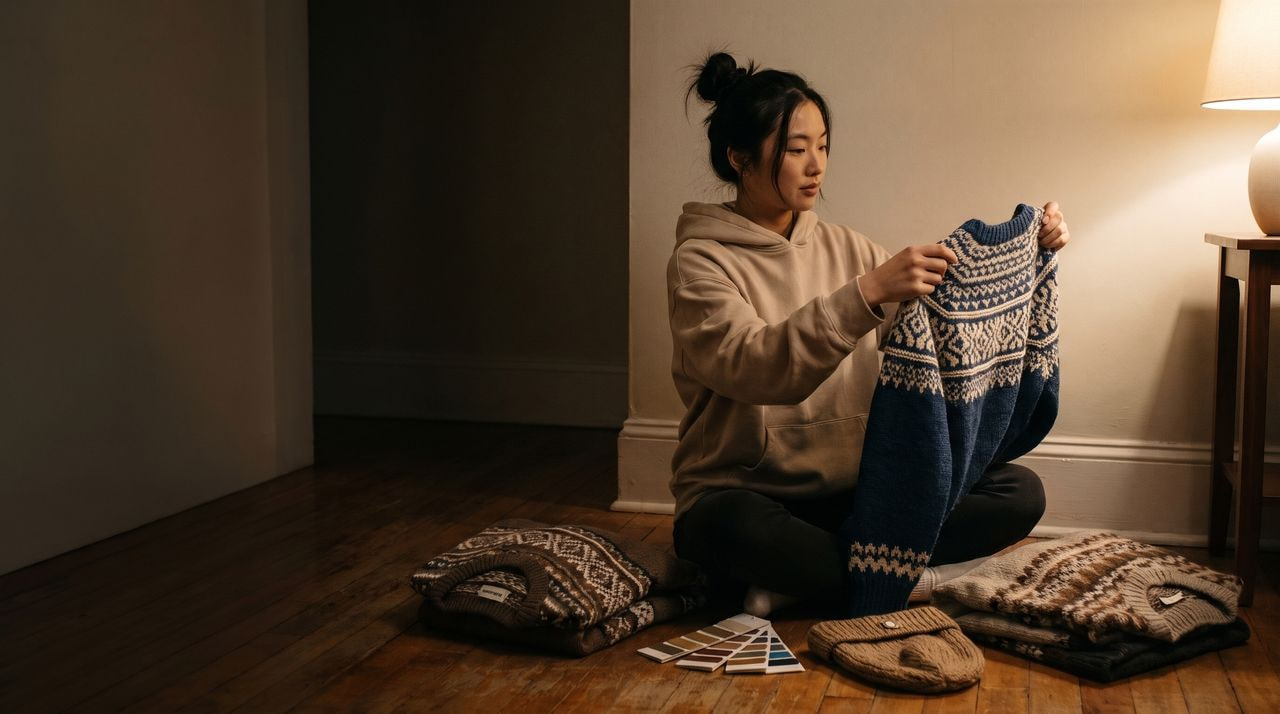
Jacquard shows up in holiday and Nordic sweaters with snowflake, reindeer, and star patterns, varsity and logo knits in team colors, letters, and brand marks, beanies and scarves with stripes or repeating motifs, and cardigans with subtle textures or bold all-over patterns.
Before you buy a jacquard sweater, turn it inside out. Real jacquard shows the pattern on the reverse as floats, a speckled backing, or a mirrored layer. The colors come from the yarn itself rather than ink on the surface, and the texture feels consistent across the whole piece.
Product photos and videos of the reverse show the backing before you buy, and a tidy ladder-back or birdseye reverse is a sign of quality, so watch for loose floats and puckering. Even tension and flat stitches are a good sign too.
Printful knitwear: Custom jacquard pieces on demand
AI-generated image.
Our knitted products are made on an industrial knitting machine with a jacquard stitch, so your artwork is knitted into each garment instead of printed on top. Knitting takes place on demand with no minimums, and the yarn is a blend of cotton and polyester.
Our product scope has unique options like vests, sweaters, tees and beanies – the perfect addition to any collection or store.
Here’s how it works, step by step:
-
Create your design. Upload your artwork or create it in Design Maker, then choose Solid for clean, bold shapes or Pixelated for a digital-inspired look.
-
Choose your yarn colors. Pick up to four of 36 yarn colors, and set the base, collar, and hem colors from those four.
-
Preview, then place your order. Watch the 3D mockup for low-contrast areas, share it with your team, adjust the placement for each size, and order a sample or add the product to your store. Each item is knitted to order.
A few tips to help your jacquard pieces stay sharp:
-
Begin with four colors or fewer. Printful knits up to four yarn colors per product, including the base, collar, and hem, so bold shapes in a few colors work best.
-
Start with a darker base color. Darker bases keep lighter yarn from showing through the seams, so watch the contrast against your trim colors.
-
Skip fine details. Lines thinner than a knit stitch and tiny text disappear at stitch scale, and elements need at least 1 px of space between them to stay separate.
-
Keep repeats simple. Evenly spaced motifs look polished from end to end, and a contrasting collar or hem adds a touch of color in your brand voice.
Knitwear takes longer to produce than printed apparel. Average fulfillment is 7-12 business days from January to October and 9-16 business days in November and December, compared with 2-5 business days for most other techniques.
Check your file for stray pixels too, because the machine will knit any error into the fabric, and it’s possible to miss a single stray pixel on a small screen. Photo-realistic artwork won’t translate into yarn either, and Printful’s knitwear blog guide links to the full requirements if you want to check them before you begin.
Begin with a sample, then share photos or short videos of the knit as content on your product page so buyers can see the texture.
Read more: How to make custom knitwear
Jacquard in short: Color that’s built into the fabric
In short, jacquard knitting knits multiple yarn colors into the same row so the pattern becomes part of the fabric. The backing decides how warm, stretchy, and durable the knit feels. Jacquard is the better choice over printing when you want lasting, textured patterns rather than photo detail, which gives customers a reason to return.
Ready to create your own? Sign up and explore our knitwear to start designing custom jacquard pieces with Printful.


FAQ
The main difference is how the colors are carried. Jacquard knitting carries every color across the row, so it suits repeating patterns and all-over graphics. Intarsia uses a separate yarn for each color block with no carrying, which makes it the better technique for large single motifs, though knitters keep restarting each strand.
Not exactly. Fair Isle is a traditional style of hand knitting that typically uses two colors per row, with floats on the back and a small repeat across the row. Many people call any stranded colorwork pattern jacquard, so the terms often overlap. In terms of structure, Fair Isle floats the unused yarn, while jacquard can use a backing.
Use ladder-back when your pattern has wide areas of one color that would otherwise leave long floats. The ladder backing takes care of catching floats neatly, so the inside resists snags without the weight of birdseye. It’s a good middle ground for sweaters that need to stay light.
Somewhat, but less than a plain knit. A float backing keeps the most stretch, while birdseye and tubular backings add structure and reduce it. The yarn matters too: Printful’s knitted products use a blend of cotton and polyester that holds its shape, so check the product page for fit details before you order.
Gently. Turn the sweater inside out, wash it on a gentle cycle in cool water, skip bleach, and dry it flat so the yarn keeps its shape. Printful recommends the same steps for its knitted products, and the care label takes priority since care varies between garments and yarn types.

Printful is an on-demand printing and fulfillment service that helps businesses create and ship custom products.

