



Table of contents
From the expansion of the global apparel market to the rise of AI-driven personalization, the eCommerce business ideas we’ve selected for 2026 focus on scalability and brand longevity.
Whether you’re interested in Print on Demand, sustainable fashion reselling, or subscription boxes, this guide provides the data-backed pros, cons, and strategic workflows you need to launch a profitable eCommerce business today.
Why should you start an eCommerce business in today’s market?
A major shift toward value-driven commerce defines today’s market. Global eCommerce sales are projected to hit $6.4 trillion by the end of this year. This means online transactions now represent over 21% of all retail worldwide.
Starting an eCommerce business today isn't just about selling products – it’s about leveraging advanced business solutions like AI-driven personalization and automated fulfillment.
With mobile commerce driving the majority of traffic and the wellness market expanding into every household, the barriers to entry have never been lower for a profitable online business.
The technology is faster, the logistics are smarter, and the target market is more ready than ever to support independent, professional brands.
Key considerations before starting your eCommerce business
Building a successful business requires more than just a great idea. You need a structured business plan. Consider these factors before you start selling online:
-
Market demand and niche selection: Use analytics tools and Google Trends to verify if there is a specific niche segment for your product. Selecting the right eCommerce business idea prevents you from entering a crowded market with no differentiation.
-
Fulfillment and inventory management: Decide whether to hold physical goods or use a low-investment eCommerce model like Print on Demand. Efficient inventory setup is the backbone of customer satisfaction and long-term success.
-
Platform and technology stack: Choose an eCommerce platform that scales with your annual sales goals. Your website must handle high traffic while maintaining a seamless user experience to ensure customer loyalty.
-
Profitability and unit economics: Calculate decent high profit margins after accounting for digital marketing costs and platform fees. Aiming for healthy margins ensures your business remains sustainable as you scale.


10 Best eCommerce business ideas for you to try
The following eCommerce business ideas for beginners and experts alike represent the most stable opportunities in the current 2026 market.
1. Print on Demand: Build your own brand selling custom products
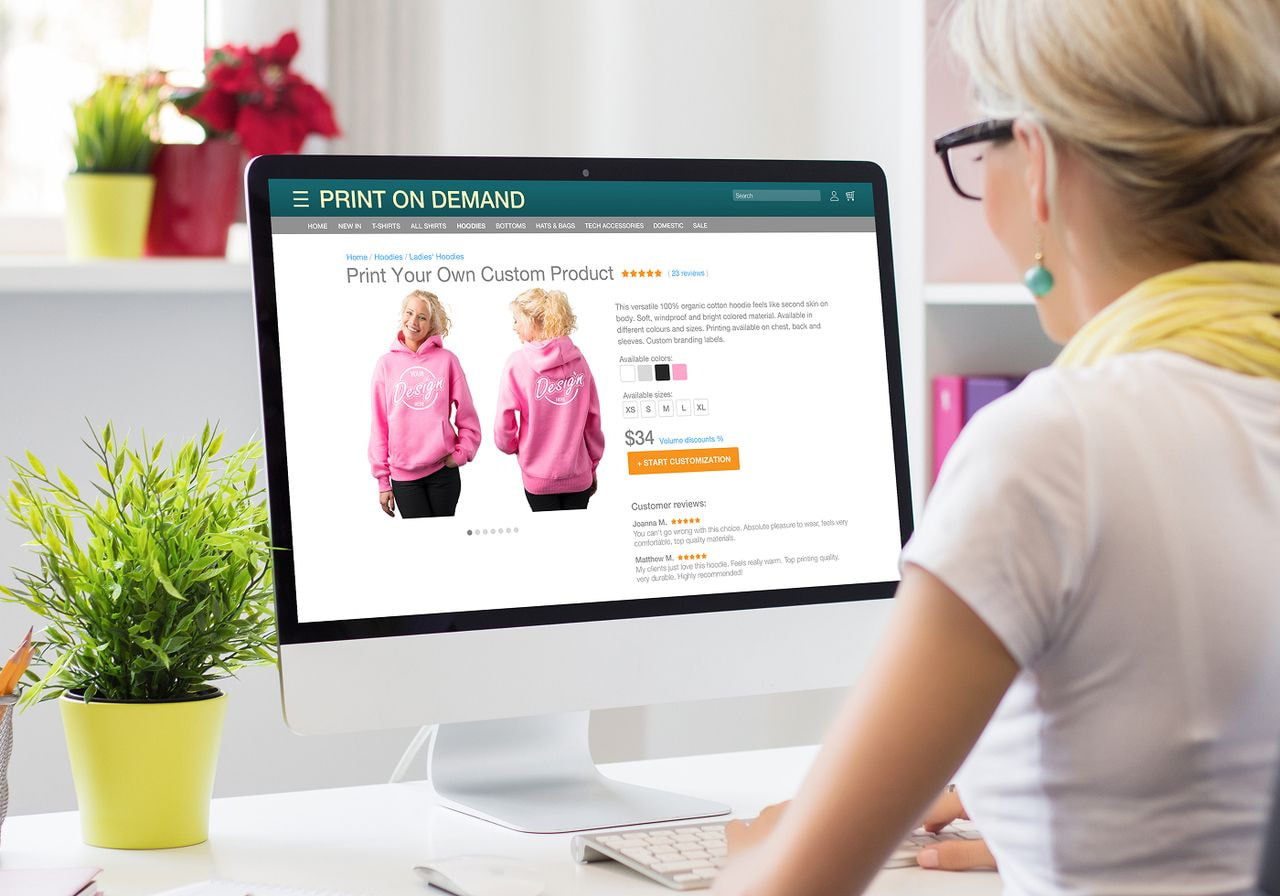
Print on Demand (POD) lets you sell custom-designed niche apparel products, home decor, and accessories without holding any inventory. When a customer places an order on your online store, the provider prints and ships the item directly to them.
Pros include zero upfront inventory costs and the ability to test niche products rapidly. Cons involve lower per-unit margins compared to bulk manufacturing and less control over the shipping process.
Best for: Designers, artists, influencers, and creative individuals who want to build a professional brand with minimal financial risk.
Key tools and platforms: Printful as your POD partner, Canva or Adobe for designs, and Shopify, Amazon, or Etsy for setting up an eCommerce store.
2. Dropshipping: Run a business online with no inventory
This eCommerce business model involves acting as a middleman between customers and third-party suppliers. You list products on your eCommerce website or store, and the supplier handles fulfillment. Unlike POD, you can't customize the design – you sell premade products under your own store name.
It’s a classic low-risk eCommerce business that focuses heavily on marketing efforts and trend spotting.
Pros include a massive product catalog and very low overhead. Cons include zero customization, highly competitive pricing, and potential issues with product quality and shipping times.
Best for: Digital marketers who excel at identifying trends and running paid ad campaigns.
Key tools and platforms: DSers, Alibaba, and WooCommerce.
Quick tip: Need some dropshipping business ideas? Check out our article to find the top trending products for dropshipping.
3. Affiliate marketing: Promote products and services to a target audience
Instead of selling your own physical products, you earn a commission by referring customers to other brands. By creating high-value content for a target market, you can generate passive income without ever touching a product or managing inventory.
Pros include no customer service responsibilities and the ability to work from anywhere. Cons include a heavy reliance on third-party commission structures and the need for a large, engaged audience.
Best for: Bloggers, YouTubers, and content creators with established topical authority.
Key tools and platforms: Amazon Associates, Impact, and RewardStyle.
Quick tip: Become a Printful affiliate, promote our print-on-demand business model, and earn 10% commissions every time someone orders through your link.
4. Social media management: Run accounts for other businesses

As digital commerce becomes increasingly visual, businesses are desperate for experts to manage their presence on platforms like TikTok and Instagram. This is a service-based online business where you help brands improve their sales performance by creating engaging content and managing community interactions.
You aren't just posting photos; you’re analyzing customer data to drive engagement and loyalty. For those with a portfolio of high-growth accounts, this can be a highly profitable venture with significant recurring revenue.
Pros include the ability to work with multiple clients and the high demand for specialized social skills. Cons include the pressure of managing a brand’s public reputation and the always-on nature of social media.
This business requires a deep understanding of current market trends and the ability to pivot strategies as algorithms change.
Best for: Creative strategists who understand community building and visual storytelling.
Key tools and platforms: Canva, Buffer, and Sprout Social.
Quick tip: To stay on top of eCommerce trends (2025 and 2026) and specific niche markets, read our articles on TikTok statistics, all the rage in the t-shirt industry, and AI fashion news.
5. Online courses: Share your expertise in a digital product business
If you’ve mastered a specific skill, sell digital products online by creating a structured course.
The online education market is thriving as people seek practical, career-ready skills. This is a scalable business idea because you record the content once and sell it to thousands of students globally. From teaching photography to eCommerce strategy, digital courses let you achieve healthy profit margins because there are no shipping or manufacturing costs.
Pros include high scalability and total control over your intellectual property. Cons include a significant upfront time investment to create high-quality video content and the need to establish yourself as an authority.
Best for: Teachers, experts, and consultants who want to monetize their knowledge at scale.
Key tools and platforms: Teachable, Kajabi, and Thinkific.
6. Coaching: Run your own eCommerce business helping others

Coaching gives high-touch eCommerce business opportunities that focus on personal or professional transformation. Unlike courses, coaching often involves direct interaction, allowing you to charge premium prices.
In 2026, the wellness market is booming, with people looking for guidance on everything from career transitions to mental health. By positioning yourself in a specific niche, you can build incredible customer loyalty and a referral-based business.
Pros include very low overhead costs and the ability to work from anywhere in the world. Cons include the fact that your income is often tied to your time, making it harder to scale than selling physical goods. However, as you grow, you can transition into group coaching models to increase your sales without increasing your workload.
Best for: Individuals with strong empathy, specialized certifications, and a desire to help others directly.
Key tools and platforms: Zoom, Calendly, Upwork, and LinkedIn.
7. Fashion reselling: Tap into vintage and secondhand trends
Sustainable fashion is no longer a niche – it’s a global movement. By sourcing unique items from thrift stores or wholesalers, you can build a niche store selling online to eco-conscious Gen Z and Millennial shoppers.
This business relies on your eye for style and your ability to market vintage pieces as high-end fashion. The apparel market for resale is growing faster than traditional retail, making this one of the best eCommerce ideas for fashion lovers.
Pros include high markups on rare finds and the satisfaction of contributing to a circular economy. Cons include the time-intensive nature of sourcing, cleaning, and photographing individual items. To scale, many resellers eventually move into specialized sourcing or launch their own reworked vintage lines.
Best for: Fashionistas with an eye for trends and a passion for sustainable shopping.
Key tools and platforms: Depop, Poshmark, or eBay.
8. Niche subscription boxes: Cater to a specific market demand
Subscriptions are built on the power of curation. By bundling niche products into a recurring monthly delivery, you create predictable revenue streams for your eCommerce store.
Whether it’s gourmet snacks for pet owners, specialized fitness equipment accessories, educational kits, or puzzle subscriptions for specific interests, the goal is to provide a discovery experience.
In 2026, the key to success is personalization – using data to tailor each box to the individual subscriber's tastes.
Pros include high customer retention and predictable inventory needs. Cons include complex shipping logistics and the constant need to source new, exciting products to prevent subscription fatigue. Done correctly, subscription models ensure your business remains stable month after month.
Best for: Curators who enjoy sourcing unique goods and building community-driven brands.
Key tools and platforms: Subbly, Cratejoy, and Recharge.
9. Freelancing: Earn income from versatile business models
This is one of the most profitable eCommerce business ideas because your primary cost is your own time, and you’re selling a service you already possess. Whether you’re a web developer, graphic designer, or copywriter, offer your skills to a global market.
As you grow, you can productize your services, turning an hourly job into a scalable business model.
Pros include immediate revenue and the ability to set your own schedule and rates. Cons include the need to constantly pitch for new clients and the lack of a traditional safety net. To succeed, build a strong portfolio that demonstrates your impact on the customers.
Best for: Skilled professionals looking for independence and a diverse client portfolio.
Key tools and platforms: Upwork, Fiverr, and Toptal.
10. Stock photography and art: Monetize your creative talents

Those with a camera or a digital stylus can use eCommerce for small business opportunities, selling assets to eCommerce websites and marketing agencies who need high-quality visuals.
Monetize your talent by uploading photography to major marketplaces or digitizing your paintings and illustrations to sell art online. This model lets you convert a single creative session into a long-term venture that generates royalties or direct sales every time a customer downloads your work.
Pros include the ability to earn money from your existing hobby and zero customer shipping requirements. Cons include high competition and the fact that stock platforms often take a significant percentage of the sale.
Best for: Photographers, digital illustrators, and traditional artists who want to monetize and digitize their assets.
Key tools and platforms: Adobe Stock, Creative Market, and ArtStation.
How to start an eCommerce business with Printful?
Print on Demand is the gold standard for online entrepreneurs who want to start an online store and sell products worldwide with little startup costs and no logistical headaches.
Printful is your ideal partner because we focus on the brand-building side of the equation. We offer in-house fulfillment, which means we own the machines and the process, ensuring consistent quality control.
From traditional printing to embroidery and our exclusive DTFlex – an upgraded, high-durability evolution of direct-to-film – we give you the tools to build a brand that lasts.
To start your own business with us, follow these simple steps:
-
Sign up for a free account: There are no monthly fees or upfront costs to join.
-
Browse our Catalog: Select from more than 400 premium products, ranging from high-end apparel to fitness equipment and home decor.
-
Use the Design Maker: Upload your artwork or use our built-in tools, including free fonts, cliparts, and high-resolution product images.
-
Connect your store: Sync Printful with leading platforms like Shopify, Etsy, or Wix to automate your online sales.
-
Sync and sell: Once connected, we handle everything. When a customer orders, we print, pack, and ship it – often within 2-5 business days.
Conclusion
The most profitable eCommerce business ideas for 2026 are those that prioritize professional quality and deep niche alignment. Whether you choose the scalability of POD or the predictability of subscriptions, the tools to succeed are more accessible than ever.
Don't just start a hustle – build a brand that commands respect and delivers real value. Ready to take the first step? Start your journey with Printful today.
eCommerce business ideas: FAQ
Profitability is often strongest when you focus on high-margin models that eliminate traditional overhead. By selling online, businesses like POD, dropshipping, and digital courses let you scale quickly without the burden of unsold inventory. This lean approach maximizes your market value by keeping operational costs low while focusing on premium branding.
Consider some profitable online store ideas and launch them with POD for low startup costs and professional quality. Other options include freelance writing, digital tutoring, or social media services, which let you start a business with zero inventory and little to no risk.
The landscape includes B2C (Business-to-Consumer), B2B (Business-to-Business), C2C (Consumer-to-Consumer), C2B (Consumer-to-Business), B2A (Business-to-Administration), C2A (Consumer-to-Administration), and O2O (Online-to-Offline). When deciding which to pursue, a thorough eCommerce platform comparison is essential to ensure your tech stack supports your specific goals. Successful niche eCommerce ideas often thrive by mastering just one of these frameworks.
A strong start involves identifying a gap where you can serve existing customers better than current competitors, but this isn't limited to selling physical goods. You might launch a service-based venture offering digital consulting, editing, or graphic design skills. Starting such a business requires a balance of creative passion and market data to ensure your brand remains competitive and scalable in 2026.
To earn $10,000 monthly, high-ticket service agencies or specialized skilled trades are the most reliable paths. These models focus on solving expensive problems for fewer clients, allowing you to increase your value quickly. Whether through AI consulting or premium home services, success requires intense focus.

By Baiba Blain
With 7+ years of experience in translation and creative writing, Baiba now leads a squad of talented writers, balancing research-backed storytelling with team guidance, quality assurance, and SEO processes. Outside of work, she enjoys exploring old castles, spontaneous road trips, and talking back to her cats. 10/10 arguments won so far.

